
Close Menu
    Facebook X (Twitter) Instagram
    SciTechDaily
    • Biology
    • Chemistry
    • Earth
    • Health
    • Physics
    • Science
    • Space
    • Technology
    Facebook X (Twitter) Pinterest YouTube RSS
    SciTechDaily
    Home»Space»CfA Astronomers Find a Black Hole in a Low Mass X-Ray Binary
    Space

    CfA Astronomers Find a Black Hole in a Low Mass X-Ray Binary

    By Harvard-Smithsonian Center for AstrophysicsApril 21, 2017No Comments3 Mins Read
    Facebook Twitter Pinterest Telegram LinkedIn WhatsApp Email Reddit
    Share
    Facebook Twitter LinkedIn Pinterest Telegram Email Reddit
    Astronomers Find a Black Hole in a Low Mass X-Ray Binary
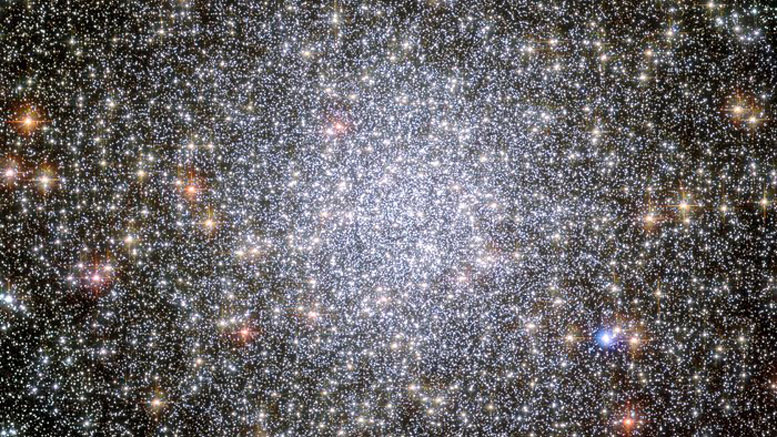
    An optical image of the globular cluster 47 Tuc taken by Hubble. There are numerous known low-mass X-ray binary stars (LMXBs) in this and other globular clusters.

    A team of astronomers from the Harvard-Smithsonian Center for Astrophysics detail the discovery of what might be the first LMXB whose compact object is a black hole rather than a neutron star.

    A globular cluster is a roughly spherical ensemble of stars (as many as several million) that are gravitationally bound together, and typically located in the outer regions of galaxies. Low mass X-ray binary stars (LMXBs) are systems in which one star is compact (a neutron star or black hole) and is accreting matter from a companion star. Scientists have long noticed that there are fractionally many more X-ray binary stars in globular clusters than elsewhere in the galaxy, an overabundance that is usually attributed to the high stellar density in globular clusters. But this calls attention to another unusual feature of the X-ray binary stars in globulars. In the galactic field, most X-ray binary stars are formed from binary stars as they age and evolve, but in globular clusters it has been shown that most X-ray binary stars form when compact objects encounter and then capture another star. There are many neutron stars in clusters, but black holes that form in these dense stellar environments are expected either to sink down to the center of the cluster or else to be gravitationally ejected from the cluster after they are formed. Indeed, all of the X-ray binary stars seen in globular clusters are of the type with a neutron star.

    Harvard astronomer Javier Garcia was a member of a team studying X-ray binary stars in the 47 Tuc globular cluster. They discovered one, called X9, that appears to contain a black hole, and if the interpretation is correct X9 would be the first such case in our Galaxy. The team used simultaneous observations of the source with Chandra, NuSTAR, and the Australia Compact Array, plus archival datasets, to find a twenty-eight-minute modulation of the signal from X9, such as would be produced by a black hole of about one solar mass orbited by a white dwarf star of about 0.02 solar-masses. The source has some other unusual characteristics, including a precession period of 6.8 days, and a relatively high rate of mass transfer for X-ray binary stars, about seven-millionths of an Earth-mass per year.

    Reference: “The Ultracompact Nature of the Black Hole Candidate X-Ray Binary 47 Tuc X9” by Arash Bahramian, Craig O. Heinke, Vlad Tudor, James C. A. Miller-Jones, Slavko Bogdanov, Thomas J. Maccarone, Christian Knigge, Gregory R. Sivakoff, Laura Chomiuk, Jay Strader, Javier A. Garcia and Timothy Kallman, 24 February 2017, MNRAS.
    DOI: 10.1093/mnras/stx166
    arXiv

    Never miss a breakthrough: Join the SciTechDaily newsletter.
    Follow us on Google and Google News.

    Astronomy Astrophysics Binary Star Black Hole Harvard-Smithsonian Center for Astrophysics
    Share. Facebook Twitter Pinterest LinkedIn Email Reddit

    Related Articles

    Researchers Model the Workings of an X-ray Binary Star

    Researchers Study Mysterious Gamma Ray Source with No Known Counterpart

    Researchers Trace the Evolution of Galaxies that Host Massive Black Holes

    Distinguishing Black Holes from Naked Singularities

    Runaway Binary LP 400-22 is Leaving the Galaxy

    A Link Between Black Hole Accretion Rate and Star Formation Rate

    Astronomers Measure a Black Hole’s “Point of No Return”

    Cloud of Hydrogen and Helium Plunging Toward the Galactic Center

    Study Challenges Prevailing Ideas About How Supermassive Black Holes Grow

    Leave A Reply Cancel Reply

    • Facebook
    • Twitter
    • Pinterest
    • YouTube

    Don't Miss a Discovery

    Subscribe for the Latest in Science & Tech!

    Trending News

    The Universe Is Expanding Too Fast and Scientists Can’t Explain Why

    “Like Liquid Metal”: Scientists Create Strange Shape-Shifting Material

    Early Warning Signals of Esophageal Cancer May Be Hiding in Plain Sight

    Common Blood Pressure Drug Shows Surprising Power Against Deadly Antibiotic-Resistant Superbug

    Scientists Uncover Dangerous Connection Between Serotonin and Heart Valve Disease

    Scientists Discover a “Protector” Protein That Could Help Reverse Hair Loss

    Bone-Strengthening Discovery Could Reverse Osteoporosis

    Scientists Uncover Hidden Trigger Behind Stem Cell Aging

    Follow SciTechDaily
    • Facebook
    • Twitter
    • YouTube
    • Pinterest
    • Newsletter
    • RSS
    SciTech News
    • Biology News
    • Chemistry News
    • Earth News
    • Health News
    • Physics News
    • Science News
    • Space News
    • Technology News
    Recent Posts
    • A Common Diabetes Drug May Hold the Key to Stopping HIV From Coming Back
    • Ancient “Syphilis-Like” Disease in Vietnam Challenges Key Scientific Assumptions
    • Drinking Alcohol To Cope in Your 20s Could Damage Your Brain for Life
    • Scientists Crack Alfalfa’s Chromosome Mystery After Decades of Debate
    • Ancient Ant-Plant Alliance Collapses As Predatory Wasps Move In
    Copyright © 1998 - 2026 SciTechDaily. All Rights Reserved.
    • Science News
    • About
    • Contact
    • Editorial Board
    • Privacy Policy
    • Terms of Use

    Type above and press Enter to search. Press Esc to cancel.