
Close Menu
    Facebook X (Twitter) Instagram
    SciTechDaily
    • Biology
    • Chemistry
    • Earth
    • Health
    • Physics
    • Science
    • Space
    • Technology
    Facebook X (Twitter) Pinterest YouTube RSS
    SciTechDaily
    Home»Science»Challenging Current Timelines: New Fossil Finds Suggest Early Humans in South America Over 20,000 Years Ago
    Science

    Challenging Current Timelines: New Fossil Finds Suggest Early Humans in South America Over 20,000 Years Ago

    By PLOSJuly 19, 2024No Comments3 Mins Read
    Facebook Twitter Pinterest Telegram LinkedIn WhatsApp Email Reddit
    Share
    Facebook Twitter LinkedIn Pinterest Telegram Email Reddit
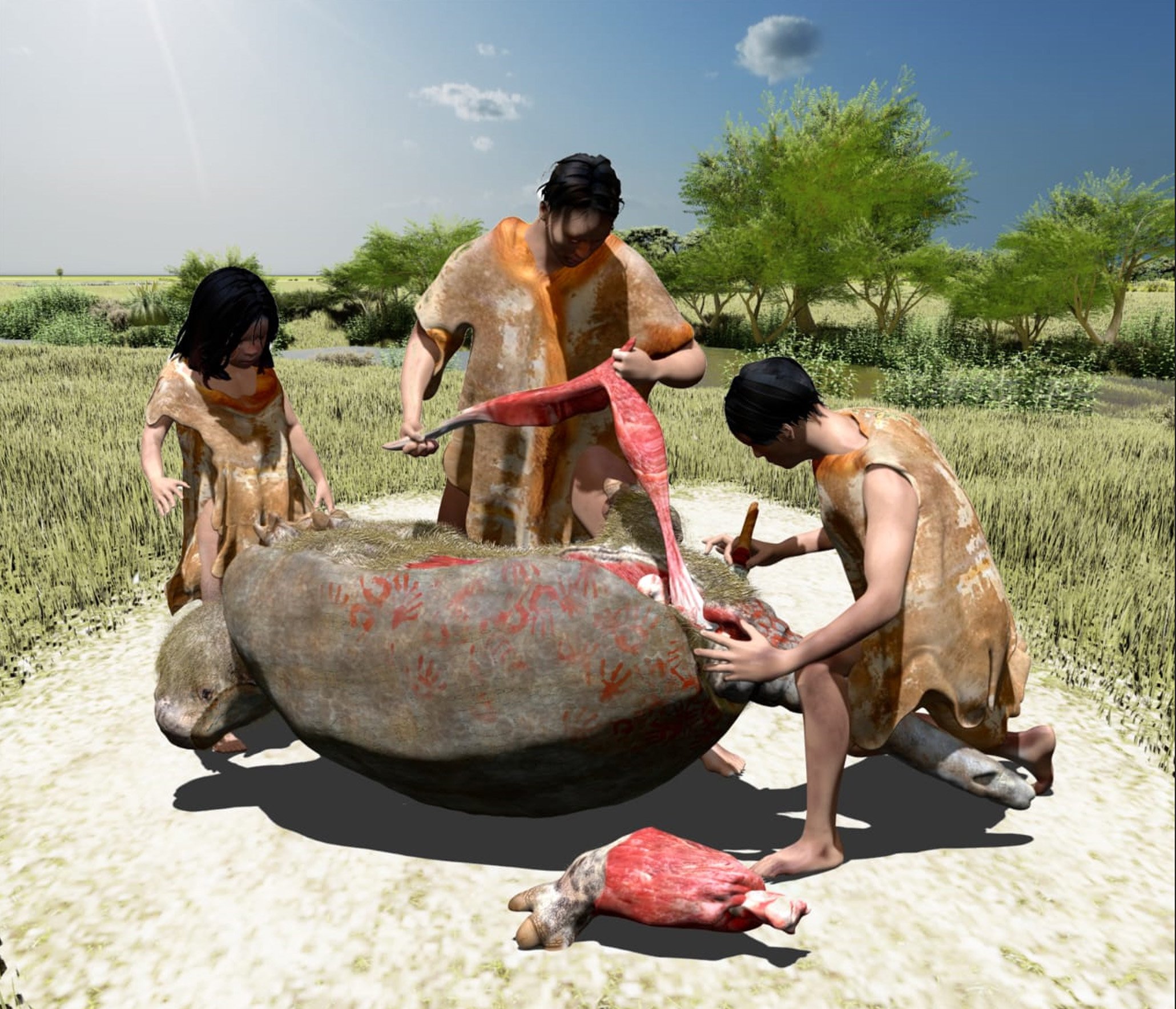
    3D Rendering of the Probable Butchery Event
    3D rendering of the probable butchery event according to a paleoartistic reconstruction. The illustration was made by modeling three-dimensional meshes, 3D digital scanning, and texturing by projection, based on the proportions of the excavated fossil materials and the results obtained in the study. Credit: Damián Voglino, Museo de Ciencias Naturales A. Scasso (Colegio Don Bosco), San Nicolás de los Arroyos, Provincia de Buenos Aires, CC-BY 4.0

    Tool marks might represent some of the earliest known signs of human presence in southern South America.

    Recent findings from Argentina indicate human presence and exploitation of large mammals over 20,000 years ago, challenging previous beliefs about when humans first settled in the Americas.

    According to a study recently published in the open-access journal PLOS ONE, incisions found on fossils suggest that humans may have utilized large mammals in Argentina over 20,000 years ago. The research, conducted by Mariano Del Papa and colleagues from the National University of La Plata, Argentina, explores this possibility.

    The timing of early human occupation of South America is a topic of intense debate, highly relevant to a study of early human dispersal across the Americas and of humans’ potential role in the extinction of large mammals at the end of the Pleistocene Epoch. This discussion is hampered by a general scarcity of direct archaeological evidence of early human presence and human-animal interactions.
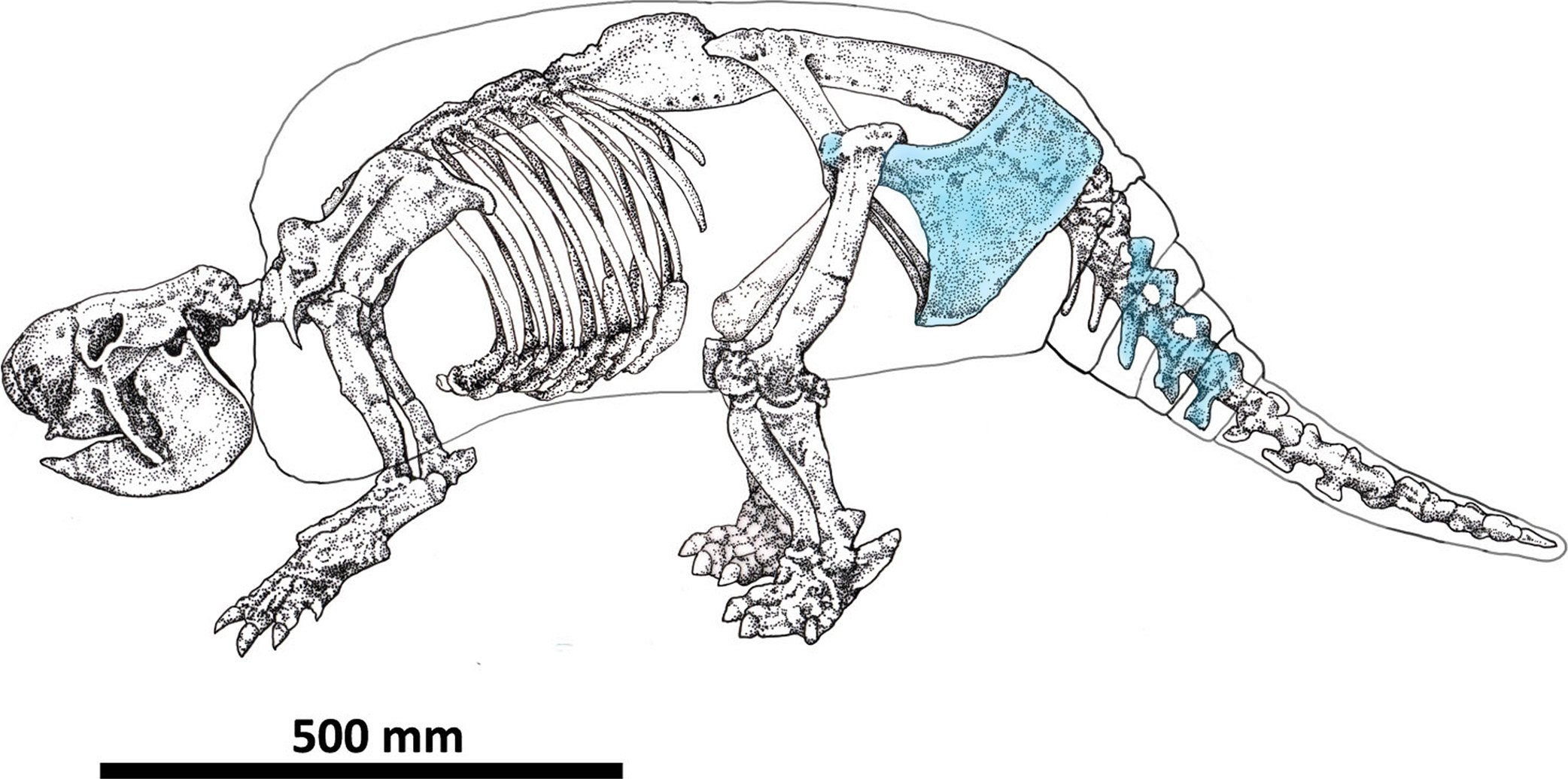
    Drawing of a Neosclerocalyptus Skeleton
    Drawing of a Neosclerocalyptus skeleton highlighting cut-marked skeletal elements in light blue found at the CRS-10 specimen. Credit: Del Papa et al., 2024, PLOS ONE, CC-BY 4.0

    In this study, researchers present evidence of butchery on Pleistocene mammal fossils from the banks of the Reconquista River, northeast of the Pampean region in Argentina. The fossils are those of a glyptodont, a giant relative of armadillos, named Neosclerocalyptus. Statistical analysis finds that cut marks on parts of the pelvis, tail, and body armor are consistent with known marks made by stone tools, and the placement of these marks is consistent with a butchering sequence targeting areas of dense flesh. Radiocarbon dating indicates these fossils are around 21,000 years old, nearly six thousand years older than other known archaeological evidence in southern South America.

    These results fit with other recent findings that indicate early human presence in the Americas over 20,000 years ago. These fossils are also among the oldest evidence of human interaction with large mammals shortly before many of those mammals became extinct. The authors suggest that these findings might be further supported by additional excavation at this site, further analysis of the cut marks, and more extensive radiocarbon dating of the fossils.

    Miguel Delgado, the corresponding author, adds: “The study’s evidence puts into question the time frame for the first human peopling of the Americas 16,000 years ago.”

    Reference: “Anthropic cut marks in extinct megafauna bones from the Pampean region (Argentina) at the last glacial maximum” by Mariano Del Papa, Martin De Los Reyes, Daniel G. Poiré, Nicolás Rascovan, Guillermo Jofré and Miguel Delgado, 17 July 2024, PLOS ONE.
    DOI: 10.1371/journal.pone.0304956

    Work leading to this publication was funded by grants from National Natural Science Foundation of China (#31771393), Wenner-Gren Foundation for Anthropological Research (USA) Grant/Award number 9391, Consejo Nacional de Investigaciones Científicas y Técnicas (CONICET), Facultad de Ciencias Naturales y Museo Universidad Nacional de La Plata (FCNyM, UNLP), INCEPTION program (Investissement d’Avenir grant ANR-16-CONV-0005) and ERC-2020-STG – PaleoMetAmerica – 948800.

    Never miss a breakthrough: Join the SciTechDaily newsletter.
    Follow us on Google and Google News.

    Anthropology Archaeology Fossils PLOS
    Share. Facebook Twitter Pinterest LinkedIn Email Reddit

    Related Articles

    Ancient Footprints Provide Evidence of Human Activity in the Americas Thousands of Years Earlier Than Thought

    Surprising Diversity of Cretaceous Reptiles at Argentina Fossil Site – Revealed by Discovery of Ancient Teeth

    Archaeologists Discover That Ancient Islamic Tombs Cluster Like Galaxies

    Indiscriminate Killing Revealed in Genetic Analysis of Ancient Massacre

    Deformed Skulls Discovered in an Ancient Cemetery Reveal a Remarkably Diverse Community

    Neandertals Dove Underwater to Collect Clam Shells to Use as Tools

    New View of Human Evolution Unearthed by Rare 10 Million-Year-Old Fossil [Video]

    Anthropologists Shed New Light on Prehistoric Human Migration

    400,000 Year Old Fossil Helps Shed New Light on Human Evolution

    Leave A Reply Cancel Reply

    • Facebook
    • Twitter
    • Pinterest
    • YouTube

    Don't Miss a Discovery

    Subscribe for the Latest in Science & Tech!

    Trending News

    Just a Few Breathless Minutes a Day Could Slash Your Risk of 8 Major Diseases

    This Simple Habit Could Cut Your Risk of Dementia by 30%

    Scientists Debunk Rattlesnake Myth That Fooled Hikers and Doctors for Decades

    Scientists Discover Plants Can “Count” – and May Be Smarter Than We Thought

    New Research Reveals Ancient Mars May Have Been Warm, Wet – and Possibly Alive

    This Surprising Daily Habit Could Cut Dementia Risk by 35%

    Just 10 Minutes a Day: Scientists Say This Ancient Chinese Practice Shows Powerful Blood Pressure Benefits

    Scientists Say This Popular Food Could Help Your Body Get Rid of Microplastics

    Follow SciTechDaily
    • Facebook
    • Twitter
    • YouTube
    • Pinterest
    • Newsletter
    • RSS
    SciTech News
    • Biology News
    • Chemistry News
    • Earth News
    • Health News
    • Physics News
    • Science News
    • Space News
    • Technology News
    Recent Posts
    • Scientists Uncover Giant Lava Fields From an Active Underwater Volcano
    • Baffling Geologists for 150 Years: New Study Finally Solves Green River Mystery
    • Are Your Vegetables Safe? Scientists Uncover Hidden Chemical Risks in Crops
    • Scientists Discover “Shape-Shifting” Semiconductors Activated by Light
    • Forget Wi-Fi This Laser Tech Hits 360 Gbps at Half the Power
    Copyright © 1998 - 2026 SciTechDaily. All Rights Reserved.
    • Science News
    • About
    • Contact
    • Editorial Board
    • Privacy Policy
    • Terms of Use

    Type above and press Enter to search. Press Esc to cancel.