
Close Menu
    Facebook X (Twitter) Instagram
    SciTechDaily
    • Biology
    • Chemistry
    • Earth
    • Health
    • Physics
    • Science
    • Space
    • Technology
    Facebook X (Twitter) Pinterest YouTube RSS
    SciTechDaily
    Home»Science»New View of Human Evolution Unearthed by Rare 10 Million-Year-Old Fossil [Video]
    Science

    New View of Human Evolution Unearthed by Rare 10 Million-Year-Old Fossil [Video]

    By SciTechDailySeptember 17, 2019No Comments5 Mins Read
    Facebook Twitter Pinterest Telegram LinkedIn WhatsApp Email Reddit
    Share
    Facebook Twitter LinkedIn Pinterest Telegram Email Reddit
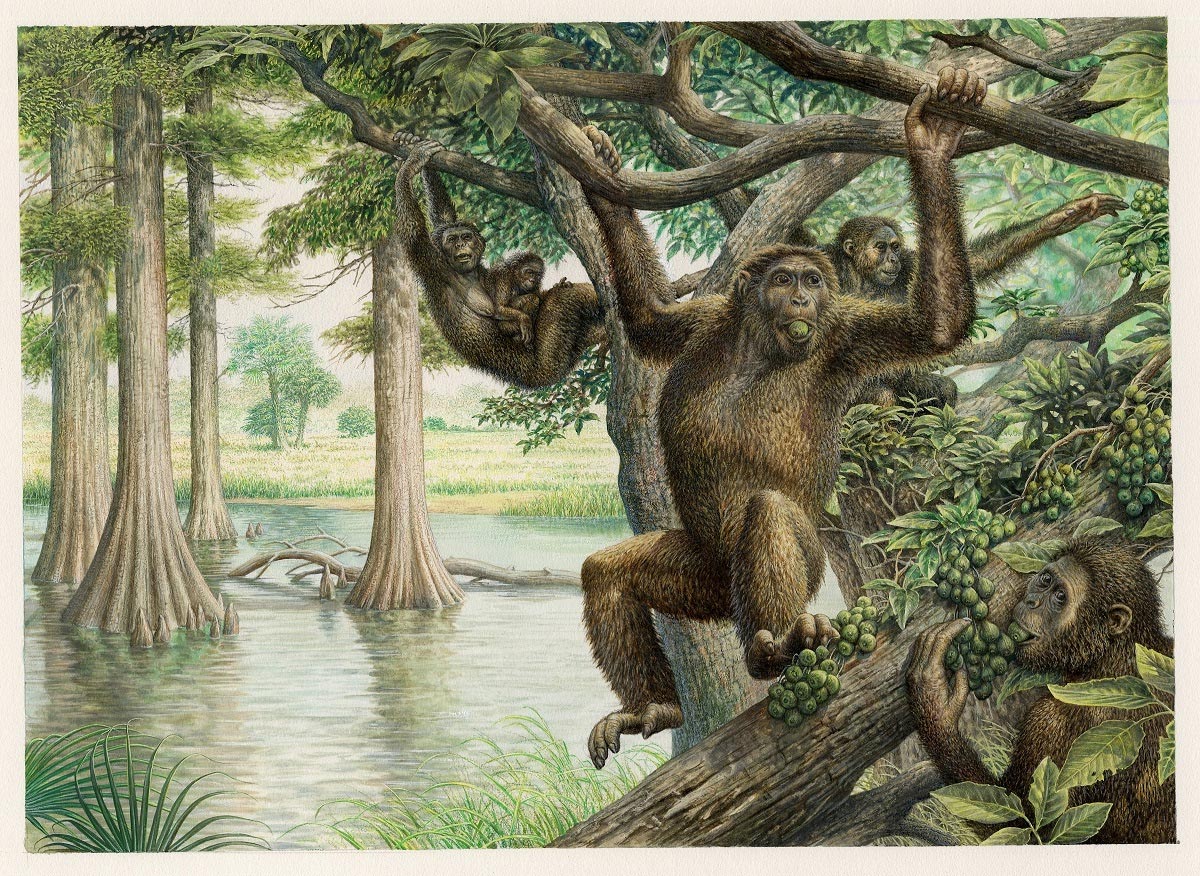
    Illustration of Rudapithecus
    Rudapithecus was pretty ape-like and probably moved among branches like apes do now — holding its body upright and climbing with its arms. However, it would have differed from modern great apes by having a more flexible lower back, which would mean when Rudapithecus came down to the ground, it might have had the ability to stand upright more as humans do. Illustration courtesy of John Siddick

    Near an old mining town in Central Europe, known for its picturesque turquoise-blue quarry water, lay Rudapithecus. For 10 million years, the fossilized ape waited in Rudabánya, Hungary, to add its story to the origins of how humans evolved.

    What Rudabánya yielded was a pelvis — among the most informative bones of a skeleton, but one that is rarely preserved. An international research team led by Carol Ward at the University of Missouri analyzed this new pelvis and discovered that human bipedalism — or the ability for people to move on two legs — might possibly have deeper ancestral origins than previously thought.

    10 Million Year Old Fossil Pelvis
    A fossil pelvis from Rudapithecus. The pelvis is among the most informative bones of a skeleton, but one that is rarely preserved. Credit: Carol Ward

    The Rudapithecus pelvis was discovered by David Begun, a professor of anthropology at the University of Toronto who invited Ward to collaborate with him to study this fossil. Begun’s work on limb bones, jaws and teeth has shown that Rudapithecus was a relative of modern African apes and humans, a surprise given its location in Europe. But information on its posture and locomotion has been limited, so the discovery of a pelvis is important.

    “Rudapithecus was pretty ape-like and probably moved among branches like apes do now — holding its body upright and climbing with its arms,” said Ward, a Curators Distinguished Professor of Pathology and Anatomical Sciences in the MU School of Medicine and lead author on the study. “However, it would have differed from modern great apes by having a more flexible lower back, which would mean when Rudapithecus came down to the ground, it might have had the ability to stand upright more as humans do. This evidence supports the idea that rather than asking why human ancestors stood up from all fours, perhaps we should be asking why our ancestors never dropped down on all fours in the first place.”

    Modern African apes have a long pelvis and short lower back because they are such large animals, which is one reason why they typically walk on all fours when on the ground. Humans have longer, more flexible lower backs, which allow them to stand upright and walk efficiently on two legs, a hallmark characteristic of human evolution. Ward said if humans evolved from an African ape-like body build, substantial changes to lengthen the lower back and shorten the pelvis would have been required. If humans evolved from an ancestor more like Rudapithecus, this transition would have been much more straightforward.
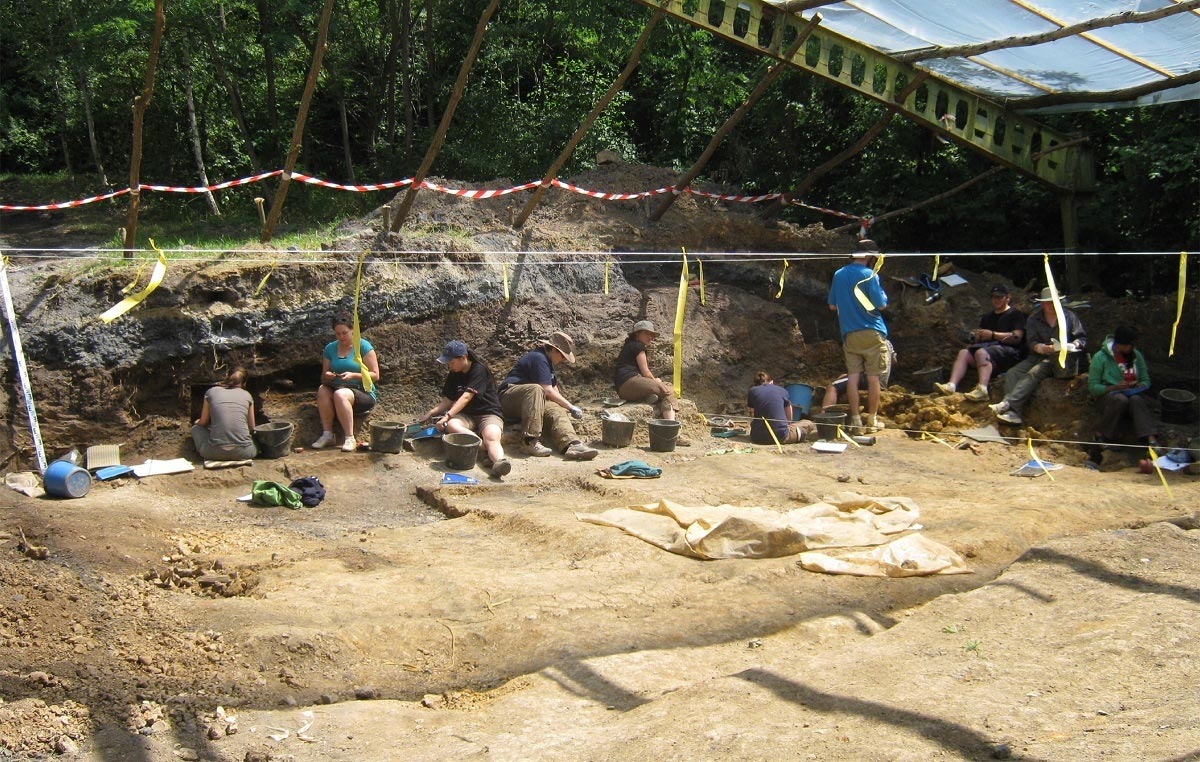
    Excavation at Rudabanya Site
    Excavation at the Rudabànya site. Image courtesy of David R. Begun.

    “We were able to determine that Rudapithecus would have had a more flexible torso than today’s African apes because it was much smaller — only about the size of a medium dog,” Ward said. “This is significant because our finding supports the idea suggested by other evidence that human ancestors might not have been built quite like modern African apes.”
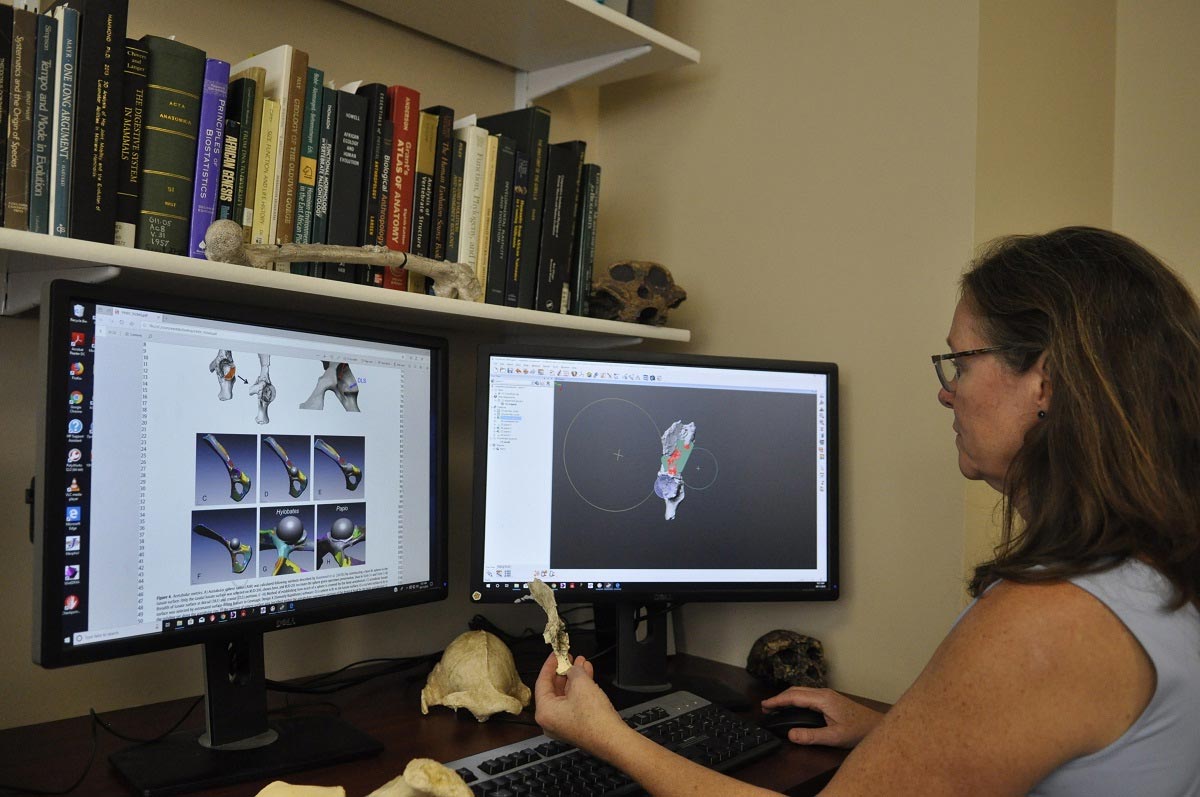
    Carol Ward Curators Distinguished Professor of Pathology and Anatomical Sciences
    Carol Ward, a Curators Distinguished Professor of Pathology and Anatomical Sciences in the MU School of Medicine, and her team used new 3D modeling techniques to digitally complete the fossil’s shape, then compared their models with modern animals. Credit: University of Missouri

    Ward teamed up with Begun to study the pelvis along with MU alumna Ashley Hammond, Assistant Curator of Biological Anthropology at the American Museum of Natural History, and J. Michael Plavcan, a professor of anthropology at the University of Arkansas. Since the fossil was not 100% complete, the team used new 3D modeling techniques to digitally complete its shape, then compared their models with modern animals. Ward said their next step will be to conduct a 3D analysis of other fossilized body parts of Rudapithecus to gather a more complete picture of how it moved, giving more insight into the ancestors of African apes and humans.

    ###

    The study, “A late Miocene hominid partial pelvis from Hungary,” was published in the Journal of Human Evolution. Funding was provided by the National Science Foundation, Natural Sciences and Engineering Research Council, National Geographic Society, Leakey Foundation, Wenner-Gren Foundation for Anthropological Research and University of Missouri Research Council. The content is solely the responsibility of the authors and does not necessarily represent the official views of the funding agencies.

    Reference: “A late Miocene hominid partial pelvis from Hungary” by Carol V. Ward, Ashley S. Hammond, J. Michael Plavcan and David R. Begun, 17 September 2019, Journal of Human Evolution.
    DOI: 10.1016/j.jhevol.2019.102645

    Never miss a breakthrough: Join the SciTechDaily newsletter.
    Follow us on Google and Google News.

    Anthropology Archaeology Evolution Fossils University of Missouri-Columbia
    Share. Facebook Twitter Pinterest LinkedIn Email Reddit

    Related Articles

    Accurate Hominin Data: Getting the Fossil Record Right on Human Evolution

    Early Human Evolution: Hominin Fossils in “Cradle of Humankind” May Be a Million Years Older Than Thought

    Human Ancestor Fossils in the “Cradle of Humankind” May Be More Than a Million Years Older Than Thought

    Anthropologists Shed New Light on Prehistoric Human Migration

    New Findings Provide Further Evidence That Early Anthropoids Were Minuscule Creatures

    Scientists Discover A New Species of Hominin

    Ancient DNA Reveals the First Detailed Genetic History of Modern Europe

    400,000 Year Old Fossil Helps Shed New Light on Human Evolution

    Million-Year-Old Ash in South African Cave Yields Evidence of Cooking

    Leave A Reply Cancel Reply

    • Facebook
    • Twitter
    • Pinterest
    • YouTube

    Don't Miss a Discovery

    Subscribe for the Latest in Science & Tech!

    Trending News

    Popular Sugar-Free Sweetener Linked to Liver Disease, Study Warns

    What Is Hantavirus? The Deadly Disease Raising Alarm Worldwide

    Scientists Just Discovered How the Universe Builds Monster Black Holes

    Scientists Unveil New Treatment Strategy That Could Outsmart Cancer

    A Simple Vitamin May Hold the Key to Treating Rare Genetic Diseases

    Scientists Think the Real Fountain of Youth May Be Hiding in Your Gut

    Ravens Don’t Follow Wolves, They Predict Them

    This Common Knee Surgery May Be Doing More Harm Than Good

    Follow SciTechDaily
    • Facebook
    • Twitter
    • YouTube
    • Pinterest
    • Newsletter
    • RSS
    SciTech News
    • Biology News
    • Chemistry News
    • Earth News
    • Health News
    • Physics News
    • Science News
    • Space News
    • Technology News
    Recent Posts
    • A Strange Quantum Effect May Explain One of Biology’s Greatest Mysteries
    • NASA’s Psyche Spacecraft Is About To Fly Shockingly Close to Mars
    • This Mars Rock Refused To Let Go of NASA’s Curiosity Rover
    • James Webb Telescope Reveals the Universe’s Hidden Cosmic Web in Stunning Detail
    • Scientists Build a Living AI Device Using Real Brain Cells
    Copyright © 1998 - 2026 SciTechDaily. All Rights Reserved.
    • Science News
    • About
    • Contact
    • Editorial Board
    • Privacy Policy
    • Terms of Use

    Type above and press Enter to search. Press Esc to cancel.