
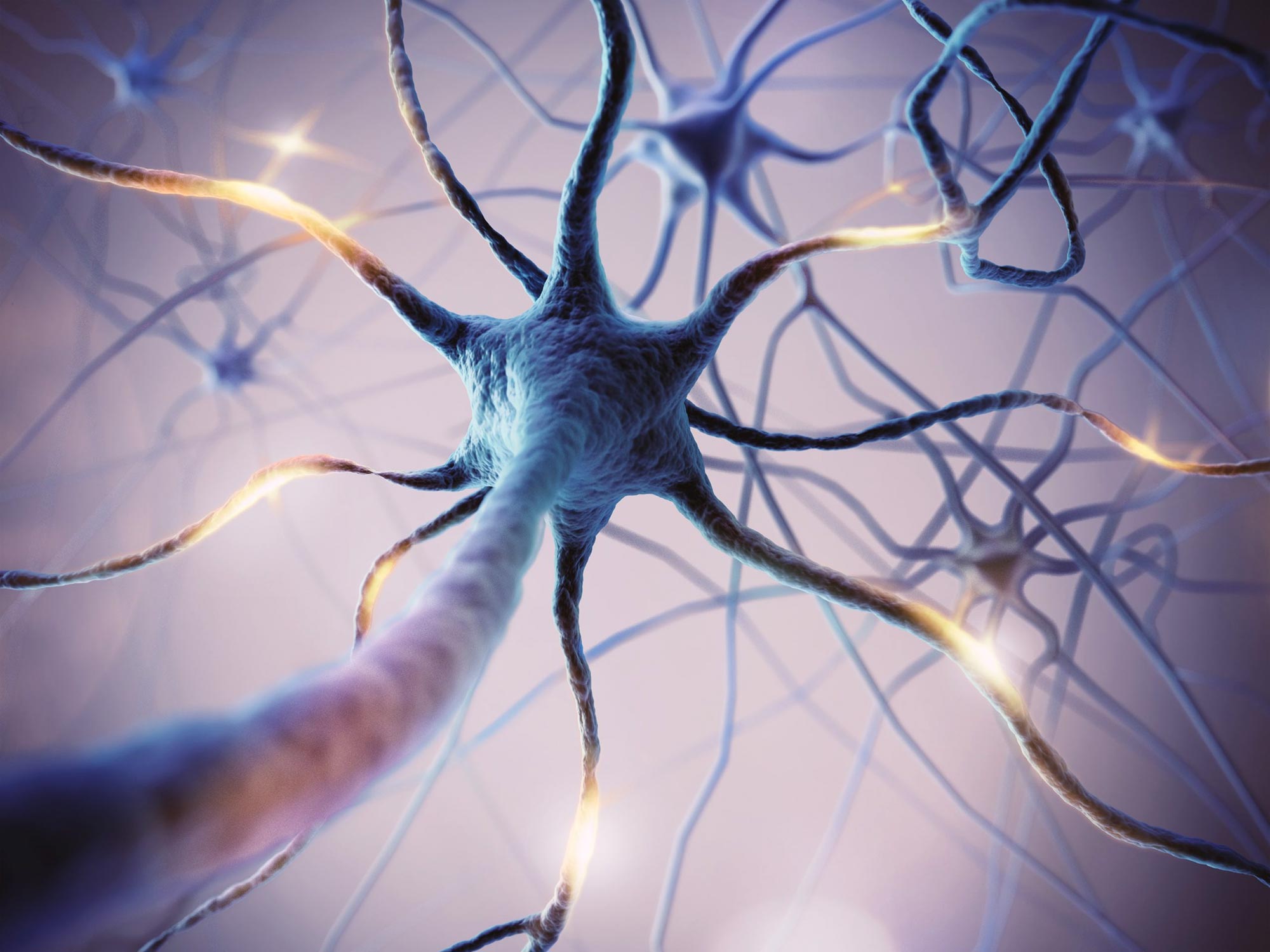
Using in-vitro models of a specific type of brain cell, scientists have demonstrated that neurons can transform from one type to another.
Neurons are specialized brain cells responsible for transmitting signals throughout the body. For a long time, scientists believed that once neurons develop from stem cells into a specific subtype, their identity remains fixed, regardless of changes in their surrounding environment.
However, new research from the Braingeneers, a collaborative team of scientists from UC Santa Cruz and UC San Francisco, challenges this long-held belief.
In a study published in iScience, the Braingeneers report that neuronal subtype identity may be more flexible than previously thought. The team used cerebral organoids, 3D models of brain tissue, to investigate how neurons develop and adapt. Their findings offer new insights into how different neuron subtypes influence brain function and may play a role in neurodevelopmental disorders.
“This goes against this idea that neuronal identity is completely stable,” said Mohammed Mostajo-Radji, a research scientist at the UC Santa Cruz Genomics Institute and the paper’s lead author. “It’s making all of us rethink how neurons are actually made and maintained, and the influence of the environment in this process.”
First-of-their-kind models
There are two main types of neurons in the cerebral cortex, the outermost layer of the brain: excitatory, which make up 80% of neurons, or inhibitory, the remaining 20%. Of inhibitory neurons in the cerebral cortex, the majority (60%) are parvalbumin-positive neurons.
These inhibitory cells have control over plasticity in the brain, affecting the time period in which a person has the ability to learn a new language without an accent, or enhance other senses after the loss of one. They are also recognized to be involved in many neurodevelopmental disorders, including autism and schizophrenia.
This paper shows that the scientists were able to create a large number of parvalbumin-positive neurons in the living models in the lab, the first instance when scientists were able to produce more than just a small amount of these cells. These brain cells were transplanted into and cultured within cerebral organoids, and the researchers believe the 3D structure which more closely mimics the brain, may have been key to the breakthrough.
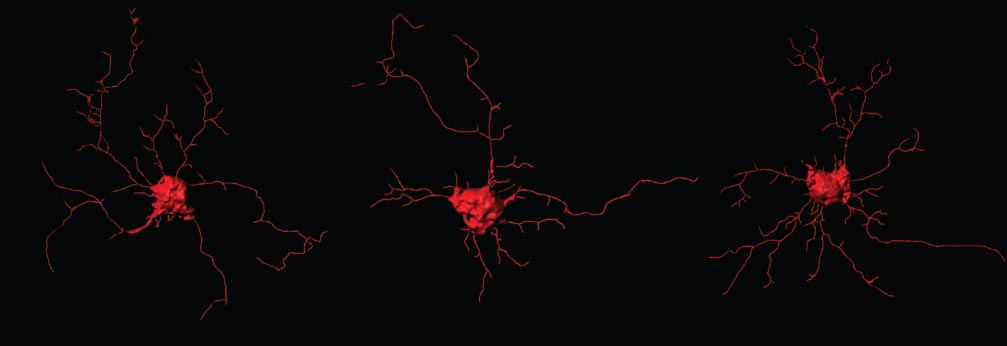
“I think part of the answer is that it does not work if you try 2D models,” Mostajo-Radji said. “We provide what I believe is the first evidence that you need a 3D environment. It might challenge us to think about what other cell types we still can’t make in-vitro, and if that’s because we always thought everything could be done in 2D, but actually they need a 3D environment.”
The ability to produce and maintain these parvalbumin-positive neurons in the lab opens the door for a wide range of research into these important cell types. Scientists could learn more about their role in neurodevelopmental disease and the brain as a whole.
“When thinking about assembling brain models, missing this cell type is actually quite critical,” Mostajo-Radji said. “Now, we can make a more realistic model of the brain.”
Changing identity
Next, to further challenge the idea that these cells have a fixed identity, the researchers investigated how the external environment around subtypes of neurons can affect the cell’s identity.
To do so, they took another kind of inhibitory neuron, called somatostatin neurons, and added them to the 3D organoid model. They observed that in these conditions, some somatostatin neurons transitioned into parvalbumin-positive neurons.
While they are not sure the exact genetic and environmental conditions that enabled the transition, just knowing that this change can occur in living cells in the lab opens up the possibility that the processes could be happening in the brain as well.
“It’s possible that this process of changing identity might actually happen naturally in the brain,” Mostajo-Radji said. “We don’t know that yet, but maybe there is a process in which this has actually been observed in the brain, but overlooked. It’s an exciting window we should explore, and some other labs around the country are starting to think the same way.”
While they have some initial ideas about which genetic pathways might be at play, the researchers want to further explore what factors are responsible for enabling this fluidity of neuronal identity. The researchers also want to further investigate the excitatory cells to find out how they influence the fate of the inhibitory cells.
Reference: “Fate plasticity of interneuron specification” by Mohammed A. Mostajo-Radji, Walter R. Mancia Leon, Arnar Breevoort, Jesus Gonzalez-Ferrer, Hunter E. Schweiger, Julian Lehrer, Li Zhou, Matthew T. Schmitz, Yonatan Perez, Tanzila Mukhtar, Ash Robbins, Julia Chu, Madeline G. Andrews, Frederika N. Sullivan, Dario Tejera, Eric C. Choy, Mercedes F. Paredes, Mircea Teodorescu, Arnold R. Kriegstein, Arturo Alvarez-Buylla and Alex A. Pollen, 27 March 2025, iScience.
DOI: 10.1016/j.isci.2025.112295
UC Santa Cruz researchers involved in this research include: Jesus Gonzalez-Ferrer, Hunter Schweiger, Julian Lehrer, Frederika Sullivan, Ash Robbins, Eric Choy, and Associate Professor of Electrical and Computer Engineering Mircea Teodorescu.
Never miss a breakthrough: Join the SciTechDaily newsletter.
Follow us on Google and Google News.
3 Comments
Let me know if I can help
Interesting. I’d just been writing on how money being artificial parts of whole solutions combinations, people appear to stretch, not having formed enough solution combinations prior to had afforded any last decision they’d made.
I think that writer’s tech only being provided to writers who tell you what you like & never what you don’t, reduces the shock threshold for truth, raises the violence rate, makes this a more dangerous world for all people ..& tech developers are burning their wick at both ends not providing free writer lateral thinkers free hardcore writer’s tech. It’s easy to go through 3 devices a year. I guess solving problems after the fact, for money, is easier to prove than to solve them before their time. I don’t want money. Good tech improves the good humour of a lateral thinker turned philosopher. Writer’s tech had been developed for us, & money if used wisely is for tech for all, & diversity. Thinks got a bit out of control didn’t it. So, there are about 800000 been tutored in lateral thinking behind me. We’re entered our forties. I wonder lateral thinking increases plasticity. Awe creates more awe. Like popularity
Autism is a neurodivergent condition, not a neurodevelopmental disorder. Please don’t contribute to the stigmatization we’re subjected to on a regular basis.