
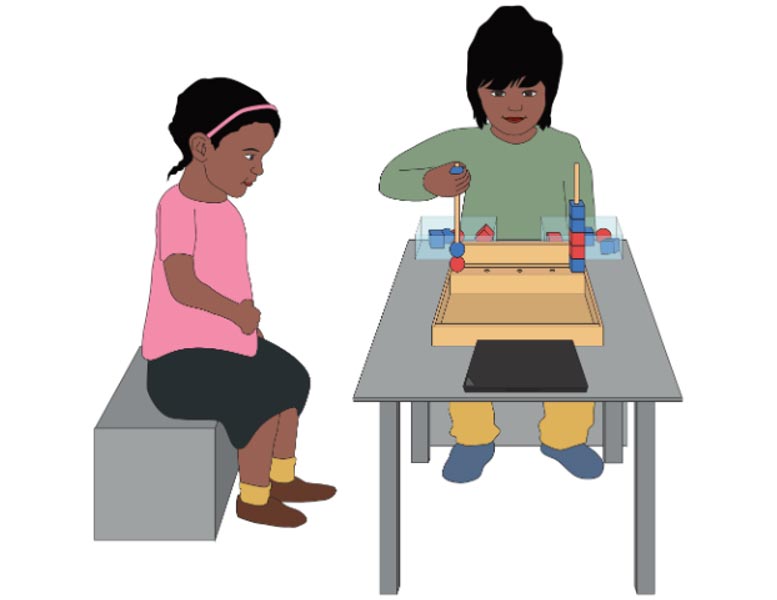
Led by the University of Plymouth, UK, and Freie Universität Berlin, Germany, the study analyzed the behavior of 376 children aged five to eight from eight societies in Africa, Asia, Europe, and South America.
From how we say ‘hello’ to the side of the road we drive on, all societies have norms – or ‘rules’ – that shape people’s everyday lives.
Now a new study – the first of its kind – has shown that children worldwide will challenge peers if they break the ‘rules’, but how they challenge them varies between cultures.
Led by the University of Plymouth, UK, and Freie Universität Berlin, Germany, the study analyzed the behavior of 376 children aged five to eight from eight societies in Africa, Asia, Europe, and South America.
The children were each taught to play a block sorting game – with half taught to sort the blocks by color, and half taught to sort them by shape. They were then put into pairs, with one playing the game and the other observing.
The research showed that observers intervened more often when the other child appeared to play by the wrong set of rules. The more a child intervened, the more likely their partner was to change their behavior. The study also showed that the type of intervention varied – with children from rural areas using imperative verbal protest more than children from urban areas.
Cultural Differences in Challenging Norms
The study is the first to analyze children’s behavior in challenging norm violations across cultures worldwide, and adds to our understanding of how norms allow people to achieve coordination and cooperation.
Lead author Dr. Patricia Kanngiesser from the University of Plymouth said: “What is new about this study is that we observed children’s behaviors and traveled worldwide to do so – we didn’t ask children what they intended to do, but measured what they actually did in real-life social interactions.
“It was also really interesting to see that how the children corrected each other varied by location. To our surprise, children from rural small-scale communities protested as much or even more than children from urban settings. We assumed that, because everyone knows everyone else in small-scale communities, direct interventions would be less common, as people could rely on more indirect ways such as reputation to ensure compliance with rules. But we actually found the opposite to be true.
“The next step is to explore further what motivates children to intervene and how they learn to intervene. For example, do they learn from adults or older children around them how to react to rule-breaking?”
Reference: “Children across societies enforce conventional norms but in culturally variable ways” by Patricia Kanngiesser, Marie Schäfer, Esther Herrmann, Henriette Zeidler, Daniel Haun and Michael Tomasello, 28 December 2021, Proceedings of the National Academy of Sciences.
DOI: 10.1073/pnas.2112521118
The study was co-authored by:
- Dr. Marie Schäfer, University of Leipzig, Germany
- Dr. Esther Herrmann, University of Portsmouth, UK
- Dr. Henriette Zeidler, Aston University, Birmingham, UK
- Professor Daniel Haun, Max Planck Institute for Evolutionary Anthropology, Leipzig, Germany
- Prof Michael Tomasello, Duke University, Durham, USA
Never miss a breakthrough: Join the SciTechDaily newsletter.
Follow us on Google and Google News.