
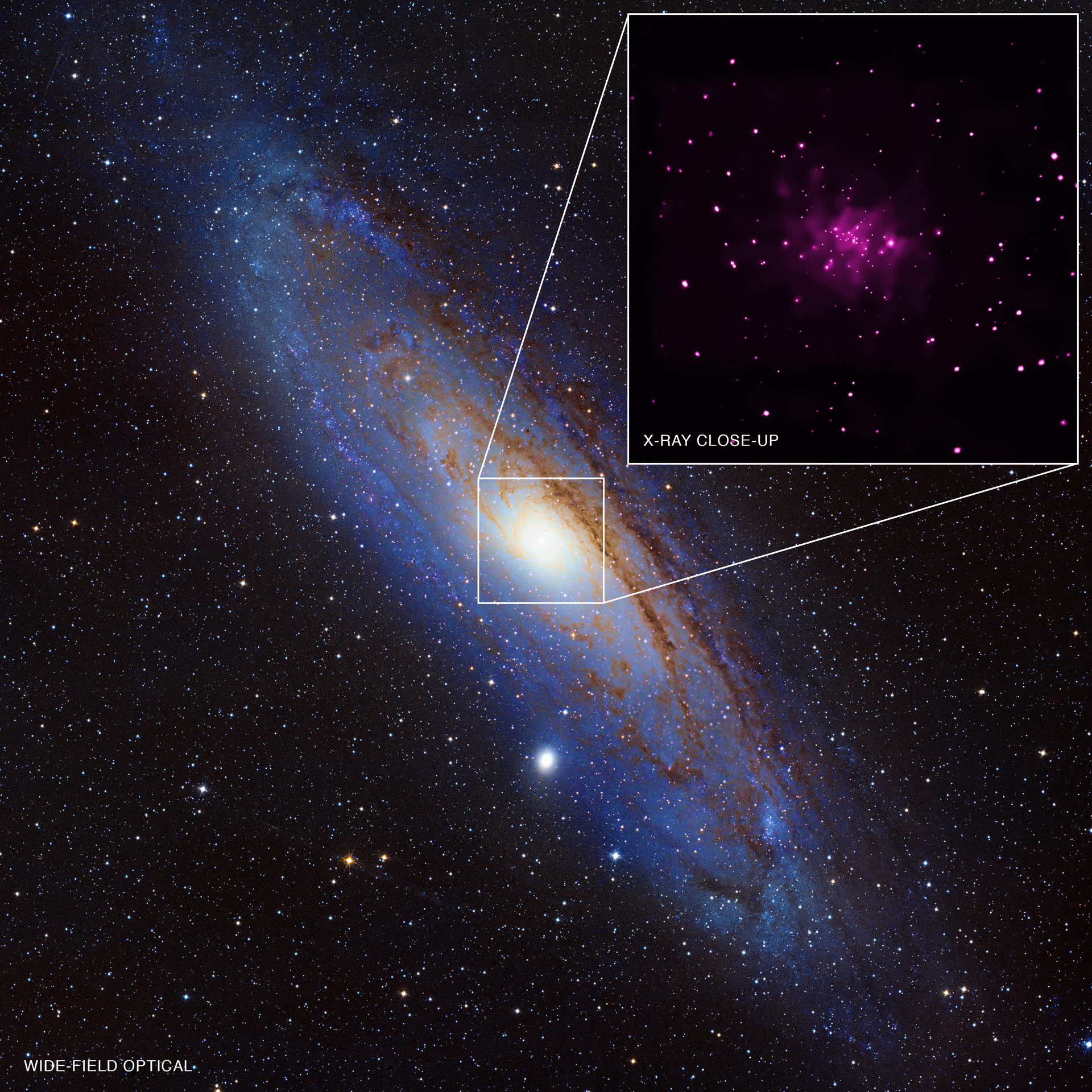
Using data from 152 observations of Chandra spanning over 13 years, researchers discovered twenty-six new stellar-mass black hole candidates in Andromeda, also known as M31.
Using data from NASA’s Chandra X-ray Observatory, astronomers have discovered an unprecedented bonanza of black holes in the Andromeda Galaxy, one of the nearest galaxies to the Milky Way.
Using more than 150 Chandra observations, spread over 13 years, researchers identified 26 black hole candidates, the largest number to date, in a galaxy outside our own. Many consider Andromeda to be a sister galaxy to the Milky Way. The two ultimately will collide, several billion years from now.
“While we are excited to find so many black holes in Andromeda, we think it’s just the tip of the iceberg,” said Robin Barnard of Harvard-Smithsonian Center for Astrophysics (CfA) in Cambridge, Massachusetts, and lead author of a new paper describing these results. “Most black holes won’t have close companions and will be invisible to us.”
The black hole candidates belong to the stellar mass category, meaning they formed in the death throes of very massive stars and typically have masses five to 10 times that of our sun. Astronomers can detect these otherwise invisible objects as material is pulled from a companion star and heated up to produce radiation before it disappears into the black hole.
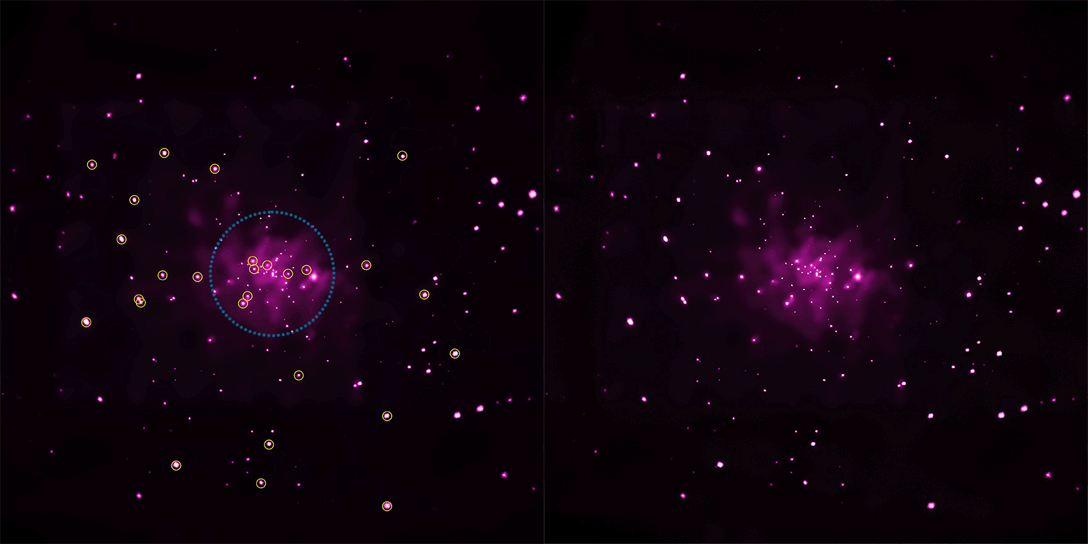
The first step in identifying these black holes was to make sure they were stellar mass systems in the Andromeda Galaxy itself, rather than supermassive black holes at the hearts of more distant galaxies. To do this, the researchers used a new technique that draws on information about the brightness and variability of the X-ray sources in the Chandra data. In short, the stellar mass systems change much more quickly than the supermassive black holes.
To classify those Andromeda systems as black holes, astronomers observed that these X-ray sources had special characteristics: that is, they were brighter than a certain high level of X-rays and also had a particular X-ray color. Sources containing neutron stars, the dense cores of dead stars that would be the alternate explanation for these observations, do not show both of these features simultaneously. But sources containing black holes do.
The European Space Agency’s XMM-Newton X-ray observatory added crucial support for this work by providing X-ray spectra, the distribution of X-rays with energy, for some of the black hole candidates. The spectra are important information that helps determine the nature of these objects.
“By observing in snapshots covering more than a dozen years, we are able to build up a uniquely useful view of M31,” said co-author Michael Garcia, also of CfA. “The resulting very long exposure allows us to test if individual sources are black holes or neutron stars.”
The research group previously identified nine black hole candidates within the region covered by the Chandra data, and the present results increase the total to 35. Eight of these are associated with globular clusters, the ancient concentrations of stars distributed in a spherical pattern about the center of the galaxy. This also differentiates Andromeda from the Milky Way as astronomers have yet to find a similar black hole in one of the Milky Way’s globular clusters.
Seven of these black hole candidates are within 1,000 light-years of the Andromeda Galaxy’s center. That is more than the number of black hole candidates with similar properties located near the center of our own galaxy. This is not a surprise to astronomers because the bulge of stars in the middle of Andromeda is bigger, allowing more black holes to form.
“When it comes to finding black holes in the central region of a galaxy, it is indeed the case where bigger is better,” said co-author Stephen Murray of Johns Hopkins University and CfA. “In the case of Andromeda, we have a bigger bulge and a bigger supermassive black hole than in the Milky Way, so we expect more smaller black holes are made there as well.”
This new work confirms predictions made earlier in the Chandra mission about the properties of X-ray sources near the center of M31. Earlier research by Rasmus Voss and Marat Gilfanov of the Max Planck Institute for Astrophysics in Garching, Germany, used Chandra to show there was an unusually large number of X-ray sources near the center of M31. They predicted most of these extra X-ray sources would contain black holes that had encountered and captured low-mass stars. This new detection of seven black hole candidates close to the center of M31 gives strong support to these claims.
“We are particularly excited to see so many black hole candidates this close to the center, because we expected to see them and have been searching for years,” said Barnard.
These results will be published in the June 20 issue of The Astrophysical Journal and are online now. Many of the Andromeda observations were made within Chandra’s Guaranteed Time Observer program.
NASA’s Marshall Space Flight Center in Huntsville, Alabama, manages the Chandra Program for NASA’s Science Mission Directorate in Washington. The Smithsonian Astrophysical Observatory controls Chandra’s science and flight operations from Cambridge, Massachusetts.
Reference: ” Chandra identification of 26 new black hole candidates in the central region of M31″ by R. Barnard, M. R. Garcia and S. S. Murray, 5 June 2013, The Astrophysical Journal.
DOI: 10.1088/0004-637X/770/2/148
arXiv:1304.7780
Related Link: Chandra Press Release
Never miss a breakthrough: Join the SciTechDaily newsletter.
Follow us on Google and Google News.