

Astronomers reveal evidence of repeated bursts, or eruptions, from a black hole at the center of a large elliptical galaxy located within the core of the Centaurus Cluster of galaxies. This black hole has been “beating” about every 5 to 10 million years, pumping material and energy into its environment. These bursts created cavities within the hot, X-ray emitting gas that pervades the cluster.
The large elliptical galaxy called NGC 4696, located at the center of the Centaurus galaxy cluster, is home to a supermassive black hole.
New data from the Chandra X-ray Observatory has revealed details about this giant black hole, located some 145 million light-years from Earth. Although the black hole itself is undetected, scientists are learning about the impact it has on the galaxy it inhabits and the larger cluster around it.
In some ways, this black hole resembles a beating heart that pumps blood outward into the body via the arteries. Likewise, a black hole can inject material and energy into its host galaxy and beyond.
By examining the details of the X-ray data from Chandra, astronomers have discovered evidence for repeated bursts of energetic particles in jets generated by the supermassive black hole at the center of NGC 4696. These bursts create vast cavities in the hot gas that fills the space between the galaxies in the cluster. The bursts also create shock waves, akin to sonic booms produced by high-speed airplanes, which travel tens of thousands of light years across the cluster.
The composite image at the top of the page contains X-ray data from Chandra (red) that reveals the hot gas in the cluster, and radio data from the NSF’s Karl G. Jansky Very Large Array (blue) that shows high-energy particles produced by the black hole-powered jets. Visible light data from the Hubble Space Telescope (green) show galaxies in the cluster as well as galaxies and stars outside the cluster.
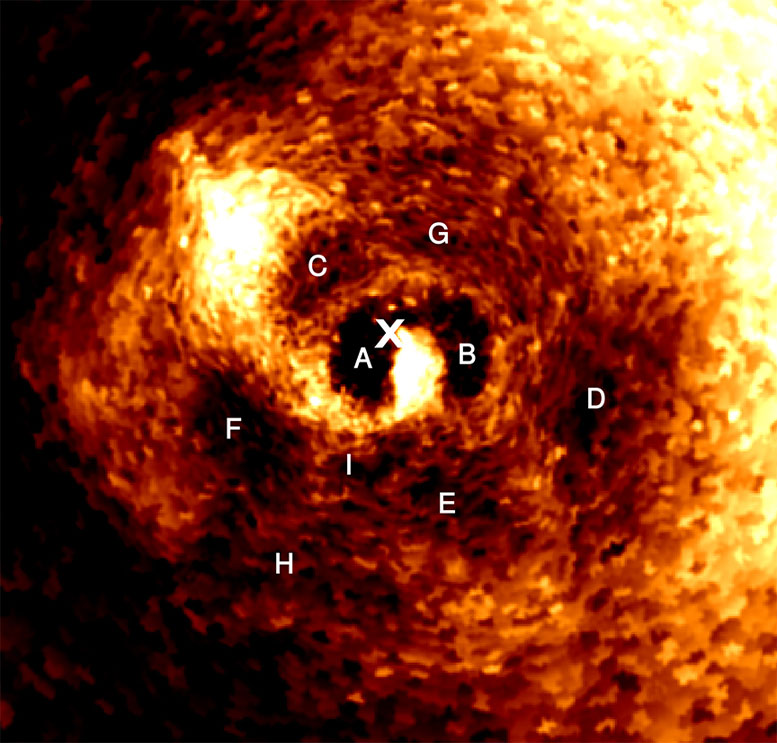
Scientists employed special processing to the X-ray data (shown above) to emphasize nine cavities visible in the hot gas. These cavities are labeled A through I in an additional image, and the location of the black hole is labeled with a cross. The cavities that formed most recently are located nearest to the black hole, in particular the ones labeled A and B.
The researchers estimate that these black hole bursts, or “beats”, have occurred every five to ten million years. Besides the vastly differing time scales, these beats also differ from typical human heartbeats in not occurring at particularly regular intervals.
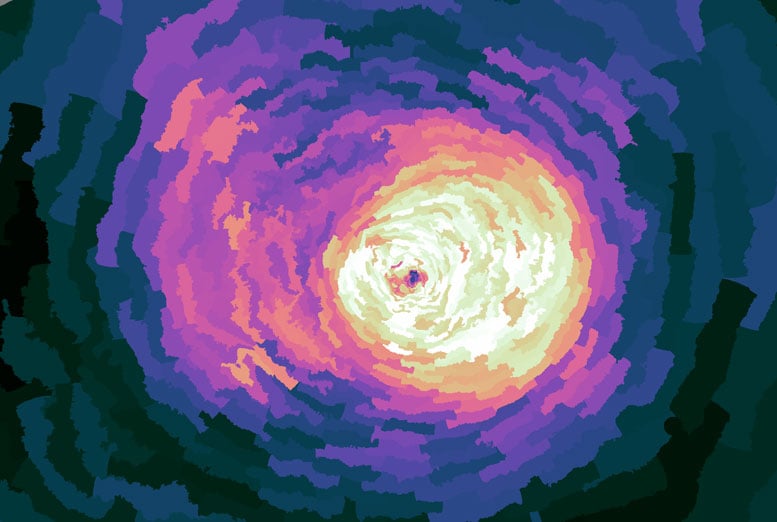
A different type of processing of the X-ray data reveals a sequence of curved and approximately equally spaced features in the hot gas. These may be caused by sound waves generated by the black hole’s repeated bursts. In a galaxy cluster, the hot gas that fills the cluster enables sound waves – albeit at frequencies far too low for the human ear to detect – to propagate.
The features in the Centaurus Cluster are similar to the ripples seen in the Perseus cluster of galaxies. The pitch of the sound in Centaurus is extremely deep, corresponding to a discordant sound about 56 octaves below the notes near middle C. This corresponds to a slightly higher (by about one octave) pitch than the sound in Perseus. Alternative explanations for these curved features include the effects of turbulence or magnetic fields.
The Centaurus Cluster is a collection of hundreds of galaxies located about 145 million light-years from Earth. At the center of the cluster is a large elliptical galaxy called NGC 4696. Buried within the core of NGC 4696 lies a supermassive black hole.
The black hole bursts also appear to have lifted up gas that has been enriched in elements generated in supernova explosions. The authors of the study of the Centaurus cluster created a map showing the density of elements heavier than hydrogen and helium. The brighter colors in the map show regions with the highest density of heavy elements and the darker colors show regions with a lower density of heavy elements. Therefore, regions with the highest density of heavy elements are located to the right of the black hole. A lower density of heavy elements near the black hole is consistent with the idea that enriched gas has been lifted out of the cluster’s center by bursting activity associated with the black hole. The energy produced by the black hole is also able to prevent the huge reservoir of hot gas from cooling. This has prevented large numbers of stars from forming in the gas.
Reference: A very deep Chandra view of metals, sloshing and feedback in the Centaurus cluster of galaxies” by J. S. Sanders, A. C. Fabian, G. B. Taylor, H. R. Russell, K. M. Blundell, R. E. A. Canning, J. Hlavacek-Larrondo, S. A. Walker and C. K. Grimes, 19 January 2016, MNRAS.
DOI: 10.1093/mnras/stv2972
arXiv
Never miss a breakthrough: Join the SciTechDaily newsletter.
Follow us on Google and Google News.
1 Comment
In search of black holes and dark matter astrophysicists are relying on indirect observations. Only the measurement of the event horizon of a black hole directly would be a direct evidence. However nobody done it yet, so for now an existence of BH is a hypothesis.