

Centaurus A’s black hole jet emits from its edges, revealing surprising behavior captured in record-breaking detail by the EHT.
An international team anchored by the Event Horizon Telescope (EHT) Collaboration, which is known for capturing the first image of a black hole in the galaxy Messier 87, has now imaged the heart of the nearby radio galaxy Centaurus A in unprecedented detail. The astronomers pinpoint the location of the central supermassive black hole and reveal how a gigantic jet is being born. Most remarkably, only the outer edges of the jet seem to emit radiation, which challenges our theoretical models of jets. This work, led by Michael Janssen from the Max Planck Institute for Radio Astronomy in Bonn and Radboud University Nijmegen is published in Nature Astronomy today (July 19th, 2021).
At radio wavelengths, Centaurus A emerges as one of the largest and brightest objects in the night sky. After it was identified as one of the first known extragalactic radio sources in 1949, Centaurus A has been studied extensively across the entire electromagnetic spectrum by a variety of radio, infrared, optical, X-ray, and gamma-ray observatories. At the center of Centaurus A lies a black hole with the mass of 55 million suns, which is right between the mass scales of the Messier 87 black hole (six and a half billion suns) and the one in the center of our own galaxy (about four million suns).
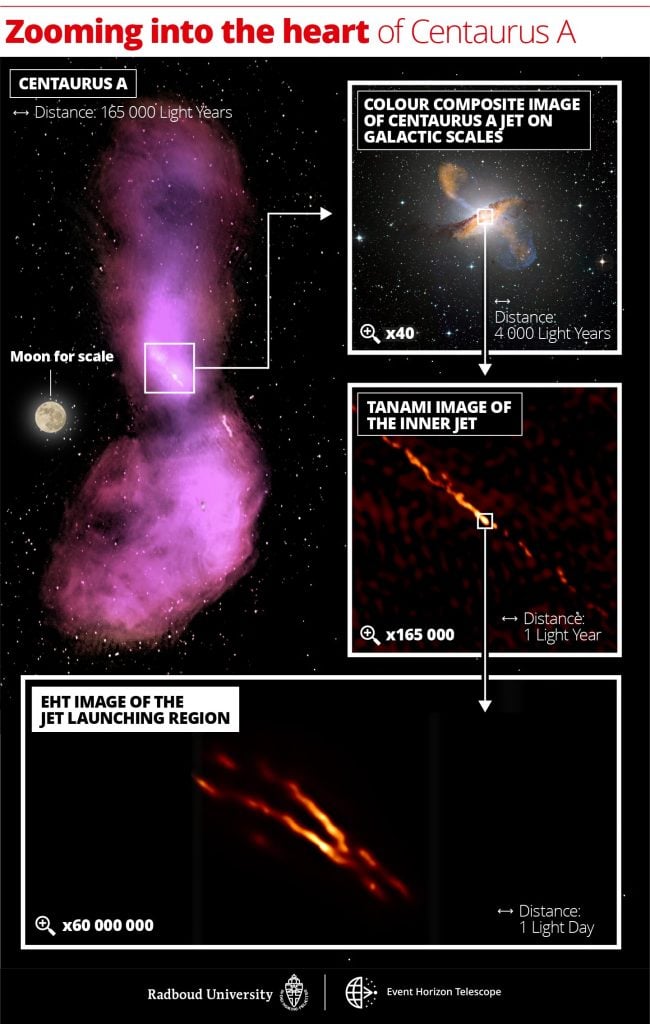
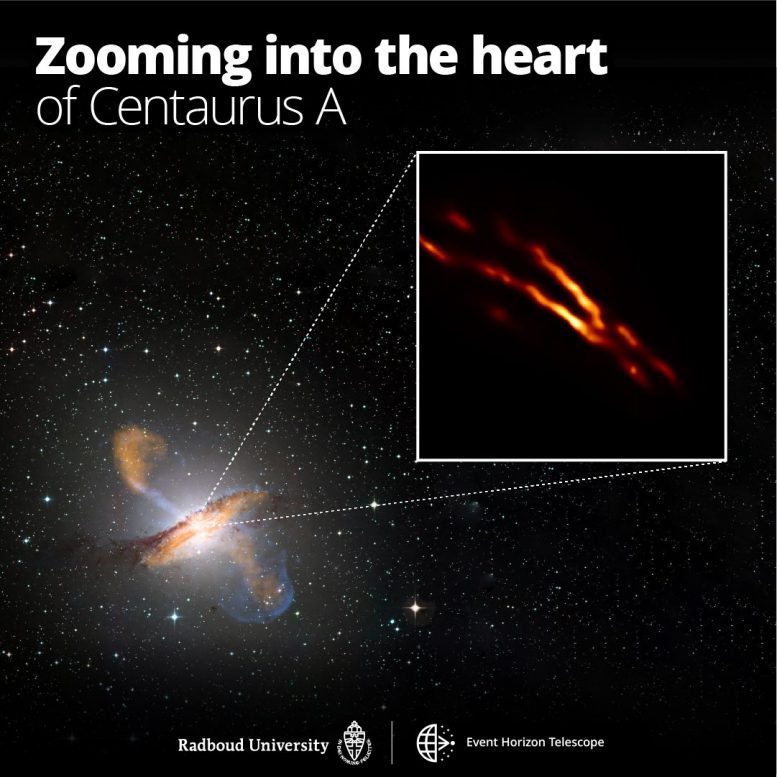
In a new paper in Nature Astronomy, data from the 2017 EHT observations have been analyzed to image Centaurus A in unprecedented detail. “This allows us for the first time to see and study an extragalactic radio jet on scales smaller than the distance light travels in one day. We see up close and personally how a monstrously gigantic jet launched by a supermassive black hole is being born,” says astronomer Michael Janssen.
Compared to all previous high-resolution observations, the jet launched in Centaurus A is imaged at a tenfold higher frequency and sixteen times sharper resolution. With the resolving power of the EHT, we can now link the vast scales of the source, which are as big as 16 times the angular diameter of the Moon on the sky, to their origin near the black hole in a region of merely the width of an apple on the Moon when projected on the sky. That is a magnification factor of one billion.
Understanding Jets
Supermassive black holes residing in the center of galaxies like Centaurus A are feeding off gas and dust that is attracted by their enormous gravitational pull. This process releases massive amounts of energy and the galaxy is said to become ‘active’. Most matter lying close to the edge of the black hole falls in. However, some of the surrounding particles escape moments before capture and are blown far out into space: Jets — one of the most mysterious and energetic features of galaxies — are born.
Astronomers have relied on different models of how matter behaves near the black hole to better understand this process. But they still do not know exactly how jets are launched from its central region and how they can extend over scales that are larger than their host galaxies without dispersing out. The EHT aims to resolve this mystery.
The new image shows that the jet launched by Centaurus A is brighter at the edges compared to the center. This phenomenon is known from other jets, but has never been seen so pronouncedly before. “Now we are able to rule out theoretical jet models that are unable to reproduce this edge-brightening. It’s a striking feature that will help us better understand jets produced by black holes,” says Matthias Kadler, TANAMI leader and professor for astrophysics at the University of Würzburg in Germany.
Reference: “Event Horizon Telescope observations of the jet launching and collimation in Centaurus A” by Michael Janssen, Heino Falcke, Matthias Kadler, Eduardo Ros, Maciek Wielgus, Kazunori Akiyama, Mislav Baloković, Lindy Blackburn, Katherine L. Bouman, Andrew Chael, Chi-kwan Chan, Koushik Chatterjee, Jordy Davelaar, Philip G. Edwards, Christian M. Fromm, José L. Gómez, Ciriaco Goddi, Sara Issaoun, Michael D. Johnson, Junhan Kim, Jun Yi Koay, Thomas P. Krichbaum, Jun Liu, Elisabetta Liuzzo, Sera Markoff, Alex Markowitz, Daniel P. Marrone, Yosuke Mizuno, Cornelia Müller, Chunchong Ni, Dominic W. Pesce, Venkatessh Ramakrishnan, Freek Roelofs, Kazi L. J. Rygl, Ilse van Bemmel and The Event Horizon Telescope Collaboration, 19 July 2021, Nature Astronomy.
DOI: 10.1038/s41550-021-01417-w
Future observations
With the new EHT observations of the Centaurus A jet, the likely location of the black hole has been identified at the launching point of the jet. Based on this location, the researchers predict that future observations at an even shorter wavelength and higher resolution would be able to photograph the central black hole of Centaurus A. This will require the use of space-based satellite observatories.
“These data are from the same observing campaign that delivered the famous image of the black hole in M87. The new results show that the EHT provides a treasure trove of data on the rich variety of black holes and there is still more to come,” says Heino Falcke, EHT board member and professor for Astrophysics at Radboud University.
Background information
To observe the Centaurus A galaxy with this unprecedentedly sharp resolution at a wavelength of 1.3 mm, the EHT collaboration used Very Long Baseline Interferometry (VLBI), the same technique with which the famous image of the black hole in M87 was made. An alliance of eight telescopes around the world joined together to create the virtual Earth-sized Event Horizon Telescope. The EHT collaboration involves more than 300 researchers from Africa, Asia, Europe, North and South America.
The EHT consortium consists of 13 stakeholder institutes: the Academia Sinica Institute of Astronomy and Astrophysics, the University of Arizona, the University of Chicago, the East Asian Observatory, Goethe University Frankfurt, Institut de Radioastronomie Millimétrique (MPG/CNRS/IGN), Large Millimeter Telescope, Max Planck Institute for Radio Astronomy, MIT Haystack Observatory, National Astronomical Observatory of Japan, Perimeter Institute for Theoretical Physics, Radboud University and the Center for Astrophysics | Harvard & Smithsonian.
TANAMI (Tracking Active Galactic Nuclei with Austral Milliarcsecond Interferometry) is a multiwavelength program to monitor relativistic jets in active galactic nuclei of the Southern Sky. This program has been monitoring Centaurus A with VLBI at centimeter-wavelengths since the mid 2000s. The TANAMI array consists of nine radio telescopes located on four continents observing at wavelengths of 4 cm and 1.3 cm.
Never miss a breakthrough: Join the SciTechDaily newsletter.
Follow us on Google and Google News.