
Early life experiences leave lasting epigenetic marks across multiple tissues, shaping aging and health in complex ways that extend far beyond childhood.
Experiences during childhood may influence health far into adulthood, leaving biological traces that affect multiple systems throughout the body.
A study published in Science examined a rare population of free-ranging rhesus macaques whose life histories have been documented from birth. By combining those records with genomic data from 12 adult tissues, researchers found some of the strongest evidence to date that adversity early in life can produce long-lasting changes in the epigenome, the layer of biological regulation that controls how genes are activated and expressed.
The research was led by scientists at Arizona State University, Vanderbilt University, and several collaborating institutions. The team focused on DNA methylation, a key epigenetic marker associated with aging. Patterns of DNA methylation are commonly used to create “epigenetic clocks,” which estimate both chronological age (how long an organism has lived) and biological age (how old its body appears physiologically).
“Our goal was to understand how aging unfolds across the body, and how early experiences might influence that process,” said study co-senior author Noah Snyder-Mackler, a professor in Arizona State University’s School of Life Sciences. “What we found is that early life adversity leaves a coordinated epigenetic signature that spans multiple tissues—but it doesn’t simply accelerate aging in a uniform way.”
Multi-Tissue Epigenetic Clocks Reveal Diverse Aging Patterns
To investigate these effects, researchers developed highly accurate tissue-specific epigenetic clocks that could estimate age to within about one year of an animal’s actual age. The study included 237 macaques living in semi-natural conditions on Cayo Santiago, often called “Monkey Island,” a 38-acre (15-hectare) island off Puerto Rico’s eastern coast.
More than 1,500 free-ranging rhesus macaques inhabit the island, which is managed by the University of Puerto Rico and the Caribbean Primate Research Center. Using DNA methylation data collected from multiple tissues in adulthood alongside detailed records of each animal’s early life experiences, the researchers explored how adversity and aging interact at the molecular level.
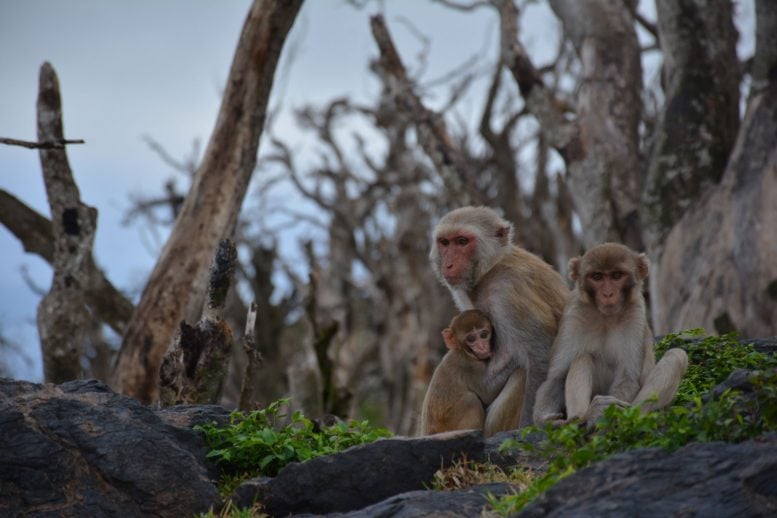
Researchers developed highly precise tissue-specific aging clocks that predicted age within about one year. Studying 237 rhesus macaques living on Puerto Rico’s Cayo Santiago (“Monkey Island”), they combined DNA methylation data from multiple tissues with detailed early-life records to reveal how adversity influences biological aging at the molecular level. Credit: Arizona State University.
The analysis revealed that aging does not affect all tissues in the same way. Instead, age-related DNA methylation changes varied considerably depending on the tissue being examined.
“At a molecular level, aging looks very different depending on which tissue you examine,” said Amanda Lea, assistant professor of Biological Sciences at Vanderbilt University, co-senior author of the study. “Blood, which is most commonly measured in human studies, only captures part of the picture.” The thymus and pituitary gland, for example, displayed especially strong age-related signatures, while other tissues showed more modest changes.
Despite these differences, the researchers also found evidence of coordination across the body. Animals that appeared biologically older in one tissue were often older in other tissues as well, suggesting that aging is partly synchronized across organ systems.
Early Life Adversity Leaves Coordinated Genomic Signatures
Some of the study’s most significant findings came from examining early life adversity, including maternal loss, low maternal social status, and growing up in crowded social groups. These experiences were linked to DNA methylation changes that appeared across multiple tissues.
“We found that each type of adversity tends to affect specific regions of the genome,” said Lea. “But once it targets those regions, the effects are often shared across multiple tissues.”
The researchers identified thousands of genomic regions where DNA methylation patterns were associated with adverse early life experiences. Many of these regions overlapped with areas affected by aging, but the relationship was not straightforward.
“In some cases, adversity-related changes looked like accelerated aging. In others, they went in the opposite direction,” explained co-lead author Rachel Petersen, a Vanderbilt postdoctoral researcher. “This tells us that early adversity doesn’t simply ‘speed up’ aging. Instead, it reshapes the epigenome in more complex ways.”
The findings challenge the common idea that adversity in childhood consistently speeds biological aging. Instead, the results suggest that early experiences can alter the course of molecular aging in different ways across the body. In some tissues, including the pituitary gland, adversity appeared to strengthen aging-related effects, while other tissues showed different responses. The results also indicate that some health consequences linked to early adversity may arise through biological pathways that are separate from aging itself.
Why Whole-Body Aging Research Matters
The study underscores the value of examining multiple tissues when studying aging and environmental influences. Many previous investigations have focused on blood samples because they are relatively easy to collect, but the new findings suggest that blood alone may overlook important biological changes occurring elsewhere in the body.
“Different tissues have their own epigenetic landscapes and respond differently to both age and adversity,” said co-lead author Baptiste Sadoughi, an ASU postdoctoral researcher. “To fully understand health and disease, we need to take a whole-body perspective.”
The study examined telltale aging hallmarks of the epigenome—called DNA methylation patterns. DNA methylation is one of the most well-studied markers of aging and can be used to build “epigenetic clocks” that estimate both an organism’s chronological age (how long it has been alive) and biological age (how old it appears physiologically). Credit: Lucca Cristiano, Arizona State University
Rhesus macaques are particularly useful for this type of research because they share many biological and social characteristics with humans. Unlike laboratory animals, they live in complex social environments that naturally expose them to a wide range of life experiences.
“This kind of dataset is incredibly rare,” said Lea. “It allows us to connect detailed life histories with molecular changes across the body in a way that simply isn’t possible in most human studies.”
Implications for Lifelong Health and Disease Risk
Beyond advancing knowledge of aging biology, the study offers new insights into the developmental origins of health and disease. By demonstrating how early experiences influence the epigenome across many tissues, the research provides a potential explanation for how childhood conditions affect health later in life.
“Early life is a critical window for biological development,” said Snyder-Mackler. “Our findings suggest that experiences during this period can leave lasting marks on the genome that influence health trajectories over the lifespan.”
The researchers caution that the effects of adversity are highly complex. Different forms of adversity do not produce identical outcomes, meaning that long-term consequences likely depend on factors such as timing, context, and individual differences.
“This is not a simple story,” Lea said. “But that’s what makes it exciting. We’re beginning to see how life experiences are written into our biology—and why those signatures might vary within and between individuals.”
As scientists continue investigating the connections among environment, epigenetics, and aging, findings like these are reshaping our understanding of growing older. Aging appears to be more than the passage of time. It is also influenced by the unique experiences that leave lasting marks on our biology throughout life.
Reference: “Age and early life adversity shape heterogeneity of the epigenome across tissues in macaques” by Baptiste Sadoughi, Rachel M. Petersen, Sam K. Patterson, Elizabeth Slikas, Christine Adjangba, Nicholas Ryan, Christina E. Costa, Laura E. Newman, Marina M. Watowich, Cameron R. Kelsey, Ashlee Greenier, Elisabeth A. Goldman, Josué E. Negrón-Del Valle, Daniel Phillips, Indya Thompson, Samuel E. Bauman Surratt, Olga González, Nicole Compo, Armando Burgos, Cayo Biobank Research Unit‡, Alex R. DeCasien, Kenneth L. Chiou, Christopher S. Walker, Angelina V. Ruiz Lambides, Melween I. Martínez, Kirstin N. Sterner, Amanda D. Melin, Lauren J. N. Brent, James P. Higham, Michael J. Montague, Michael L. Platt, Noah Snyder-Mackler, Amanda J. Lea, Susan C. Antón, Lauren J. N. Brent, James P. Higham, Melween I. Martínez, Amanda D. Melin, Michael J. Montague, Michael L. Platt, Jerome Sallet and Noah Snyder-Mackler, 18 June 2026, Cayo Biobank Research Unit.
DOI: 10.1126/science.aea4922
The study was made possible by funding from the National Institutes of Health, including the National Institute on Aging (grants R01AG060931, R01AG084706, R00AG075241, and R21AG078554), the National Institute of Mental Health (R01MH118203) and the Office of Research Infrastructure Programs (P40OD012217); the National Science Foundation (SMA-2105307, BCS-2041654, and SBE-2313953); the Hevolution Foundation/American Federation for Aging Research; and The Leakey Foundation.
Never miss a breakthrough: Join the SciTechDaily newsletter.
Follow us on Google and Google News.