
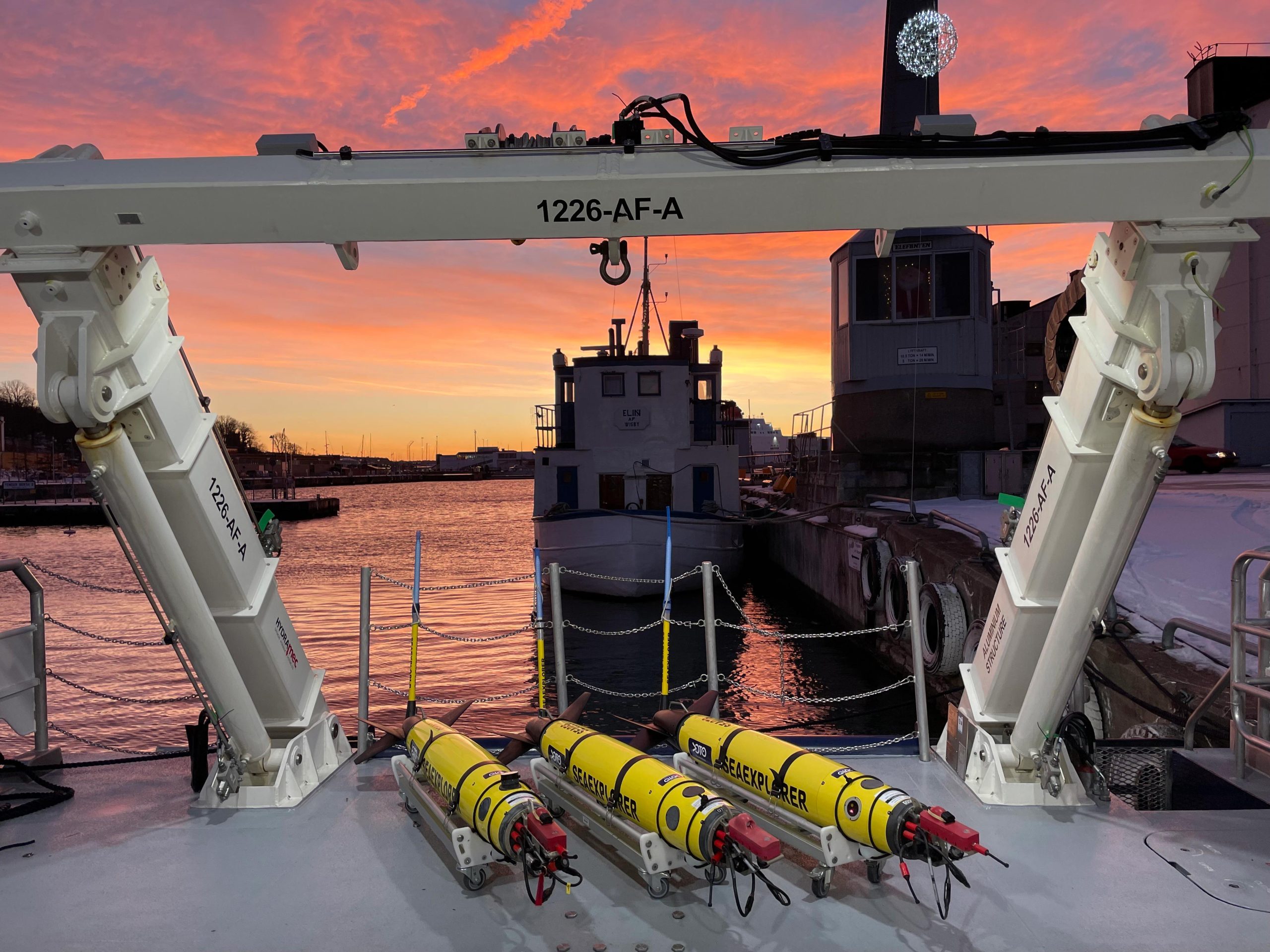
Methane from the Nord Stream leak spread across the southern Baltic Sea for months, impacting 23 protected marine areas.
A new study by researchers from the University of Gothenburg and the Voice of the Ocean research foundation reveals that methane released from the damaged Nord Stream pipelines spread across a large area of the southern Baltic Sea and persisted for several months.
While most of the methane gas rapidly rose to the sea surface and entered the atmosphere, a portion remained underwater and was carried by ocean currents, contributing to its widespread distribution.

“The results of our measurements show that methane spread to large parts of the southern Baltic Sea, from the coast of Danish Zealand in the west, to the Polish Gulf of Gdansk in the east,” says Martin Mohrmann, a researcher at Voice of the Ocean, VOTO.

High-resolution measurements
The Voice of the Ocean Foundation deployed an underwater robot, known as a glider, just outside the exclusion zone around the leaks. This instrument allowed the researchers to measure methane concentrations over a large area, all the way from the surface to the depths. In addition, they continued to measure using the glider for three months after the spill. In the end, they had collected the most high-resolution measurements from the immediate area around the leaks, giving great confidence in their research results.
“To get the most robust estimations, we combined observations from the gliders with surface observations collected by our colleagues at the German research institute IOW from a ferry. It was gratifying to see how well it matched the results from the University of Gothenburg’s research vessel’s expedition to the Nord Stream leak area too. All this together makes us feel confident that we have a really good picture of how the methane spread in the Baltic Sea, both across time and space,” says Bastien Queste, an oceanographer at the University of Gothenburg.

1,000 times higher
In the initial period following the pipeline explosion at the end of September 2022, methane levels in the waters were sometimes 1,000 times above normal. In some areas, abnormal concentrations of methane were measured several months after the release, before it was diluted, consumed by bacteria or escaped to the atmosphere.

“Our gliders, together with ocean modeling for the southern Baltic Sea, have given us a good picture of the areas affected by the spill. In total, we estimate that over 14 percent of the entire Baltic Sea was exposed to methane levels that were at least five times above normal,” says Martin Mohrmann.
Marine-protected areas affected
The results of the study are published in Nature Communications, along with two other studies that have mapped the impact of the Nord Stream emission on the atmosphere.
The researchers from VOTO and the University of Gothenburg have used their measurements to create a robust model of how the methane was dispersed in the water. The ocean currents transported the methane to 23 marine protected areas.
“We now know the areas where the methane emission may have had an impact. It will be easier to determine whether a future problem in the Baltic Sea ecosystems, for example, is related to the Nord Stream leak or not,” says Bastien Queste.
Reference: “Nord Stream methane leaks spread across 14% of Baltic waters” by Martin Mohrmann, Louise C. Biddle, Gregor Rehder, Henry C. Bittig and Bastien Y. Queste, 15 January 2025, Nature Communications.
DOI: 10.1038/s41467-024-53779-0
Related Studies:
“Airborne observations reveal the fate of the methane from the Nord Stream pipelines” by Friedemann Reum, Julia Marshall, Henry C. Bittig, Lutz Bretschneider, Göran Broström, Anusha L. Dissanayake, Theo Glauch, Klaus-Dirk Gottschaldt, Jonas Gros, Heidi Huntrieser, Astrid Lampert, Michael Lichtenstern, Scot M. Miller, Martin Mohrmann, Falk Pätzold, Magdalena Pühl, Gregor Rehder and Anke Roiger, 15 January 2025, Nature Communications.
DOI: 10.1038/s41467-024-53780-7
“Methane emissions from the Nord Stream subsea pipeline leaks” by Stephen J. Harris, Stefan Schwietzke, James L. France, Nataly Velandia Salinas, Tania Meixus Fernandez, Cynthia Randles, Luis Guanter, Itziar Irakulis-Loitxate, Andreea Calcan, Ilse Aben, Katarina Abrahamsson, Paul Balcombe, Antoine Berchet, Louise C. Biddle, Henry C. Bittig, Christian Böttcher, Timo Bouvard, Göran Broström, Valentin Bruch, Massimo Cassiani, Martyn P. Chipperfield, Philippe Ciais, Ellen Damm, Enrico Dammers, Hugo Denier van der Gon, Matthieu Dogniaux, Emily Dowd, François Dupouy, Sabine Eckhardt, Nikolaos Evangeliou, Wuhu Feng, Mengwei Jia, Fei Jiang, Andrea K. Kaiser-Weiss, Ines Kamoun, Brian J. Kerridge, Astrid Lampert, José Lana, Fei Li, Joannes D. Maasakkers, Jean-Philippe W. Maclean, Buhalqem Mamtimin, Julia Marshall, Gédéon Mauger, Anouar Mekkas, Christian Mielke, Martin Mohrmann, David P. Moore, Riccardo Nanni, Falk Pätzold, Isabelle Pison, Ignacio Pisso, Stephen M. Platt, Raphaël Préa, Bastien Y. Queste, Michel Ramonet, Gregor Rehder, John J. Remedios, Friedemann Reum, Anke Roiger, Norbert Schmidbauer, Richard Siddans, Anusha Sunkisala, Rona L. Thompson, Daniel J. Varon, Lucy J. Ventress, Chris Wilson and Yuzhong Zhang, 15 January 2025, Nature.
DOI: 10.1038/s41586-024-08396-8
Never miss a breakthrough: Join the SciTechDaily newsletter.
Follow us on Google and Google News.
7 Comments
I mentioned this to folks 20 years ago. I’m just a common idiot look at my bank account
“In total, we estimate that over 14 percent of the entire Baltic Sea was exposed to methane levels that were at least five times above normal,”
This is modestly interesting. However, I’d like to see some numbers that are actually germane. What were the levels that were claimed to be “at least five times above normal?” Were there any similar investigations conducted BEFORE the release to establish the “normal” levels? The abstract suggests the baseline was established by a model, which wouldn’t be able to anticipate an abnormally high natural background. Perhaps that area is unusually high all the time. Lastly, and most importantly, is there any obvious evidence of damage to the ecosystem?
This reads like some young, inexperienced scientists playing with their new toys and justifying it based on ambiguous results from a poorly designed experiment. Was there a particular question that they were attempting to answer, such as “Did the release damage the ecosystem?” Or, was this just a data point to possibly be used in the future if problems show up?
One would assume that some good folk had measured the amount of methane occurring naturally in various parts of the Baltic, which could be the used to develop a general model about what amount of methane might be drifting around, . even at that spot before the leak or even the pipeline went in. If one finds 1000 times that amount in the general vicinity of a known leak, that would significant
……even before the pipeline……
Why would you assume that? There is always demand and competition for limited research funds and it is impossible to acquire baseline data for every location on Earth for every possible concern. Why do you suppose I brought up the issue of historical data? Because it is actually unlikely, it wasn’t mentioned in the article, modeling was mentioned, and it it key to the claim.
Bacterial methane breakdown takes
Several forms
Could any of them be used commercially
To convert to less dangerious products$$$$$
Profit drives the world
Anyone still care about globol warming?