
Close Menu
    Facebook X (Twitter) Instagram
    SciTechDaily
    • Biology
    • Chemistry
    • Earth
    • Health
    • Physics
    • Science
    • Space
    • Technology
    Facebook X (Twitter) Pinterest YouTube RSS
    SciTechDaily
    Home»Physics»CHIME Detects Repeating Fast Radio Burst From Another Galaxy
    Physics

    CHIME Detects Repeating Fast Radio Burst From Another Galaxy

    By Jim Shelton, Yale UniversityJanuary 9, 20191 Comment2 Mins Read
    Facebook Twitter Pinterest Telegram LinkedIn WhatsApp Email Reddit
    Share
    Facebook Twitter LinkedIn Pinterest Telegram Email Reddit
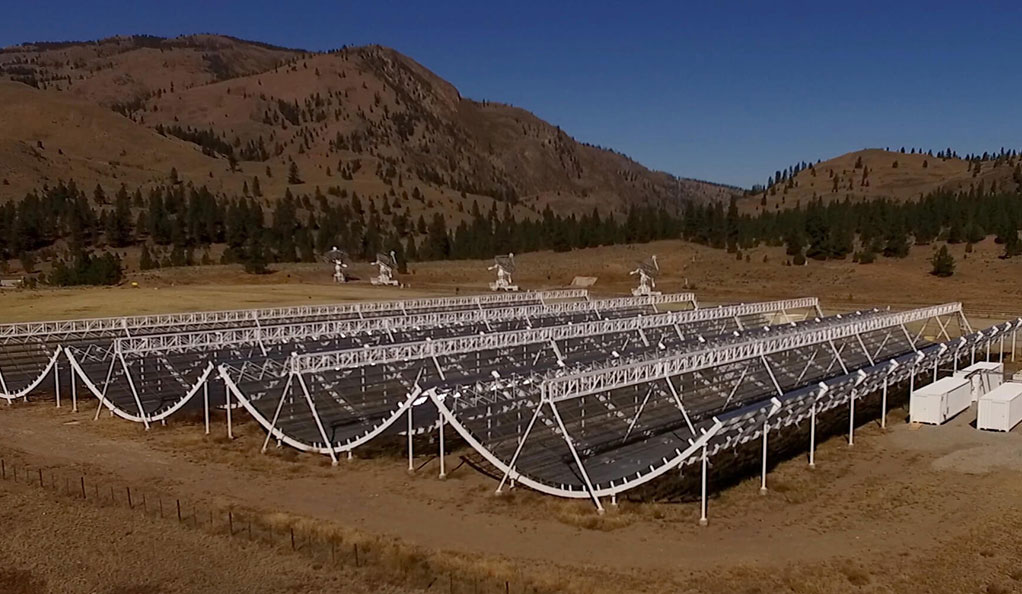
    CHIME Telescope Detects Fast Radio Burst From Other Galaxy
    The CHIME telescope has four cylindrical reflector dishes that cover an area equal to two football fields.

    Assistant professor of physics Laura Newburgh is part of a Canadian-led experiment that has detected the second-known example of a repeating fast radio burst (FRB) originating far outside the Milky Way galaxy.

    Newburgh is co-author of a pair of new studies from the Canadian Hydrogen Intensity Mapping Experiment (CHIME), a radio telescope built in 2017 and located in British Columbia. The studies appear on January 9 in the online edition of the journal Nature.

    One of the studies reports on the discovery of 13 FRBs, seven of which were recorded at the lowest frequency thus far — 400 megahertz. The other study reports on the detection of an FRB with six repeat bursts, all of them originating from the same location 1.5 billion light years from Earth.

    More than 60 FRBs have been observed to date, but this is only the second time researchers have found repeating bursts from a single source.

    “The nature of fast radio bursts is still unknown, but the potential options for what astrophysical phenomena and environments could produce such bright, fast bursts across such a broad radio band continues to narrow as we discover more sources,” Newburgh said. “With data from a limited period during instrument commissioning, the CHIME telescope added ~20% more FRBs to the known population by detecting a dozen new FRBs and finding a second repeating FRB. This highlights the power of CHIME to further unravel this mystery as the instrument gears up for a multi-year survey.”

    CHIME is a collaboration of more than 50 scientists led by the University of British Columbia, McGill University, the University of Toronto, and the National Research Council of Canada.

    Read the new studies here:

    • Observations of fast radio bursts at frequencies down to 400 megahertz
    • A second source of repeating fast radio bursts

    Never miss a breakthrough: Join the SciTechDaily newsletter.
    Follow us on Google and Google News.

    Astrophysics CHIME Fast Radio Bursts Yale University
    Share. Facebook Twitter Pinterest LinkedIn Email Reddit

    Related Articles

    Cosmic Mystery: Brightest FRB Ever Seen Doesn’t Repeat, Baffling Astronomers

    Mystery Signal Lights Up a Dead Galaxy, Baffling Astronomers

    This Mysterious Radio Burst Came From Nowhere and It’s Baffling Experts

    Mysterious Space Signal Traced Across the Universe to an Ancient Dead Galaxy

    CHIME Telescope Detects More Than 500 Mysterious Fast Radio Bursts From Outer Space

    COSINE-100 Experiment Challenges Previous Claims About Dark Matter

    The Triangulum Stream, Remnant of a Star Cluster Being Ingested by the Milky Way

    Yale Physicists Take Significant Step in the Development of Quantum Computing

    Ultracold Neutrons Could Escape to Another Braneworld

    1 Comment

    1. Daurrie Kesslyn on January 23, 2019 3:31 pm

      I wonder if this will help?

      https://archive.org/details/MaxPlanckAndQuantumPhysics

      Reply
    Leave A Reply Cancel Reply

    • Facebook
    • Twitter
    • Pinterest
    • YouTube

    Don't Miss a Discovery

    Subscribe for the Latest in Science & Tech!

    Trending News

    The Secret to Healthy Aging May Be More Protein and More Exercise

    These 567-Million-Year-Old Fossils Are Rewriting the Story of Life on Earth

    The Spider-Like Creatures Helping Scientists Decode the Origins of Fatherhood

    Scientists Baffled by a Sudden Reversal Deep Inside Earth’s Core

    This Strange Sea Creature Can Survive Five Years Without Food – Scientists Finally Know Why

    New Quantum Sensor Opens a Window Into the Invisible Universe

    Stanford Scientists Reverse Age-Related Memory Loss by Targeting the Gut

    James Webb Uncovers the Atmosphere of a Hellish Lava World 41 Light-Years Away

    Follow SciTechDaily
    • Facebook
    • Twitter
    • YouTube
    • Pinterest
    • Newsletter
    • RSS
    SciTech News
    • Biology News
    • Chemistry News
    • Earth News
    • Health News
    • Physics News
    • Science News
    • Space News
    • Technology News
    Recent Posts
    • One of Arizona’s Largest Reservoirs Is Less Than 1% Full After Snowpack Collapse
    • Scientists Detect Hundreds of Iceberg Earthquakes at Antarctica’s Crumbling Doomsday Glacier
    • This 400-Year-Old Shark May Hold the Secret to Preserving Human Vision
    • Hip Replacements Are Lasting Far Longer Than Doctors Once Thought
    • Why Swallowing a Fish Bone Can Become a Life-Threatening Medical Emergency
    Copyright © 1998 - 2026 SciTechDaily. All Rights Reserved.
    • Science News
    • About
    • Contact
    • Editorial Board
    • Privacy Policy
    • Terms of Use

    Type above and press Enter to search. Press Esc to cancel.