
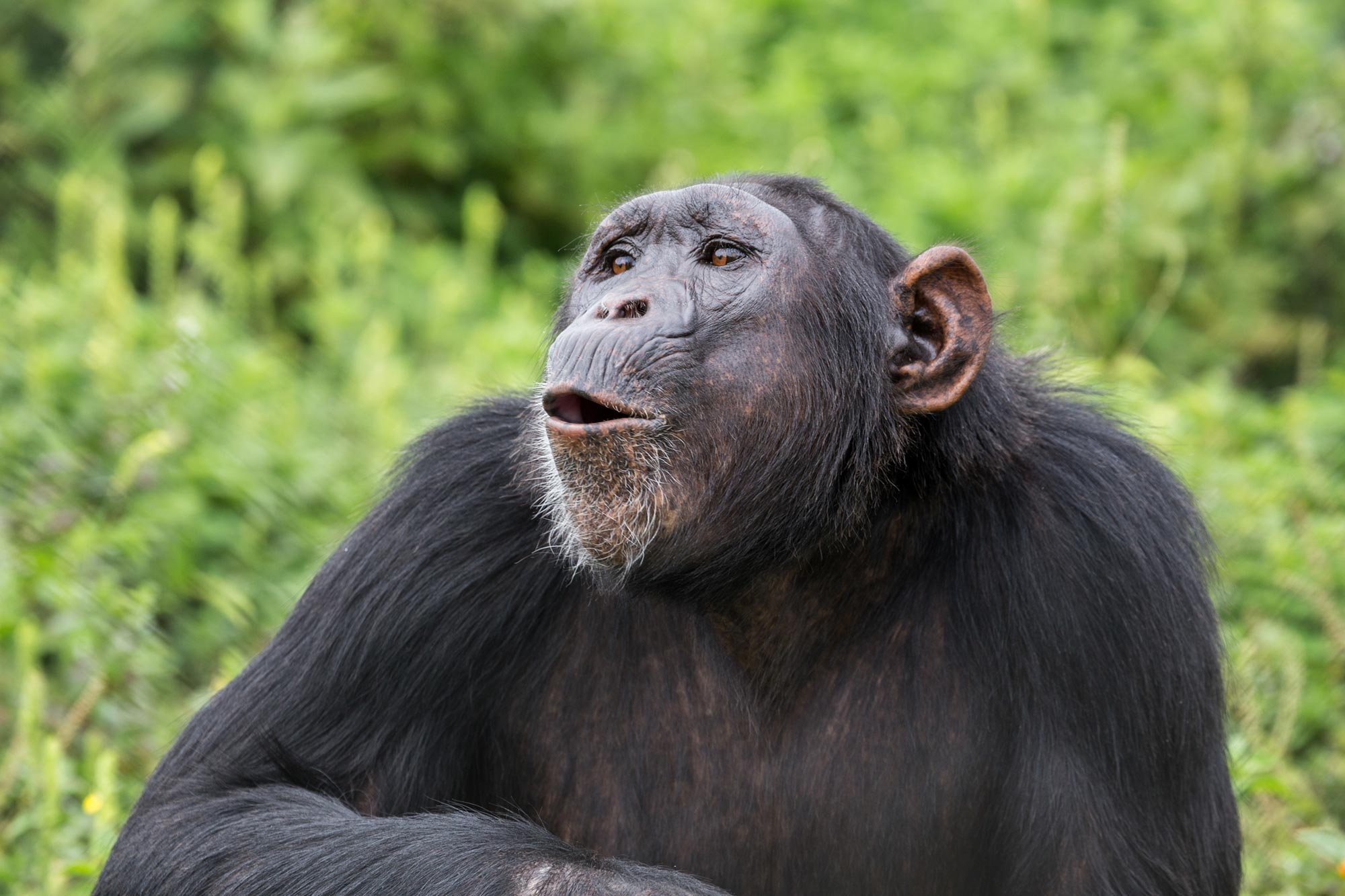
Human brains still react to chimp voices, hinting at a deep evolutionary link in how we recognize sound.
The human brain is not limited to recognizing speech from other people. Researchers at the University of Geneva (UNIGE) have found that specific parts of the auditory cortex react strongly to the vocalizations of chimpanzees. These primates are our closest relatives both in evolutionary terms and in the acoustic qualities of their calls. The study, published in the journal eLife, points to the presence of specialized subregions in the human brain that are particularly responsive to the sounds made by certain primate species.
This discovery offers new insight into how voice recognition originated and may help explain how language later developed.
Searching for the Evolutionary Roots of Vocal Communication
The human voice plays a crucial role in social interaction, and a large portion of the auditory cortex is devoted to processing it. Scientists have long wondered whether this ability emerged only recently or whether it has much deeper evolutionary origins. To explore this question, researchers from UNIGE’s Faculty of Psychology and Educational Sciences examined vocal communication through an evolutionary lens.
By comparing how the human brain processes vocalizations from closely related species, including chimpanzees, bonobos, and macaques, scientists can identify which neural traits humans share with other primates and which are unique. This approach helps reveal how the neural foundations of vocal communication began to form well before spoken language appeared.
Visualizing Vocalizations in the Brain
To carry out the study, the UNIGE research team asked 23 human volunteers to listen to vocal sounds from four different species. Human voices were included as a control. Chimpanzee vocalizations were chosen because of their close genetic and acoustic similarity to humans. Bonobo sounds were also tested, despite their vocalizations being more similar to birdsong. Macaque calls were included as well, since macaques are more distantly related to humans both genetically and acoustically. Brain activity was monitored using functional magnetic resonance imaging (fMRI), allowing researchers to observe how the auditory cortex responded.
“Our intention was to verify whether a subregion sensitive specifically to primate vocalizations existed,” explains Leonardo Ceravolo, research associate at UNIGE’s Faculty of Psychology and Educational Sciences and first author of the study.
A Distinct Response to Chimpanzee Calls
The brain scans revealed exactly what the researchers were looking for. A part of the auditory cortex called the superior temporal gyrus, which is involved in processing sounds related to language, music, and emotional expression, became active in response to certain primate vocalizations. “When participants heard chimpanzee vocalizations, this response was clearly distinct from that triggered by bonobos or macaques.”
What makes this finding especially striking is the comparison with bonobos. Although bonobos are just as genetically close to humans as chimpanzees, their vocal sounds differ greatly in structure. The results suggest that it is not genetic relatedness alone that shapes the brain’s response, but a combination of evolutionary closeness and acoustic similarity.
What This Means for the Evolution of Language
These findings open new possibilities for understanding how communication systems evolved in the brain. They suggest that some regions of the human auditory cortex may have retained sensitivity to the calls of closely related primates over millions of years.
“We already knew that certain areas of the animal brain reacted specifically to the voices of their fellow creatures. But here, we show that a region of the adult human brain, the anterior superior temporal gyrus, is also sensitive to non-human vocalizations,” says Leonardo Ceravolo.
The results support the idea that humans and great apes share core vocal processing abilities that existed before the emergence of spoken language. They may also help researchers better understand how voice recognition develops early in life. For example, this research could offer clues as to how infants are able to recognize familiar voices, even while still in utero.
Reference: “Sensitivity of the human temporal voice areas to nonhuman primate vocalizations” by Leonardo Ceravolo, Coralie Debracque, Thibaud Gruber and Didier Grandjean, 25 November 2025, eLife.
DOI: 10.7554/eLife.108795.1
Never miss a breakthrough: Join the SciTechDaily newsletter.
Follow us on Google and Google News.
4 Comments
That’s a thought – script: Strange scientist runs sound experiments on unaware colleagues while sleeping, triggering ancient, long dormant brain signals when he notices an odd skull-morphology in the mirror when shaving…
I wish they’d included housecat sounds as well as dogs, just to see what they trigger. Cats and dogs evolved to make sounds like human babies so we would protect them, but it would be interesting to see what they stimulate without genetic closeness.
At least by its description here, this study seems woefully ignorant. It’s already well established that the human brain is particularly attuned to certain frequency ranges and their formants. It’s very unsurprising and informative that another animal’s sounds in the same regions in oke the same brain areas.
We process chimp sounds differently than bonobo sounds because chimps are more territorially aggressive than bonobos. So common sense says there would be more reason to notice an aggressor noise than non aggressive. Pigeon versus eagle vocalization.