
Researchers have discovered that neurotransmitters like dopamine and serotonin are released when processing the emotional content of words, revealing new layers of how language impacts our decisions and mental health.
This groundbreaking study by Virginia Tech not only links biological processes with the symbolic aspects of language but also suggests that regions of the brain not traditionally associated with emotional or linguistic processing might still engage with this information, potentially influencing behavior.
Exploring Emotional Language Processing
In a groundbreaking study published in Cell Reports, researchers revealed that neurotransmitters in the human brain are released as we process the emotional meaning of language. This discovery sheds new light on how people interpret the significance of words.
Led by an international team of scientists from Virginia Tech, the research explores how language shapes human choices and mental health.
Guided by computational neuroscientist Read Montague, a professor at the Fralin Biomedical Research Institute at VTC and director of the Center for Human Neuroscience Research, the study marks the first in-depth examination of how neurotransmitters manage the emotional content of language — a uniquely human capability.
The discovery, now online and slated for the January 28 issue of Cell Reports, bridges the biological and the symbolic, linking neural processes that likely have evolved for survival in a vast array of species over the eons to the richness of human communication and emotion.
Neurochemical Dynamics in Language Interpretation
“The common belief about brain chemicals, like dopamine and serotonin, is that they send out signals related to the positive or negative value of experiences,” said Montague, co-corresponding and co-senior author of the study. “Our findings suggest that these chemicals are released in specific areas of the brain when we process the emotional meaning of words. More broadly, our research supports the idea that the brain systems that evolved to help us react to good or bad things in our environment might also play a role in how we process words, which are just as important for our survival.”
The researchers are the first to simultaneously measure dopamine, serotonin, and norepinephrine release in humans in the context of the complex brain dynamics behind how people interpret and respond to language.
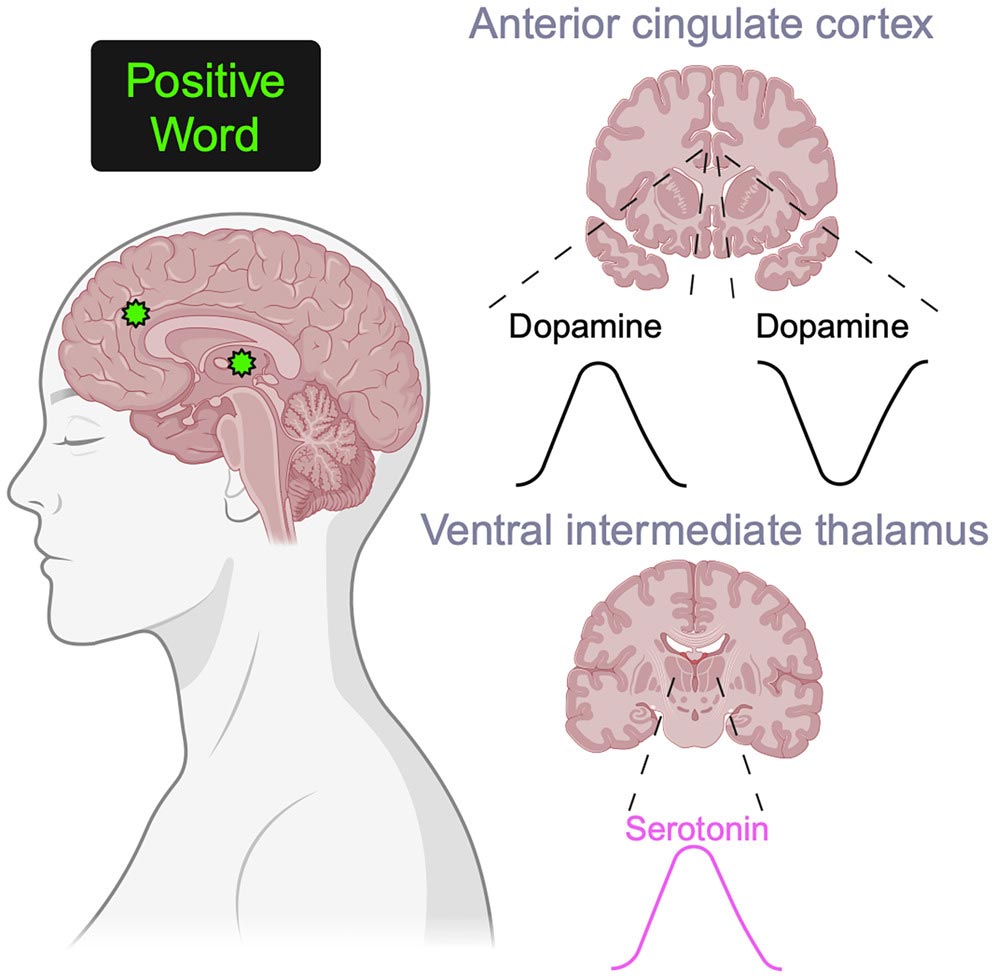
“The emotional content of words is shared across multiple transmitter systems, but each system fluctuates differently,” Montague said. “There’s no single brain region handling this activity, and it’s not as simple as one chemical representing one emotion.”
Spearheaded by computational neuroscientist Read Montague, a professor of the Fralin Biomedical Research Institute at VTC and director of the institute’s Center for Human Neuroscience Research, the study represents a first-of-its-kind exploration of how neurotransmitters process the emotional content of language — a uniquely human function. Montague was co-senior author of the Cell Reports study. Credit: Clayton Metz/Virginia Tech
Uncovering New Roles in Emotional Processing
Neurochemical measurements were taken in patients undergoing deep brain stimulation surgery for treatment of essential tremor, or for the surgical implantation of leads to monitor seizures in epilepsy patients. The procedures target distinctly different brain regions – the thalamus and the anterior cingulate cortex, respectively.
While emotionally charged words were displayed on a screen, measurements were taken using carbon fiber electrodes in the thalamus, alongside traditional platinum-iridium electrodes in the anterior cingulate cortex.
The researchers discovered the words — positive, negative, or neutral — modulate neurotransmitter release. By measuring the sub-second dynamics of the releases, they identified distinct patterns tied to emotional tone, anatomical regions, and which hemisphere of the brain was involved.

Implications and Future Research Directions
“The surprising result came from the thalamus,” said William “Matt” Howe, an assistant professor with the School of Neuroscience of the Virginia Tech College of Science. “This region hasn’t been thought to have a role in processing language or emotional content, yet we saw neurotransmitter changes in response to emotional words. This suggests that even brain regions not typically associated with emotional or linguistic processing might still be privy to that information. For instance, parts of the brain responsible for mobilizing movement might benefit from having access to emotionally significant information to guide behavior.”
While the primary discovery was made in humans, validation in animal models provided additional confidence in the results.
Alec Hartle, a co-first author of the study and a School of Neuroscience doctoral student in Howe’s lab, conducted experiments in rodent models using a technique called optogenetics to confirm the patterns seen in humans. By using light to control genetically modified cells, it allowed scientists to study the functions of specific neurons and neural circuits.
“What we observed in the human brain was extraordinary,” said Howe, co-corresponding and co-senior author of the study. “The validation in animals supports and solidifies the broader implications of these neurotransmitters in decision-making systems.”
The new findings build on a recent study released in Nature Human Behavior, in which the research group highlighted dopamine and serotonin’s roles in social behavior.
“While previous studies focused on neurotransmission during decision-making, this research explores something uniquely human: the emotional content of written words,” said Seth Batten, first author of the study and a senior research associate with the Montague laboratory. “Unlike animals, humans can understand words, their context, and meaning. The study examines how neurotransmitter systems process words with different emotional weight, reflecting the hypothesis that these systems, which evolved to keep us alive, now also help interpret language.”
While still in early stages, the study’s significance lies in its foundational nature and the questions it inspires for future research.
Reference: “Emotional words evoke region- and valence-specific patterns of concurrent neuromodulator release in human thalamus and cortex” by Seth R. Batten, Alec E. Hartle, Leonardo S. Barbosa, Beniamino Hadj-Amar, Dan Bang, Natalie Melville, Tom Twomey, Jason P. White, Alexis Torres, Xavier Celaya, Samuel M. McClure, Gene A. Brewer, Terry Lohrenz, Kenneth T. Kishida, Robert W. Bina, Mark R. Witcher, Marina Vannucci, Brooks Casas, Pearl Chiu, Pendleton R. Montague and William M. Howe, 7 January 2025, Cell Reports.
DOI: 10.1016/j.celrep.2024.115162
The words used in the study were drawn from the Affective Norms for English Words (ANEW) database, which rates words by positive, negative, or neutral emotional valence.
Never miss a breakthrough: Join the SciTechDaily newsletter.
Follow us on Google and Google News.