
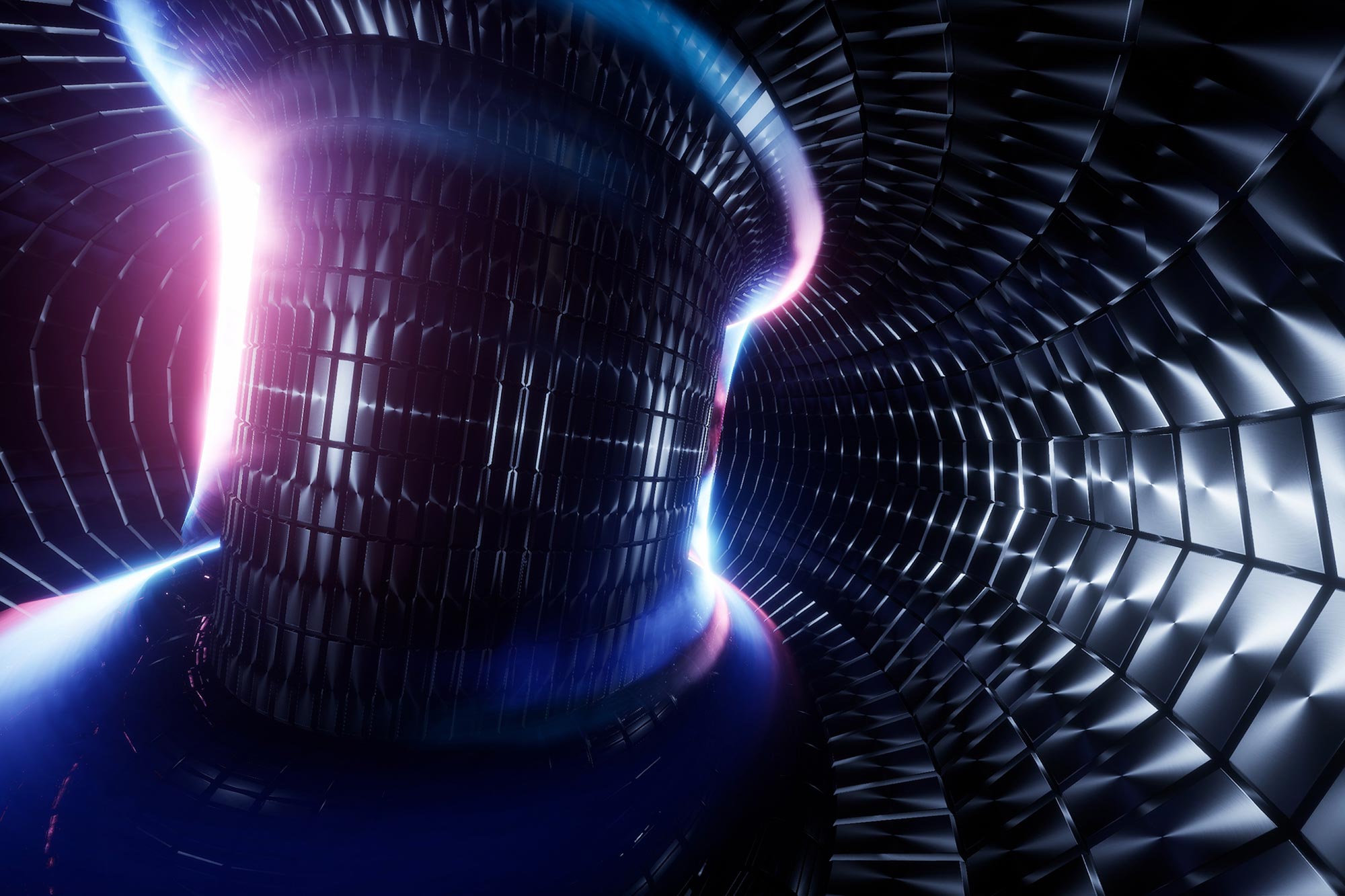
Scientists working with China’s fully superconducting Experimental Advanced Superconducting Tokamak (EAST) have reached a long-predicted state known as the “density-free regime,” where fusion plasma remains stable at densities far higher than traditional limits. The achievement marks a significant step toward solving one of fusion energy’s most persistent physical challenges. The findings were published in Science Advances on January 1.
A New High-Density Operating Strategy
The research was co-led by Prof. Ping Zhu of Huazhong University of Science and Technology and Associate Prof. Ning Yan of the Hefei Institutes of Physical Science at the Chinese Academy of Sciences. Using a newly developed high-density operating approach on EAST, the team showed that plasma density can be pushed well beyond long-accepted empirical limits without triggering the violent instabilities that typically shut down tokamak experiments.
Why Plasma Density Matters for Fusion Energy
Nuclear fusion is widely viewed as a potential source of clean, reliable energy. In deuterium-tritium fusion, the fuel must be heated to roughly 13 keV (150 million kelvin) to produce optimal reactions. At these extreme temperatures, fusion power output increases with the square of the plasma density. For decades, however, tokamak experiments have been constrained by an upper density limit. Crossing that boundary usually leads to disruptions that damage plasma confinement and threaten the stability of the device, making higher fusion performance difficult to achieve.
Plasma Wall Self-Organization Theory
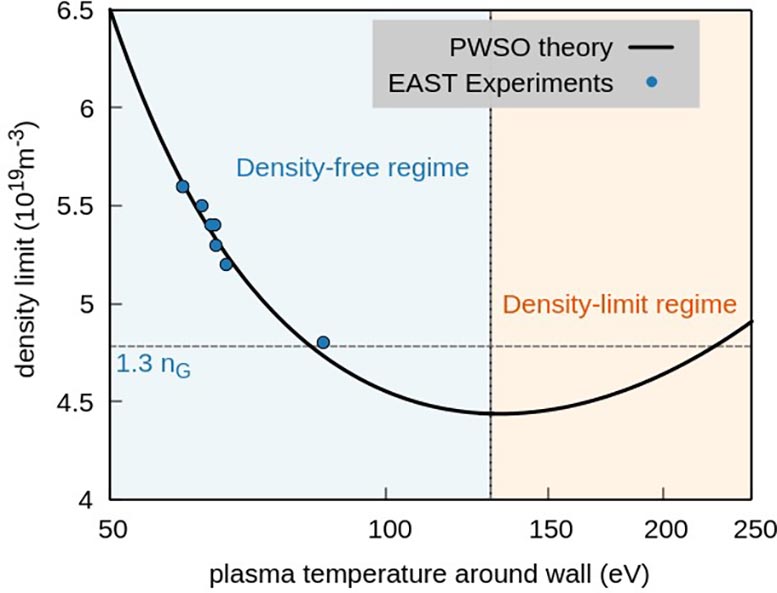
A newer theoretical framework known as plasma-wall self organization (PWSO) offers a different way to understand these limits. The concept was first proposed by D.F. Escande et al. from the French National Center for Scientific Research and Aix-Marseille University. According to the theory, a density-free regime becomes possible when the plasma and the metal walls of the reactor reach a delicate balance, particularly in systems where physical sputtering dominates plasma-wall interactions.
How EAST Reached the Density-Free Regime
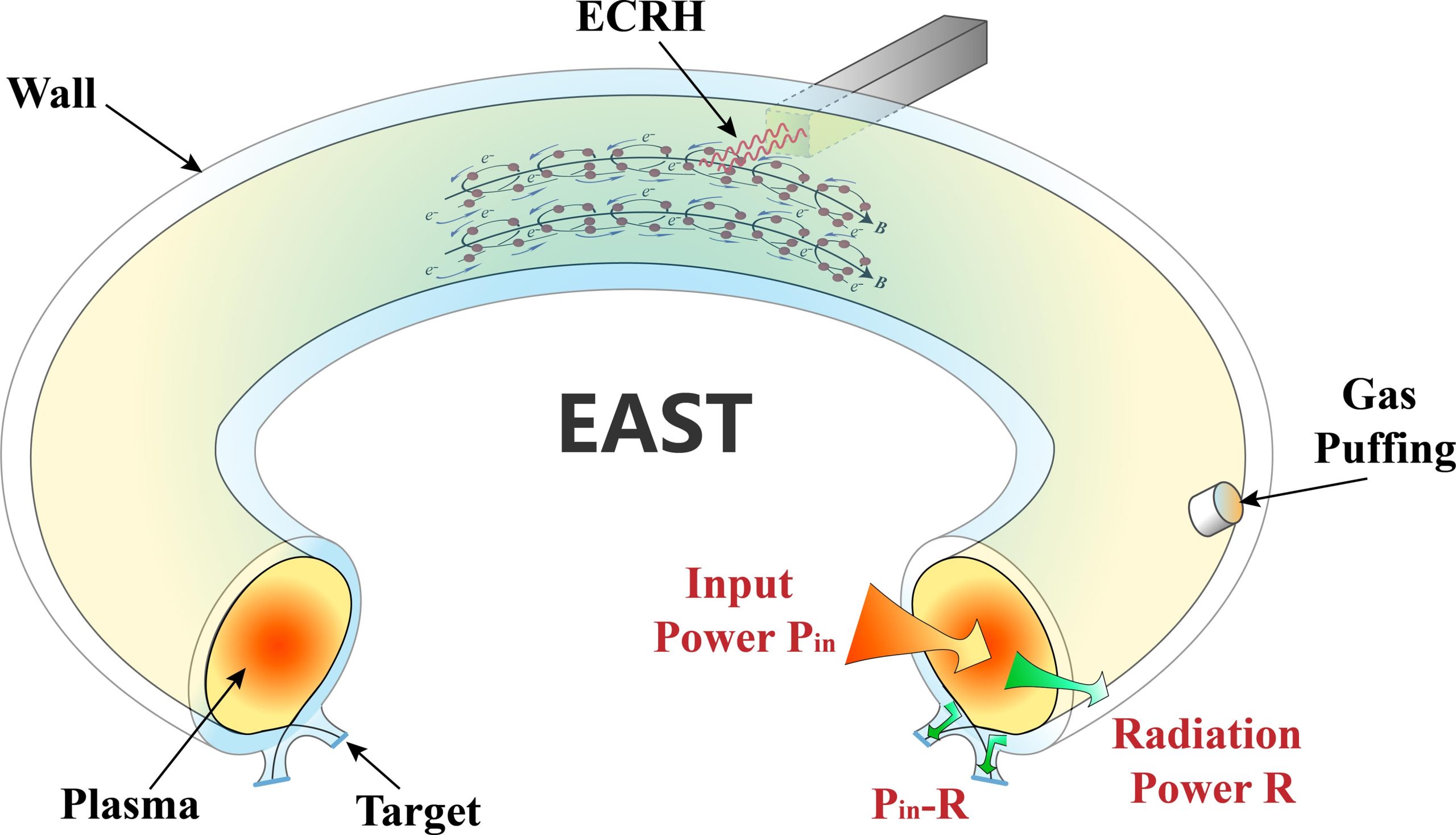
The EAST experiments provided the first experimental confirmation of this idea. Researchers carefully controlled the initial fuel gas pressure and applied electron cyclotron resonance heating during the startup phase of each plasma discharge. This early-stage control helped optimize plasma-wall interactions from the very beginning. As a result, impurity buildup and energy losses were significantly reduced, allowing the plasma density to rise steadily by the end of startup. Under these conditions, EAST successfully entered the PWSO-predicted density-free regime, where stable operation was maintained even at densities far above conventional limits.
Implications for Fusion Ignition
These results offer new insight into how the long-standing density barrier in tokamak operation might be overcome on the path toward fusion ignition.
“The findings suggest a practical and scalable pathway for extending density limits in tokamaks and next-generation burning plasma fusion devices,” said Prof. Zhu.
Associate Pro. Yan added that the team plans to apply the same method during high-confinement operation on EAST in the near future, with the goal of reaching the density-free regime under even higher performance plasma conditions.
Reference: “Accessing the density-free regime with ECRH-assisted ohmic start-up on EAST” by Jiaxing Liu, Ping Zhu, Dominique Franck Escande, Wenbin Liu, Shiwei Xue, Xin Lin, Panjun Tang, Liang Wang, Ning Yan, Jinju Yang, Yanmin Duan, Kai Jia, Zhenwei Wu, Yunxin Cheng, Ling Zhang, Jinping Qian, Rui Ding, Ruijie Zhou and the EAST team, 1 January 2026, Science Advances.
DOI: 10.1126/sciadv.adz3040
Never miss a breakthrough: Join the SciTechDaily newsletter.
Follow us on Google and Google News.
8 Comments
I recall back before Mao died PR China was a rust-bucket country dominated by violent young idiots masquerading as Red Guards. That was about 48 years ago. Amazing what education can bring about.
Thank you for your comment.
Your understanding of China is truly amazing. What you see is only the Surface, not the Essence.
Based on the Topological Vortex Theory (TVT), the sun is a complex vortex structure that can interact with different vortex systems in many ways. Temperature may not be the main physical characteristic of the sun, its electromagnetic characteristics may be more worthy of attention.
WHAT ARE THE Science Advances?
Errors or missteps in scientific inquiry are not in themselves cause for alarm. The far more concerning phenomenon is the persistent adherence to flawed premises, the continuous application of incorrect methodologies for superficial corrections, and the simultaneous opposition and resistance to fundamental, substantive improvement.
—— Excerpted from https://zhuanlan.zhihu.com/p/1991830545164959903.
A newer theoretical framework known as plasma-wall self organization (PWSO) offers a different way to understand these limits. The concept was first proposed by D.F. Escande et al. from the French National Center for Scientific Research and Aix-Marseille University. According to the theory, a density-free regime becomes possible when the plasma and the metal walls of the reactor reach a delicate balance, particularly in systems where physical sputtering dominates plasma-wall interactions.
WHY? WHY? WHY?
Please ask the researchers to think deeply:
1. What theory is your understanding based on?
2. What could happen in space if space had ideal fluid characteristics?
3. Are you producing energy or utilizing energy?
4. How do you understand momentum space?
When we pursue the ultimate truth of all things, the space in which our bodies and all things exist may itself be the final and deepest puzzle we need to explore. This is not only the pursuit of physics, but also the most magnificent exploration of the origin of the universe by human reason.
Based on the Topological Vortex Theory (TVT), space is an uniformly incompressible physical entity. Space-time vortices are the products of topological phase transitions of the tipping points in space, are the point defects in spacetime. Point defects do not only impact the thermodynamic properties, but are also central to kinetic processes. They create all things and shape the world through spin and self-organization.
In today’s physics, some so-called peer-reviewed journals—including Physical Review Letters, Nature, Science, and others—stubbornly insist on and promote the following:
1. Even though θ and τ particles exhibit differences in experiments, physics can claim they are the same particle. This is science.
2. Even though topological vortices and antivortices have identical structures and opposite rotational directions, physics can define their structures and directions as entirely different. This is science.
3. Even though two sets of cobalt-60 rotate in opposite directions and experiments reveal asymmetry, physics can still define them as mirror images of each other. This is science.
4. Even though vortex structures are ubiquitous—from cosmic accretion disks to particle spins—physics must insist that vortex structures do not exist and require verification. Only the particles that like God, Demonic, or Angelic are the most fundamental structures of the universe. This is science.
5. Even though everything occupies space and maintains its existence in time, physics must still debate and insist on whether space exists and whether time is a figment of the human mind. This is science.
6. Even though space, with its non-stick, incompressible, and isotropic characteristics, provides a solid foundation for the development of physics, physics must still insist that the ideal fluid properties of space do not exist. This is science.
and go on.
Is this the counterintuitive science they widely promote? Compromising with pseudo academic publications and peer review by pseudo scholars is an insult to science and public intelligence. Some so-called scholars no longer understand what shame is. The study of Topological Vortex Theory (TVT) reminds us that the most profound problems in physics often lie at the intersection of different theories. By exploring these border regions, we can not only resolve contradictions in existing theories but also discover new physical phenomena and application possibilities.
Under the topological vortex architecture, it is highly challenging for even two hydrogen atoms or two quarks to be perfectly symmetrical, let alone counter-rotating two sets of cobalt-60. Contemporary physics and so-called peer-reviewed publications (including Physical Review Letters, Science, Nature, etc.) stubbornly believe that two sets of counter rotating cobalt-60 are two mirror images of each other, constructing a more shocking pseudoscientific theoretical framework in the history of science than the “geocentric model”. This pseudo scientific framework and system have seriously hindered scientific progress and social development.
For nearly a century, physics has been manipulated by this pseudo scientific theoretical system and the interest groups behind it, wasting a lot of manpower, funds, and time. A large amount of pseudo scientific research has been conducted, and countless pseudo scientific papers have been published, causing serious negative impacts on scientific and social progress, as well as humanistic development.
Complexity does not necessarily mean that there is no logical and architectural framework to follow. Mathematics is the language and tool that reveals the motion of spacetime, rather than the motion itself. Although the physical form of spacetime vortices is extremely simple, their interaction patterns are highly complex, and we must develop more and richer mathematical languages to describe and understand them.
The development of the Topological Vortex Theory (TVT) reflects a progression from concrete physical phenomena to abstract mathematical modeling and, ultimately, to interdisciplinary unification. Its core innovation lies in forging the continuous spacetime geometry of general relativity with the discrete interactions of quantum field theory within the same topological dynamical system. The core idea of TVT — space is physical, and matter is its topological excitation—already provides a solid and elegant scientific path for understanding the origin of all things.
——Excerpted from https://scitechdaily.com/microscope-spacecrafts-most-precise-test-of-key-component-of-the-theory-of-general-relativity/#comment-909171 and https://t.pineal.cn/blogs/6255/A-Mathematical-and-Physical-Analysis-On-the-Origin-of-Objects.
thanks for this
Thank you for browsing and commenting.
The development and progress of science and technology cannot be separated from every person who truly cares about and loves science.