
Pioneering Quantum Network Spanning Thousands of Kilometers
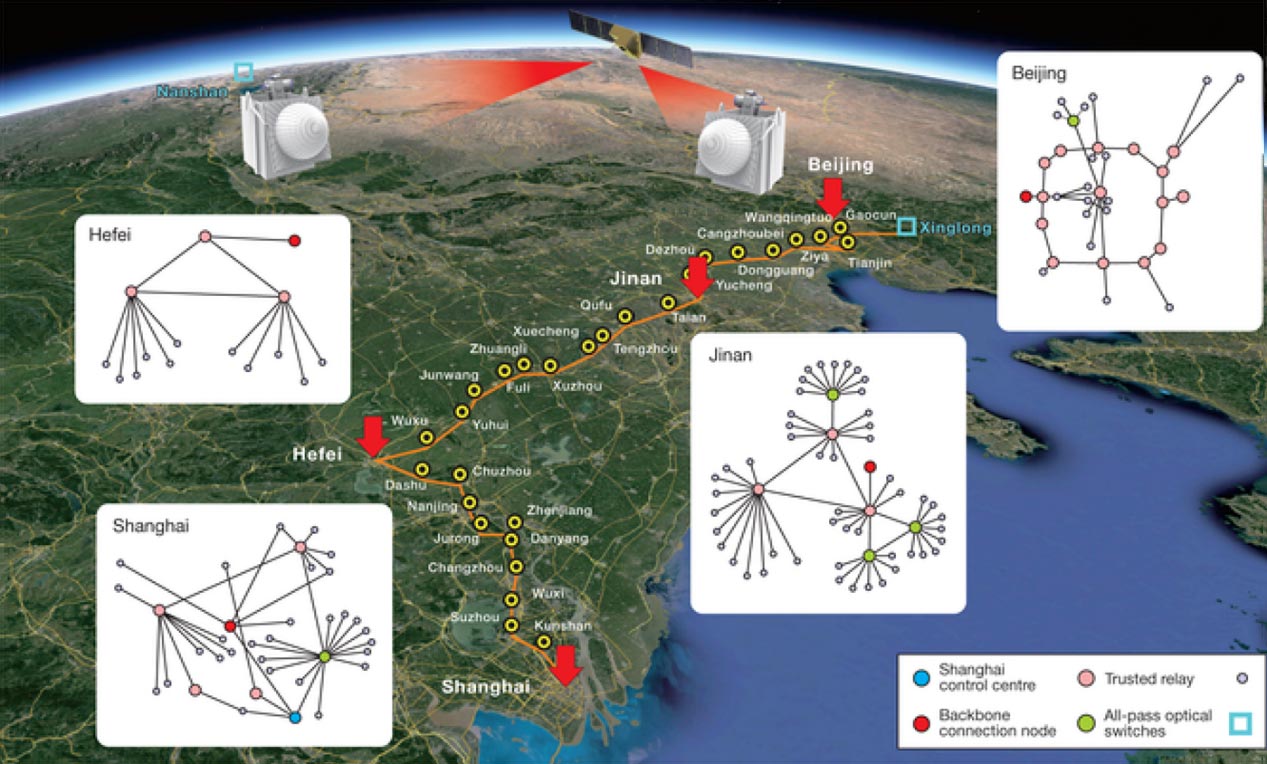
Chinese scientists have established the world’s first integrated quantum communication network, combining over 700 optical fibers on the ground with two ground-to-satellite links to achieve quantum key distribution over a total distance of 4,600 kilometers (2,860 miles) for users across the country. The team, led by Jianwei Pan, Yuao Chen, Chengzhi Peng from the University of Science and Technology of China in Hefei, reported in Nature their latest advances toward the global, practical application of such a network for future communications.
Combining Satellite and Fiber-Based QKD for Nationwide Use
Unlike conventional encryption, quantum communication is considered unhackable and therefore the future of secure information transfer for banks, power grids and other sectors. The core of quantum communication is quantum key distribution (QKD), which uses the quantum states of particles — e.g. photons — to form a string of zeros and ones, while any eavesdropping between the sender and the receiver will change this string or key and be noticed immediately. So far, the most common QKD technology uses optical fibers for transmissions over several hundred kilometers, with high stability but considerable channel loss. Another major QKD technology uses the free space between satellites and ground stations for thousand-kilometer-level transmissions. In 2016, China launched the world’s first quantum communication satellite (QUESS, or Mozi/Micius) and achieved QKD with two ground stations which are 2,600 km (1,600 mi) apart. In 2017, an over 2,000-km-long (1,240-mi-long) optical fiber network was completed for QKD between Beijing and Shanghai.
Using trusted relays, the ground-based fiber network and the satellite-to-ground links were integrated to serve more than 150 industrial users across China, including state and local banks, municipal power grids, and e-government websites. “Our work shows that quantum communication technology is sufficiently mature for large-scale practical applications,” said Jianwei Pan, Professor of USTC. Similarly, a global quantum communication network can be established if national quantum networks from different countries are combined, and if universities, institutions, and companies come together to standardize related protocols, hardware, etc., he added.
In the last couple of years, the team extensively tested and improved the performance of different parts of the integrated network. For instance, with an increased clock rate and more efficient QKD protocol, the satellite-to-ground QKD now has an average key generation rate of 47.8 kilobits per second, which is 40 times higher than the previous rate. The researchers have also pushed the record for ground-based QKD to beyond 500 km (310 mi) using a new technology called twin-field QKD (TF-QKD).
Next up, the team will further expand the network in China and with their international partners from Austria, Italy, Russia, and Canada. They also aim to develop small-scale, cost-efficient QKD satellites and ground-based receivers, as well as medium and high earth orbit satellites to achieve all-time, ten-thousand-km-level QKD.
Reference: “An integrated space-to-ground quantum communication network over 4,600 kilometres” by Yu-Ao Chen, Qiang Zhang, Teng-Yun Chen, Wen-Qi Cai, Sheng-Kai Liao, Jun Zhang, Kai Chen, Juan Yin, Ji-Gang Ren, Zhu Chen, Sheng-Long Han, Qing Yu, Ken Liang, Fei Zhou, Xiao Yuan, Mei-Sheng Zhao, Tian-Yin Wang, Xiao Jiang, Liang Zhang, Wei-Yue Liu, Yang Li, Qi Shen, Yuan Cao, Chao-Yang Lu, Rong Shu, Jian-Yu Wang, Li Li, Nai-Le Liu, Feihu Xu, Xiang-Bin Wang, Cheng-Zhi Peng and Jian-Wei Pan, 6 January 2021, Nature.
DOI: 10.1038/s41586-020-03093-8
Their work was supported by the National Development and Reform Commission of China, the provincial/municipal government of Shandong, Anhui, and Shanghai, China Banking Regulatory Commission, the Chinese Academy of Sciences, the Ministry of Science and Technology of China, and the National Science Foundation of China.
Never miss a breakthrough: Join the SciTechDaily newsletter.
Follow us on Google and Google News.
1 Comment
Could you revise the quote part? It is not precise. The version in EurekAlert! is different.
The sentence “”Our work shows that quantum communication technology is sufficiently mature for large-scale practical applications,” said Jianwei Pan, Professor of USTC.”
should be replaced by “This work shows that quantum communication technology can be used for future large-scale practical applications.”
And “he added” at the end of the paragraph should be deleted.
Here is the right version source link:https://www.eurekalert.org/pub_releases/2021-01/uosa-twf010521.php