

However, Speeding the Transition Might Nearly Cancel the Effect
First, the bad news: Nothing is free. Moving the world energy system away from fossil fuels and into renewable sources will generate carbon emissions by itself, as construction of wind turbines, solar panels, and other new infrastructure consumes energy—some of it necessarily coming from the fossil fuels we are trying to get rid of. The good news: If this infrastructure can be put online quickly, those emissions would dramatically decrease, because far more renewable energy early on will mean far less fossil fuel needed to power the changeover.
This is the conclusion of a study that for the first time estimates the cost of a green transition not in dollars, but in greenhouse gases. The study was recently published in the Proceedings of the National Academy of Sciences.
“The message is that it is going to take energy to rebuild the global energy system, and we need to account for that,” said lead author Corey Lesk, who did the research as a Ph.D. student at the Columbia Climate School’s Lamont-Doherty Earth Observatory. “Any way you do it, it’s not negligible. But the more you can initially bring on renewables, the more you can power the transition with renewables.”
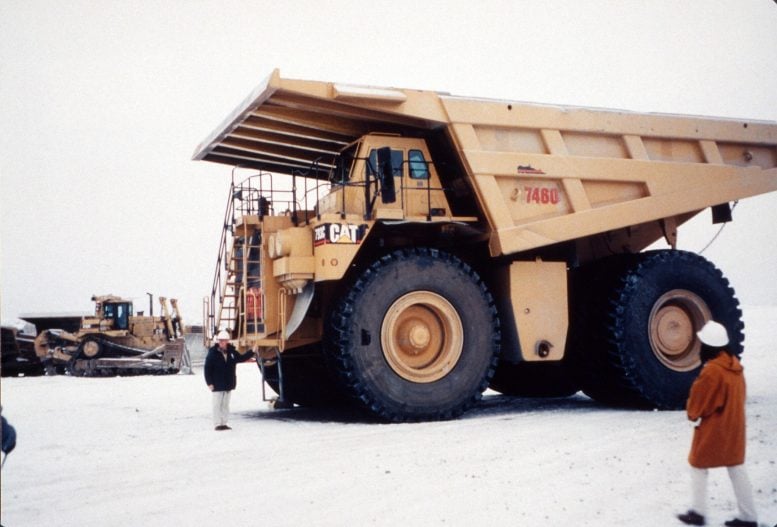
The researchers calculated the possible emissions produced by energy use in mining, manufacturing, transport, construction and other activities needed to create massive farms of solar panels and wind turbines, along with more limited infrastructure for geothermal and other energy sources. Previous research has projected the cost of new energy infrastructure in dollars—$3.5 trillion a year every year until 2050 to reach net-zero emissions, according to one study, or up to about $14 trillion for the United States alone in the same period, according to another. The new study appears to be the first to project the cost in greenhouse gases.
Emission Estimates Based on Transition Speed
On the current slow pace of renewable infrastructure production (predicted to lead to 2.7 degrees C or 4.9 degrees F warming by the end of the century), the researchers estimate these activities will produce 185 billion tons of carbon dioxide by 2100. This alone is equivalent to five or six years of current global emissions—a hefty added burden on the atmosphere. However, if the world builds the same infrastructure fast enough to limit warming to 2 degrees—current international agreement aims to come in under this—those emissions would be halved to 95 billion tons. And, if a truly ambitious path were followed, limiting warming to 1.5 degrees (2.7 degrees F), the cost would be only 20 billion tons by 2100—just six months or so of current global emissions.
The researchers point out that all their estimates are probably quite low. For one, they do not account for materials and construction needed for new electric-transmission lines, nor batteries for storage—both highly energy- and resource-intensive products. Nor do they include the cost of replacing gas- and diesel- powered vehicles with electric ones, or making existing buildings more energy efficient. The study also looks only at carbon-dioxide emissions, which currently cause about 60 percent of ongoing warming—not other greenhouse gases including methane and nitrous oxide.
Challenges in Resource Use and Ecosystem Impact
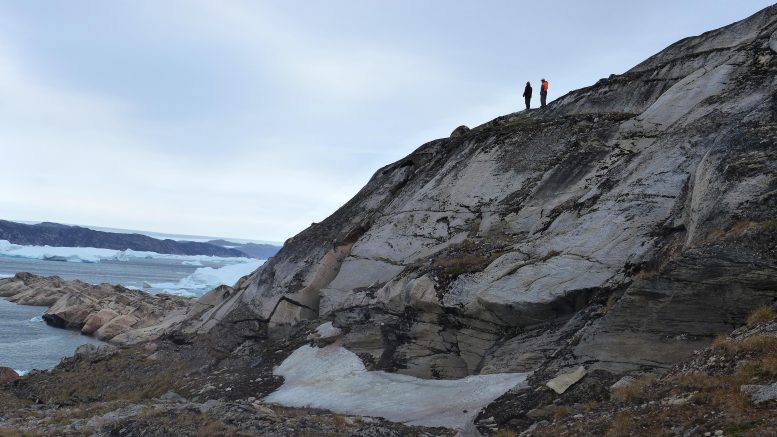
Other effects of the move to renewables are hard to quantify, but could be substantial. All this new high-tech hardware will require not just massive amounts of base metals including copper, iron and nickel, but previously lesser-used rare elements such as lithium, cobalt, yttrium and neodymium. Many commodities would probably have to come from previously untouched places with fragile environments, including the deep sea, African rain forests and fast-melting Greenland. Solar panels and wind turbines would directly consume large stretches of land, with attendant potential effects on ecosystems and people living there.
“We’re laying out the bottom bound,” said Lesk of the study’s estimates. “The upper bound could be much higher.” But, he says, “the result is encouraging.” Lesk said that given recent price drops for renewable technologies, 80 to 90 percent of what the world needs could be installed in the next few decades, especially if current subsidies for fossil-fuel production are diverted to renewables. “If we get on a more ambitious path, this whole problem goes away. It’s only bad news if we don’t start investing in the next 5 to 10 years.”
Adaptation Emissions from Sea-Level Rise
As part of the study, Lesk and his colleagues also looked at carbon emissions from adapting to sea-level rise; they found that construction of sea walls and moving cities inland where necessary would generate 1 billion tons of carbon dioxide by 2100 under the 2-degree scenario. This, again, would be only part of the cost of adaptation; they did not look at infrastructure to control inland flooding, irrigation in areas that might become drier, adapting buildings to higher temperatures or other needed projects.
“Despite these limitations, we conclude that the magnitude of CO2 emissions embedded in the broader climate transition are of geophysical and policy relevance,” the authors write. “Transition emissions can be greatly reduced under faster-paced decarbonization, lending new urgency to policy progress on rapid renewable energy deployment.”
Reference: “Mitigation and adaptation emissions embedded in the broader climate transition” by Corey Lesk, Denes Csala, Robin Hasse, Sgouris Sgouridis, Antoine Levesque, Katharine J. Mach, Daniel Horen Greenford, H. Damon Matthews and Radley M. Horton, 21 November 2022, Proceedings of the National Academy of Sciences.
DOI: 10.1073/pnas.2123486119
The other authors of the study are Denes Csala of the United Kingdom’s University of Lancaster; Robin Krekeler and Antoine Levesque of Germany’s Potsdam Institute for Climate Impacts Research; Sgouris Sgouridis of the Dubai Electricity and Water Authority; Katharine Mach of the University of Miami; Daniel Horen Greenford and H. Damon Matthews of Canada’s Concordia University; and Radley Horton of Lamont-Doherty Earth Observatory. Corey Lesk is now a postdoctoral researcher at Dartmouth College.
Never miss a breakthrough: Join the SciTechDaily newsletter.
Follow us on Google and Google News.
2 Comments
“However, if the world builds the same infrastructure fast enough to limit warming …” The reality is, because of studies and permits required, it typically takes at least a decade to get the infrastructure in place to start mining. Unless society is willing to take shortcuts and expedite permitting, it will take more than a decade to even start to see increased production. Then, there is the issue of conflict of interests. What is now called the Pebble Mine, in Alaska, was first discovered in 1988, it has still not been permitted for production and it is beginning to look like it will never produce any ore, despite having been called “one of the greatest stores of mineral wealth ever discovered, and the world’s largest undeveloped copper and gold resource”. Different priorities can, and often do, prevent mines from being developed. The article states, “If we get on a more ambitious path, this whole problem goes away. It’s only bad news if we don’t start investing in the next 5 to 10 years.” Guess what? It is almost certainly going to take more than 10 years to get started!
“The researchers point out that all their estimates are probably quite low.” Absolutely. As demands for scarce raw materials increases, the costs will inevitably increase. Furthermore, as high-grade deposits are exhausted, we will have to turn to ever lower grade deposits. That means bigger holes in the ground with energy requirements growing geometrically, not linearly, for the same amount of metal. That is energy necessary for blasting rock, hauling ore and waste rock out of the pit(s), and crushing the ore to a very fine size. Then there are the environmental costs of ever larger pits and piles of expanded waste rock that will undoubtedly result in political push back against new projects.
It isn’t a simple problem, and I don’t think that any of the political ‘leaders’ advocating “net zero” are even aware of the many technological, economic, and political barriers that will have to be overcome.
Another example that the left hand doesn’t care what the right hand is doing. The current administration is pushing for electrification, which requires copper and cobalt with current technology:
https://news.yahoo.com/us-moves-protect-minnesota-wilderness-190212552.html