
Close Menu
    Facebook X (Twitter) Instagram
    SciTechDaily
    • Biology
    • Chemistry
    • Earth
    • Health
    • Physics
    • Science
    • Space
    • Technology
    Facebook X (Twitter) Pinterest YouTube RSS
    SciTechDaily
    Home»Space»The Most Complete and Detailed X-Ray View of Puppis A
    Space

    The Most Complete and Detailed X-Ray View of Puppis A

    By NASASeptember 10, 2014No Comments2 Mins Read
    Facebook Twitter Pinterest Telegram LinkedIn WhatsApp Email Reddit
    Share
    Facebook Twitter LinkedIn Pinterest Telegram Email Reddit
    Most Complete and Detailed X-Ray View of Puppis A
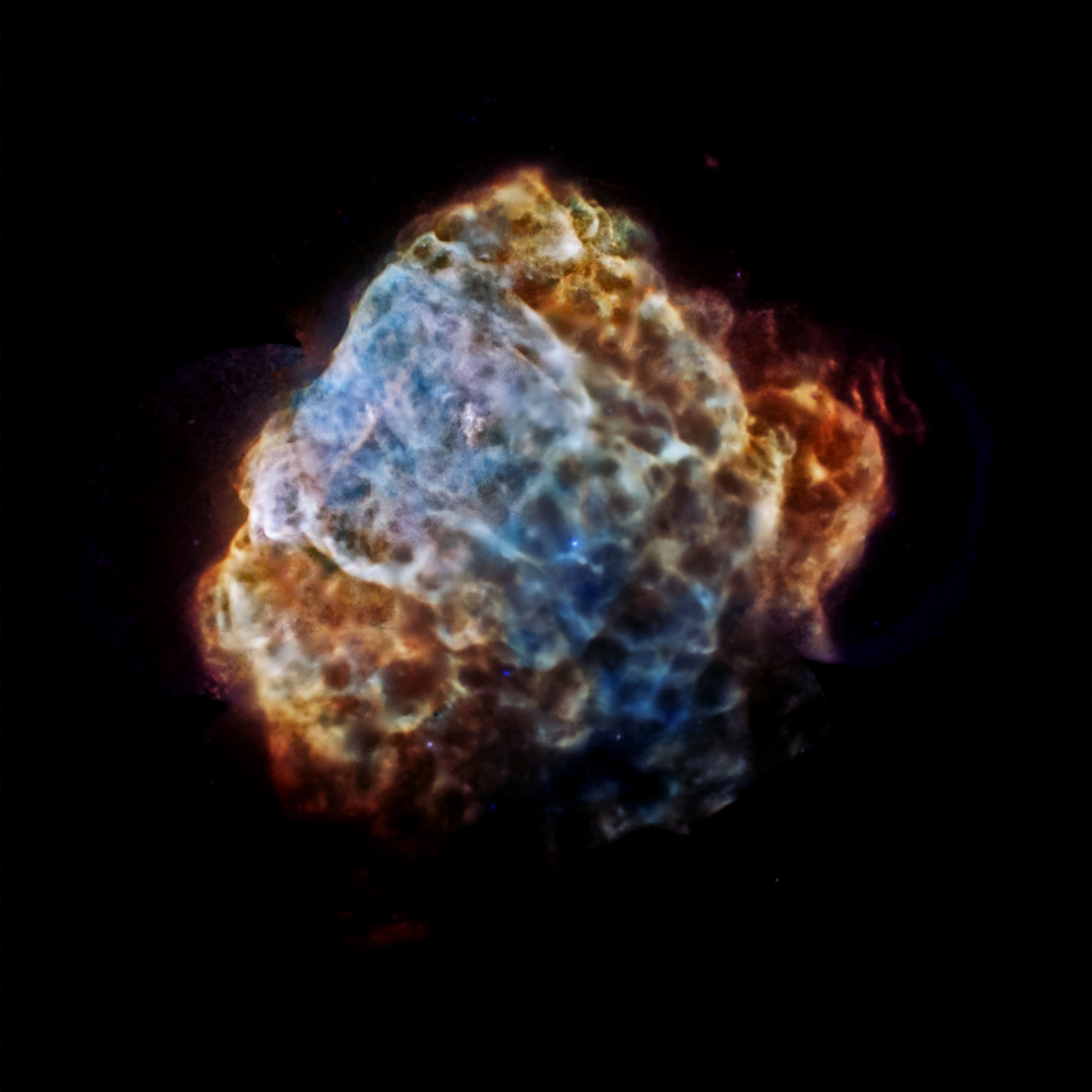
    The new image of Puppis A supernova remnant, using data from Chandra and XMM-Newton, provides the most detailed X-ray view to date. It unveils the intricate X-ray patterns resulting from the explosion. Credit: NASA/CXC/IAFE/G.Dubner et al & ESA/XMM-Newton

    This new image of supernova remnant Puppis A includes data from Chandra and XMM-Newton and is the most complete and detailed X-ray view to date, revealing a delicate tapestry of X-ray light left behind by the supernova explosion.

    The destructive results of a powerful supernova explosion reveal themselves in a delicate tapestry of X-ray light, as seen in this image from NASA’s Chandra X-Ray Observatory and the European Space Agency’s XMM-Newton.

    The image shows the remains of a supernova that would have been witnessed on Earth about 3,700 years ago. The remnant is called Puppis A, and is around 7,000 light-years away and about 10 light-years across. This image provides the most complete and detailed X-ray view of Puppis A ever obtained, made by combining a mosaic of different Chandra and XMM-Newton observations. Low-energy X-rays are shown in red, medium-energy X-rays are in green, and high-energy X-rays are colored blue.

    These observations act as a probe of the gas surrounding Puppis A, known as the interstellar medium. The complex appearance of the remnant shows that Puppis A is expanding into an interstellar medium that probably has a knotty structure.

    Supernova explosions forge the heavy elements that can provide the raw material from which future generations of stars and planets will form. Studying how supernova remnants expand into the galaxy and interact with other materials provides critical clues into our own origins.

    A paper describing these results was published in Astronomy and Astrophysics. The first author is Gloria Dubner from the Instituto de Astronomía y Física del Espacio in Buenos Aires, Argentina.

    Reference: “The most complete and detailed X-ray view of the SNR Puppis A” by G. Dubner, N. Loiseau, P. Rodriguez-Pascual, M.J.S. Smith, E. Giacani and G. Castelletti, 18 June 2013, Astronomy & Astrophysics.
    DOI: 10.1051/0004-6361/201321401
    arXiv: 1305.1275
    PDF


    Never miss a breakthrough: Join the SciTechDaily newsletter.
    Follow us on Google and Google News.

    Astronomy Astrophysics Chandra X-ray Observatory XMM-Newton
    Share. Facebook Twitter Pinterest LinkedIn Email Reddit

    Related Articles

    Supermassive Black Holes Defy Physics to Become Cosmic Titans

    Ripped Apart: A Gigantic Black Hole Destroys a Massive Star

    Mysterious ASASSN-14li: Massive Star Obliterated by a Giant Black Hole

    Unusual X-Ray Activity Detected As Object Is Roasted and Shredded by a Stellar Sidekick

    Roasted and Shredded by a Stellar Sidekick: Astronomers Find White Dwarf Blasting a Companion Object

    Astronomers Measure Distant Black Hole’s Spin

    Astronomers View Eclipsing Double White Dwarf System

    Astronomers Discover Enormous Arms of Hot Gas in the Coma Cluster of Galaxies

    Diagnosing the X-Ray Variability in Active Galaxy NGC 4507

    Leave A Reply Cancel Reply

    • Facebook
    • Twitter
    • Pinterest
    • YouTube

    Don't Miss a Discovery

    Subscribe for the Latest in Science & Tech!

    Trending News

    Enormous Prehistoric Insects Puzzle Scientists

    Scientists Develop Bioengineered Chewing Gum That Could Help Fight Oral Cancer

    After 37 Years, the World’s Longest-Running Soil Warming Experiment Uncovers a Startling Climate Secret

    NASA Satellite Captures First-Ever High-Res View of Massive Pacific Tsunami

    ADHD Isn’t Just a Deficit: Study Reveals Powerful Hidden Strengths

    Scientists Discover Stem Cells That Could Regrow Teeth and Bone

    Early Cannabis Use May Stall Key Brain Skills in Teens

    Popular Vitamin D Supplement Has “Previously Unknown” Negative Effect, Study Finds

    Follow SciTechDaily
    • Facebook
    • Twitter
    • YouTube
    • Pinterest
    • Newsletter
    • RSS
    SciTech News
    • Biology News
    • Chemistry News
    • Earth News
    • Health News
    • Physics News
    • Science News
    • Space News
    • Technology News
    Recent Posts
    • Beyond Inflammation: Scientists Uncover New Cause of Persistent Rheumatoid Arthritis
    • Cancer-Like Mutations Found in the Brain May Be Driving Alzheimer’s Disease
    • A Simple Molecule Could Unlock Safer, Easier Weight Loss
    • Stretching Diamonds Unlocks Powerful New Quantum Sensing Abilities
    • This Robot Could Explore Mars 3x Faster Than Today’s Rovers
    Copyright © 1998 - 2026 SciTechDaily. All Rights Reserved.
    • Science News
    • About
    • Contact
    • Editorial Board
    • Privacy Policy
    • Terms of Use

    Type above and press Enter to search. Press Esc to cancel.