
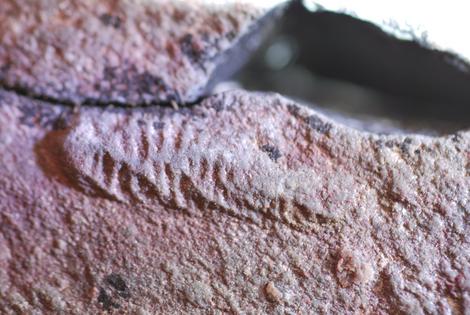
Found in rocks at the Mistaken Point Ecological Reserve, researchers discovered over 100 fossils of what are believed to be “baby” rangeomorphs that lived 580-550 million years ago.
A volcanic eruption around 579 million years ago buried a “nursery” of the earliest-known animals under a Pompeii-like deluge of ash, preserving them as fossils in rocks in Newfoundland, new research suggests.
A team from the Universities of Oxford and Cambridge, in collaboration with the Memorial University of Newfoundland, looked for evidence of life from the mysterious Ediacaran period (635-542 million years ago) in which the first ‘animals’ – complex multicellular organisms –appeared.
The team discovered over 100 fossils of what are believed to be “baby” rangeomorphs; bizarre frond-shaped organisms which lived 580-550 million years ago and superficially resemble sea-pen corals but, on closer inspection, are unlike any creature alive today. This ‘nursery’ of baby rangeomorphs was found in rocks at the Mistaken Point Ecological Reserve in Newfoundland, Canada.
A report of the research appears in the July issue of the Journal of the Geological Society.
The fossil remains of rangeomorphs are often described as ‘fern-like’ and where exactly they fit in the tree of life is unclear. Because they lived deep beneath the ocean where there would have been no light they are not thought to be plants but they may not have had all of the characteristics of animals. Mysteriously, their frond-shaped body-plan, which might have helped them gather oxygen or food, did not survive into the Cambrian period (542-488 million years ago).
“The fossilized babies we found are all less than three centimeters long and are often as small as six millimeters; many times smaller than the parent forms, seen in neighboring areas, which can reach up to two meters in length,” said Professor Martin Brasier of Oxford University’s Department of Earth Sciences, one of the authors of the report. ‘This new discovery comes from the very bottom of the fossil-bearing rocks, making it one of the oldest bedding planes to preserve ‘animal’ fossils in the whole of the geological record.
“We think that, around 579 million years ago, an underwater nursery of baby Ediacaran fronds was overwhelmed, Pompeii-style, by an ash fall from a volcanic eruption on a nearby island that smothered and preserved them for posterity.”
Dr. Alexander Liu of Cambridge University’s Department of Earth Sciences, an author of the report, said: “These juveniles are exceptionally well preserved, and include species never before found in rocks of this age, increasing the known taxonomic diversity of the earliest Ediacaran fossil sites. The discovery confirms a remarkable variety of rangeomorph fossil forms so early in their evolutionary history.”
The find reinforces the idea that “life got large” around 580 million years ago, with the advent of these frond-like forms, some of which grew up – in better times – to reach almost two meters in length. Professor Brasier said: “We are now exploring even further back in time to try and discover exactly when these mysterious organisms first appeared and learn more about the processes that led to their diversification in an Ediacaran explosion that may have mirrored the profusion of new life forms we see in the Cambrian.”
Reference: “A new assemblage of juvenile Ediacaran fronds from the Drook Formation, Newfoundland” by Alexander G. Liu, Duncan McIlroy, Jack J. Matthews and Martin D. Brasier, 1 July 2012, Journal of the Geological Society.
DOI: 10.1144/0016-76492011-094
A report of the research, entitled “A new assemblage of juvenile Ediacaran fronds from the Drook Formation, Newfoundland” is published in the July issue of the Journal of the Geological Society. The research team consisted of Professor Martin Brasier and Jack Matthews of Oxford University, Dr Alex Liu of Cambridge University, and Professor Duncan McIlroy of Memorial University of Newfoundland.
Never miss a breakthrough: Join the SciTechDaily newsletter.
Follow us on Google and Google News.