
A new study details how scientists developed the conceptual nuclear reactor design of high plutonium breeding by light water cooling, which may help advanced countries meet the growth rate of energy demand.
Professor Oka’s research team has successfully developed the world’s first conceptual nuclear reactor design with high plutonium breeding, utilizing light water cooling. He devised a new fuel assembly where fuel rods are closely packed for reducing reactor coolant to fuel volume fraction for high breeding. With computational analysis, he succeeded in high plutonium breeding with light water cooling. The study will open the way for commercialization of fast reactors and nuclear fuel cycles for the peaceful use of nuclear energy based on the mature light water cooling technologies. The result of the study was published in the January issue of Journal of Nuclear Science and Technology of Atomic Energy Society of Japan (AESJ), entitled “Plutonium breeding of light water cooled fast reactors.”
Introduction
Fast Breeder reactors (FBR) produce more fissile material than consuming, while producing electric power. It is a “dream of nuclear power”. The main line of FBR development is the liquid metal-cooled fast breeder reactor (LMFBR). It is, however, not yet commercialized because of the complexity of the plant due to using liquid sodium as the coolant.
High plutonium breeding by light water cooling has been studied for many years, but not yet attained. Nuclear power plants and fossil-fired power plants use water as the coolant. It is good to develop a fast breeder reactor based on the experience of water coolant technologies.
Commercialization of nuclear fuel cycle and fast breeder reactors are important for reducing the amount of spent nuclear fuel of light water reactors (LWR) as well as the efficient utilization of uranium resources. Nuclear power utilization is in progress in many developing countries. Commercialization of spent nuclear fuel reprocessing in advanced countries enhances nuclear security in the world.
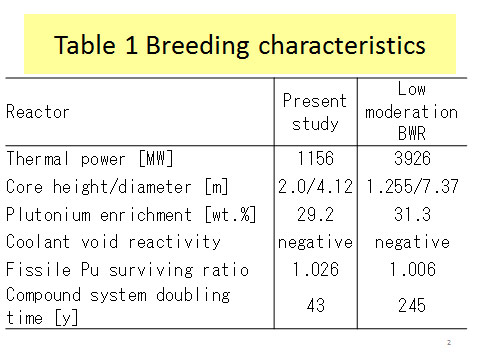
High-conversion light water reactors have been studied for many years since 1970 at research institutes and industry in Japan. The highest breeding characteristics were reported by the conceptual design study of the doubly axial heterogeneous core of a reduced moderation boiling water reactor (RMWR). The compound system doubling time (CSDT) was, however, approximately 245 years. It is substantially longer than that of LMFBR.
New concept
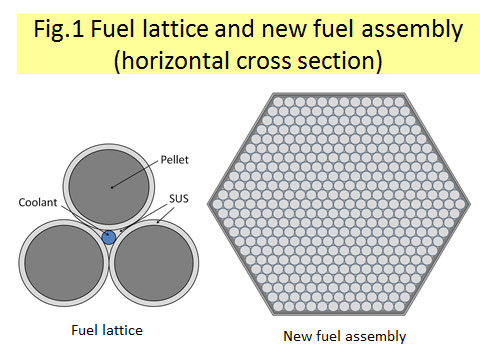
Breeding characteristics increase with decreasing the water-to-fuel volume ratio. Tight fuel lattice with narrow gap between fuel rods was adopted for RMWR. To further decrease the water-to-fuel volume fraction, a new fuel assembly of closely packed fuel rods was devised. The new fuel assembly and its fuel lattice consisting of three fuel rods are depicted in Fig.1. The coolant flows through the central hole of the fuel lattice. The integrity or the leak tightness of the fuel rod is maintained as the conventional fuel rod where both ends of the fuel cladding tube are welded by end plugs.
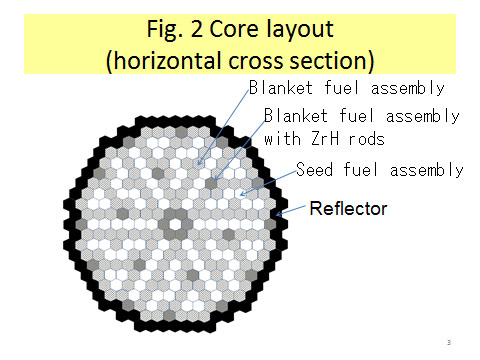
The reactor design was carried out by computational methods for the cores with new fuel assemblies. The highest breeding characteristics are obtained for the core layout of the fuel assemblies in Fig. 2. The comparison of the characteristics with the RMWR is given in Table 1. The compound system doubling time is 43 years. It is substantially shorter than that of RMWR, 245 years.
Goal of breeding characteristics
The energy demand increases with the gross domestic product (GDP). The growth rate of GDP of the seven advanced countries of OECD is 1.4% per year in 10 years. With this growth rate, the GDP will double in 50 years and the energy demand does. The breeding characteristic of Table1 is 43 years, shorter than 50 years. It means that the fast breeder reactors with the new fuel assembly meet the goal of energy demand growth of advanced countries.
Future Research and Development items
Reactor design of boiling water reactor (BWR) condition, safety design, evaluation, development of the new fuel assembly including testing, demonstration with a prototype reactor.
Social impacts
High breeding with water cooling technology will open the way for commercializing nuclear fuel cycle and fast breeder reactors. It made it possible to reduce the amount of spent LWR fuels, to enhance the deployment and the security of peaceful uses of nuclear power in developing countries.
Reference: “Plutonium breeding of light water cooled fast reactors” by Yoshiaki Oka, Takashi Inoue and Taishi Yoshida, 21 December 2012, Journal of Nuclear Science and Technology.
DOI: 10.1080/00223131.2013.750053
Never miss a breakthrough: Join the SciTechDaily newsletter.
Follow us on Google and Google News.
1 Comment
The British tried and failed with Dounreay. Bits of Plutonium floating around the reactor site. All about safety really. Which is more dangerous ? A liquid coolant (why Sodium?) or a boiling one (water). I suppose the thermal efficiency of cooling is important. The thoroughness of the development process must be very very high. As long as thermal runaway is not an option, must be fail safe. Good luck with your choice of site. Not like hosting the Olympics.