
Close Menu
    Facebook X (Twitter) Instagram
    SciTechDaily
    • Biology
    • Chemistry
    • Earth
    • Health
    • Physics
    • Science
    • Space
    • Technology
    Facebook X (Twitter) Pinterest YouTube RSS
    SciTechDaily
    Home»Space»Coronal Mass Ejections Accelerate and Concentrate Nanodust Particles
    Space

    Coronal Mass Ejections Accelerate and Concentrate Nanodust Particles

    By Harvard-Smithsonian Center for AstrophysicsMarch 10, 2015No Comments3 Mins Read
    Facebook Twitter Pinterest Telegram LinkedIn WhatsApp Email Reddit
    Share
    Facebook Twitter LinkedIn Pinterest Telegram Email Reddit
    Nanodust Observations by the Solar Terrestrial Relations Observatory
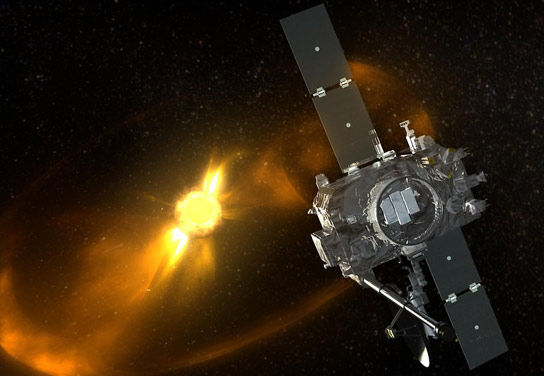
    The STEREO (Solar TErrestrial RElations Observatory) spacecraft in an artist’s conception, also showing a coronal mass ejection. Credit: NASA

    A team of astronomers has discovered that coronal mass ejections accelerate and concentrate nanodust particles in the interplanetary medium, a conclusion derived from STEREO instruments that observed an increase in the rate of nanodust impacts on the spacecraft.

    Dust particles smaller than about a wavelength of light are abundant in our solar system, created by collisions between asteroids and from the evaporation of comets. As they scatter sunlight, these particles produce the zodiacal light, the glow in the night sky that stretches along the zodiac. The zodiacal light is most easily seen after sunset or before sunrise, though it is faint enough that even moonlight can mask it. Nanodust particles are about ten times smaller than normal dust — too small to efficiently scatter sunlight. They can be sensed by spacecraft, however, because when they impact the spacecraft they generate puffs of ionized gas and electrical pulses that instruments can detect. The Solar TErrestrial RElations Observatory (STEREO) spacecraft has been detecting nanodust pulses since its launch in 2007, and previous studies of these events have confirmed the general picture that these tiny particles are an important constituent of the solar system.

    The corona of the Sun, the hot (over a million kelvin), gaseous outer region of its atmosphere, is threaded by intense magnetic fields. The fields loop and twist, stirred by the motions of the hot gas in the underlying atmosphere. When these loops snap, they eject energetic charged particles into the solar wind in events called coronal mass ejections. Nanodust particles carry a slight electric charge, and because of that, the solar wind should be able to redistribute them as it blows toward Earth through interplanetary space. CfA astronomer Gaetan Le Chat and his colleagues have analyzed seven years of data on nanodust obtained from the STEREO spacecraft and found that coronal mass ejections do indeed appear to accelerate and concentrate nanodust particles, leading to increased rates of impact on the spacecraft during periods of solar activity. The scientists also noted longer-term, regular variations in the rate of nanodust impacts, and propose from the periodic behavior that the gravitational influences of Mercury and Venus are responsible, perhaps by perturbing the tails of comets that have passed through the inner solar system, leading to a higher production of nanodust.

    Reference: “Effect of the Interplanetary Medium on Nanodust Observations by the Solar Terrestrial Relations Observatory” by G. Le Chat, K. Issautier, A. Zaslavsky, F. Pantellini, N. Meyer-Vernet, S. Belheouane and M. Maksimovic, 28 January 2015, Solar Physics.
    DOI: 10.1007/s11207-015-0651-x
    arXiv:1501.02632


    Never miss a breakthrough: Join the SciTechDaily newsletter.
    Follow us on Google and Google News.

    Astronomy Astrophysics Coronal Mass Ejections Harvard-Smithsonian Center for Astrophysics
    Share. Facebook Twitter Pinterest LinkedIn Email Reddit

    Related Articles

    X-Ray Emission From Mysterious Dark Matter

    Analyzing Dust Storm Sequences on Mars

    Intriguing Remains of a Rare Stellar Explosion Discovered in Milky Way Center

    Puzzling Astrophysics of Quasars in the Early Universe

    Four Exoplanets – Including a Super-Earth Planet – Discovered by High School Students

    Massive Rotating Stars in the Pleiades Cluster

    Astronomers Discover First Cloudless, Jupiter-Like Planet – “Smoking Gun Evidence”

    Chandra X-ray Observatory Studies Extraordinary Magnetar [Video]

    Chandra Studies Extraordinary Magnetar: Fastest Spinning and Possibly the Youngest Magnetar Known

    Leave A Reply Cancel Reply

    • Facebook
    • Twitter
    • Pinterest
    • YouTube

    Don't Miss a Discovery

    Subscribe for the Latest in Science & Tech!

    Trending News

    Popular Supplement Ingredient Linked to Shorter Lifespan in Men

    Scientists May Have Found a Way To Repair Nerve Damage in Multiple Sclerosis

    “Totally Unexpected” – Scientists Discover Pancreatic Cancer’s Fatal Addiction

    A Strange Quantum Effect May Explain One of Biology’s Greatest Mysteries

    James Webb Telescope Reveals the Universe’s Hidden Cosmic Web in Stunning Detail

    Scientists Identify Simple Supplement That Greatly Reduces Alzheimer’s Damage

    You May Have a Dangerous Type of Cholesterol Even if Your Tests Look Normal

    Your Blood Pressure Reading Could Be Wrong Because of One Simple Mistake

    Follow SciTechDaily
    • Facebook
    • Twitter
    • YouTube
    • Pinterest
    • Newsletter
    • RSS
    SciTech News
    • Biology News
    • Chemistry News
    • Earth News
    • Health News
    • Physics News
    • Science News
    • Space News
    • Technology News
    Recent Posts
    • Scientists Uncover Cancer-Fighting Power of Popular Fatty Liver Drug
    • Beyond Pain Relief: Scientists Discover a Protein That Could Stop Osteoarthritis in Its Tracks
    • NASA’s New AI Processor Is 500x Faster Than Current Space Computers
    • Scientists Find Evidence Earth Is Drifting Through the Ashes of an Exploded Star
    • This Strange Molecular Signature May Be the Best Clue Yet to Alien Life
    Copyright © 1998 - 2026 SciTechDaily. All Rights Reserved.
    • Science News
    • About
    • Contact
    • Editorial Board
    • Privacy Policy
    • Terms of Use

    Type above and press Enter to search. Press Esc to cancel.