
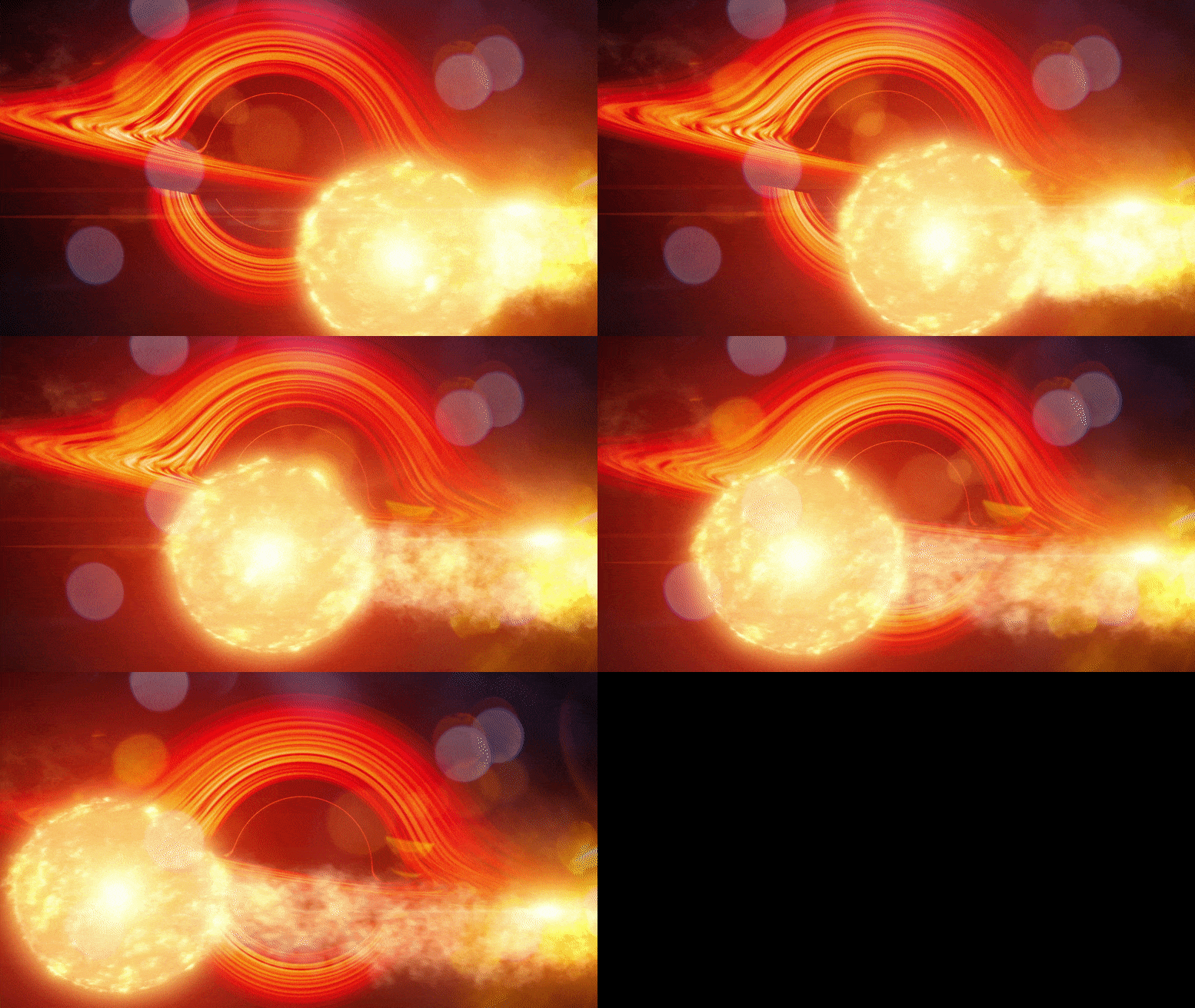
An international team of astronomers has revealed that what was once thought to be a supernova, dubbed ASASSN-14ko, is actually periodic flaring from a supermassive black hole in a distant galaxy. The black hole flares every 114 days as it tears off chunks of an orbiting star.
In a case of cosmic mistaken identity, an international team of astronomers revealed that what they once thought was a supernova is actually periodic flaring from a galaxy where a supermassive black hole gives off bursts of energy every 114 days as it tears off chunks of an orbiting star.
Six years after its initial discovery—reported in The Astronomer’s Telegram by Carnegie’s Thomas Holoien—the researchers, led by Anna Payne of University of Hawai’i at Mānoa, can now say that the phenomenon they observed, called ASASSN-14ko, is a periodically recurring flare from the center of a galaxy more than 570 million light-years away in the southern constellation Pictor.
Their findings—based on 20 instances of regular outbursts—were published in The Astrophysical Journal and presented by Payne at the American Astronomical Society’s annual meeting.
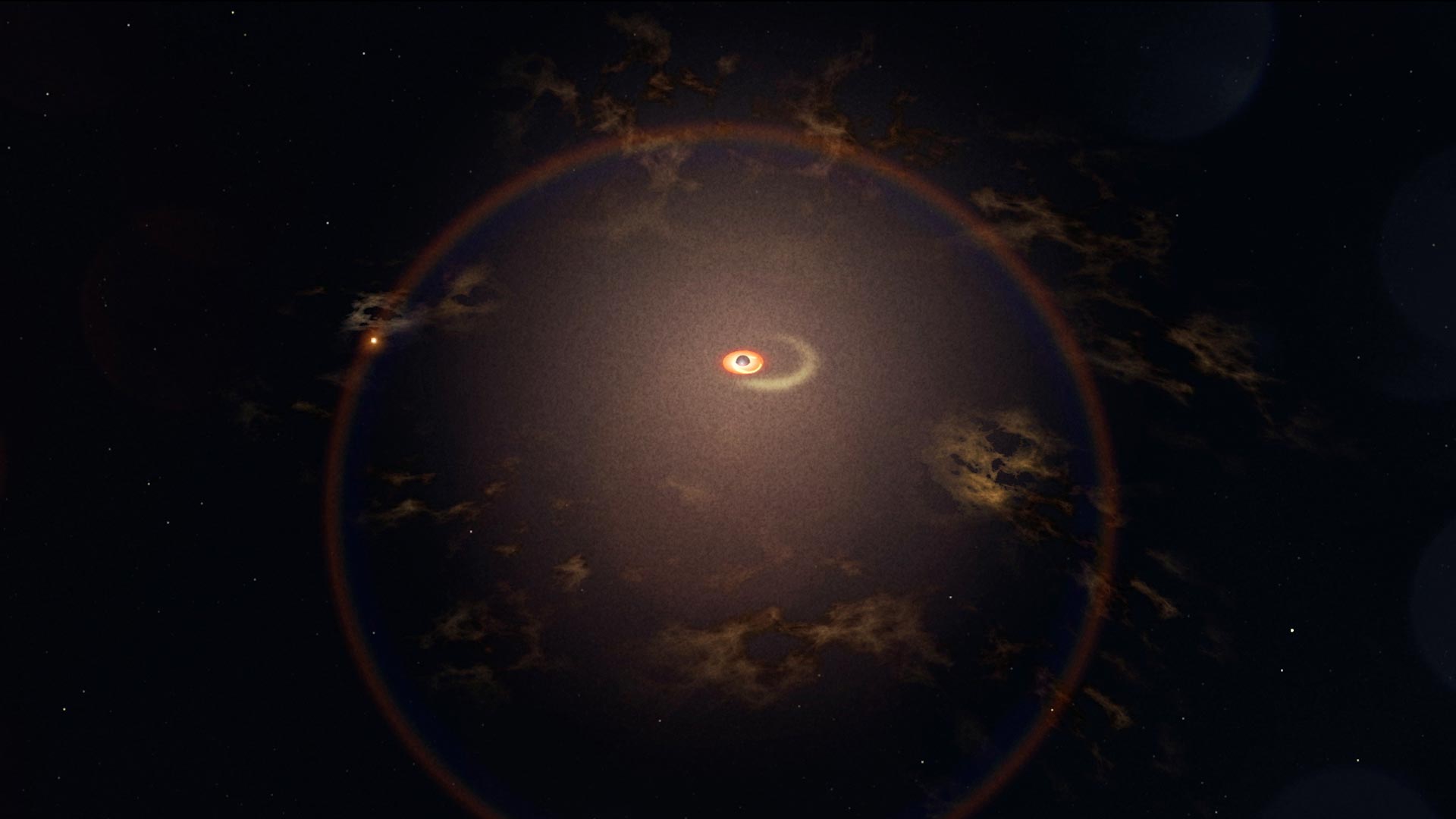
A First Example of Clockwork Flaring
Active galaxies, such as the host of ASASSN-14ko, have unusually bright and variable centers. These objects produce much more energy than the combined contribution of all their stars. Astrophysicists think this is due to gravitational and frictional forces heating up a swirling disk of gas and dust that accumulates around the central supermassive black hole. The black hole slowly consumes the material, which creates low-level, random changes in the light emitted by the disk.
This is the first unambiguous example of such clockwork behavior from an active galaxy. Periodically recurring flares, such as those from ASASSN-14ko, could be evidence of observationally elusive cosmic phenomena that have been previously predicted by theorists.
“Knowing the schedule of this extragalactic Old Faithful allows us to coordinate and study it in more detail,” Payne said.
Watch as a monster black hole partially consumes an orbiting giant star. In this illustration, the gas pulled from the star collides with the black hole’s debris disk and causes a flare. Astronomers have named this repeating event ASASSN-14ko. The flares are the most predictable and frequent yet seen from an active galaxy. Credit: NASA’s Goddard Space Flight Center
ASASSN-14ko was first detected by the All-Sky Automated Survey for Supernovae (ASAS-SN), a global network of 20 robotic telescopes headquartered at The Ohio State University (OSU) in Columbus. When Payne examined all the ASAS-SN data on the phenomenon, she noticed a series of 17 regularly spaced flares.
Based on this discovery, the astronomers predicted that the galaxy would experience another burst on May 17 of last year and coordinated ground- and space-based facilities to make observations. They have since successfully predicted and witnessed flares on September 7 and December 26.
Significance of ASASSN-14ko’s Discovery
“ASAS-SN is designed to probe the physics of our universe by looking for transient and variable events.” Holoien said. “It’s exciting that the luminous object we originally thought was a violent supernova explosion—which would be interesting in its own right, but more commonplace—turned out to be a long-sought-after cosmic event.”
For more on this discovery, see NASA Investigates an “Old Faithful” Active Galaxy That Erupts Every 114 Days.
Reference: “ASASSN-14ko is a Periodic Nuclear Transient in ESO 253-G003” by Anna V. Payne, Benjamin J. Shappee, Jason T. Hinkle, Patrick J. Vallely, Christopher S. Kochanek, Thomas W.-S. Holoien, Katie Auchettl, K. Z. Stanek, Todd A. Thompson, Jack M. M. Neustadt, Michael A. Tucker, James D. Armstrong, Joseph Brimacombe, Paulo Cacella, Robert Cornect, Larry Denneau, Michael M. Fausnaugh, Heather Flewelling, Dirk Grupe, A.N. Heinze, Laura A. Lopez, Berto Monard, Jose L. Prieto, Adam C. Schneider, Scott S. Sheppard, John L. Tonry and Henry Weiland, 5 April 2021, The Astrophysical Journal.
DOI: 10.3847/1538-4357/abe38d
Never miss a breakthrough: Join the SciTechDaily newsletter.
Follow us on Google and Google News.
2 Comments
“Periodically recurring flares, such as those from ASASSN-14ko, could be evidence…”
One more “science” article telling us that something “could be evidence” of a scientific phenomenon. Could be. Or it could be a dragon periodically coming out of its cave.
Billy boy, what brought you to this website when you don’t trust what you consider “godless science”? Is your trolling urge so strong that you just can’t help torturing yourself and reading articles beyond your comprehension ability so you can make inane comments about them?