
ESA’s Integral helps unravel origin of Fast Radio Bursts
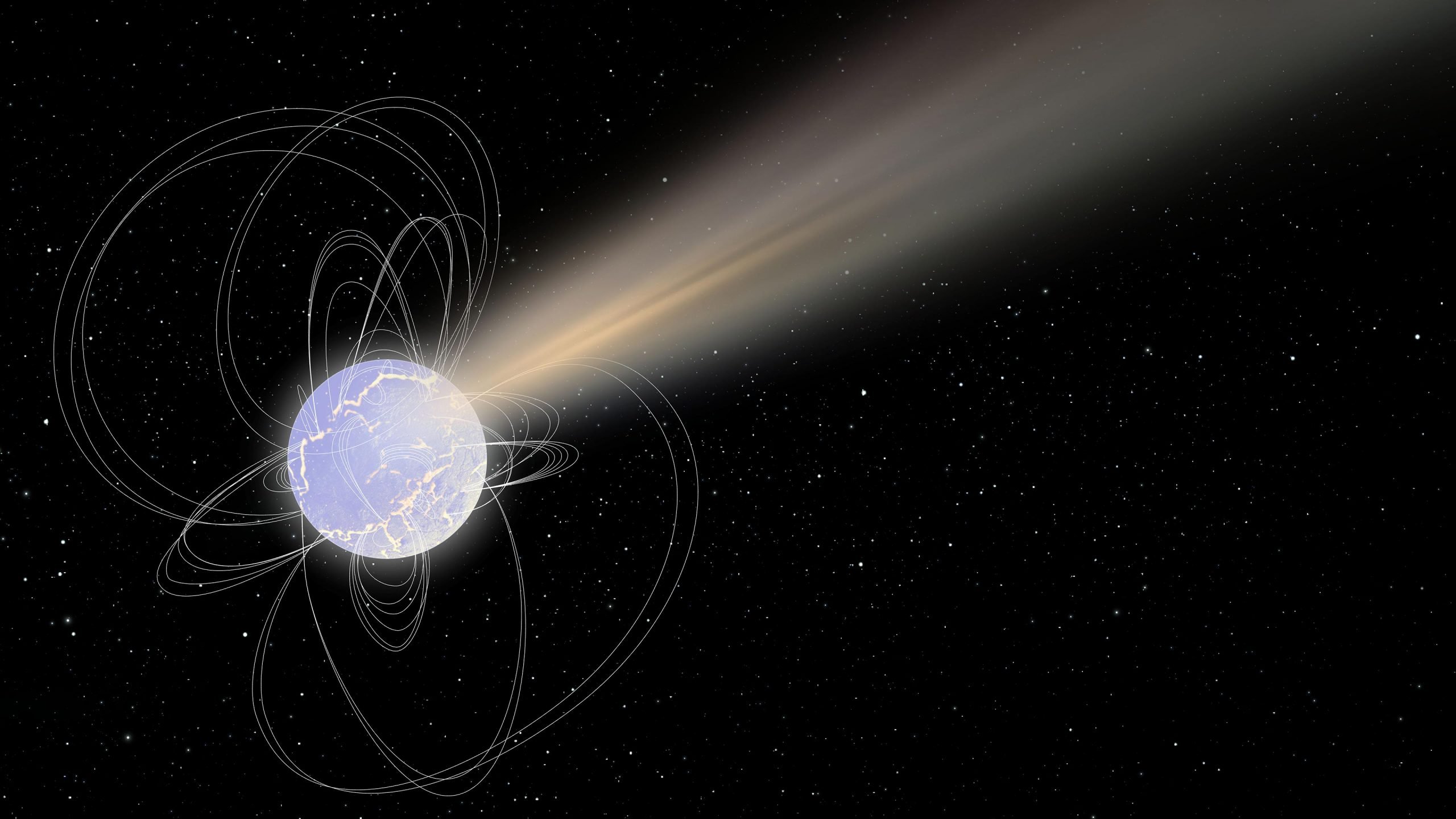
A global collaboration of telescopes including ESA’s Integral high-energy space observatory has detected a unique mix of radiation bursting from a dead star in our galaxy — something that has never been seen before in this type of star, and may solve a long-standing cosmic mystery.
The finding involves two kinds of interesting cosmic phenomena: magnetars and Fast Radio Bursts. Magnetars are stellar remnants with some of the most intense magnetic fields in the Universe. When they become ‘active’, they can produce short bursts of high-energy radiation that typically last for not even a second but are billions of times more luminous than the Sun.
Fast Radio Bursts are one of astronomy’s major unsolved mysteries. First discovered in 2007, these events pulse brightly in radio waves for just a few milliseconds before fading away, and are only rarely seen again. Their true nature remains unknown, and no such burst has ever been observed either within the Milky Way, with a known origin, or emitting any other kind of radiation beyond the radio wave domain — until now.
In late April, SGR 1935+2154, a magnetar discovered six years ago in the constellation of Vulpecula, following a substantial burst of X-rays, became active again. Soon after, astronomers spied something astonishing: this magnetar was not only radiating its usual X-rays, but radio waves, too.
“We detected the magnetar’s burst of high-energy, or ‘hard’, X-rays using Integral on 28 April,” says Sandro Mereghetti of the National Institute for Astrophysics (INAF–IASF) in Milan, Italy, lead author of a new study of this source based on the Integral data.
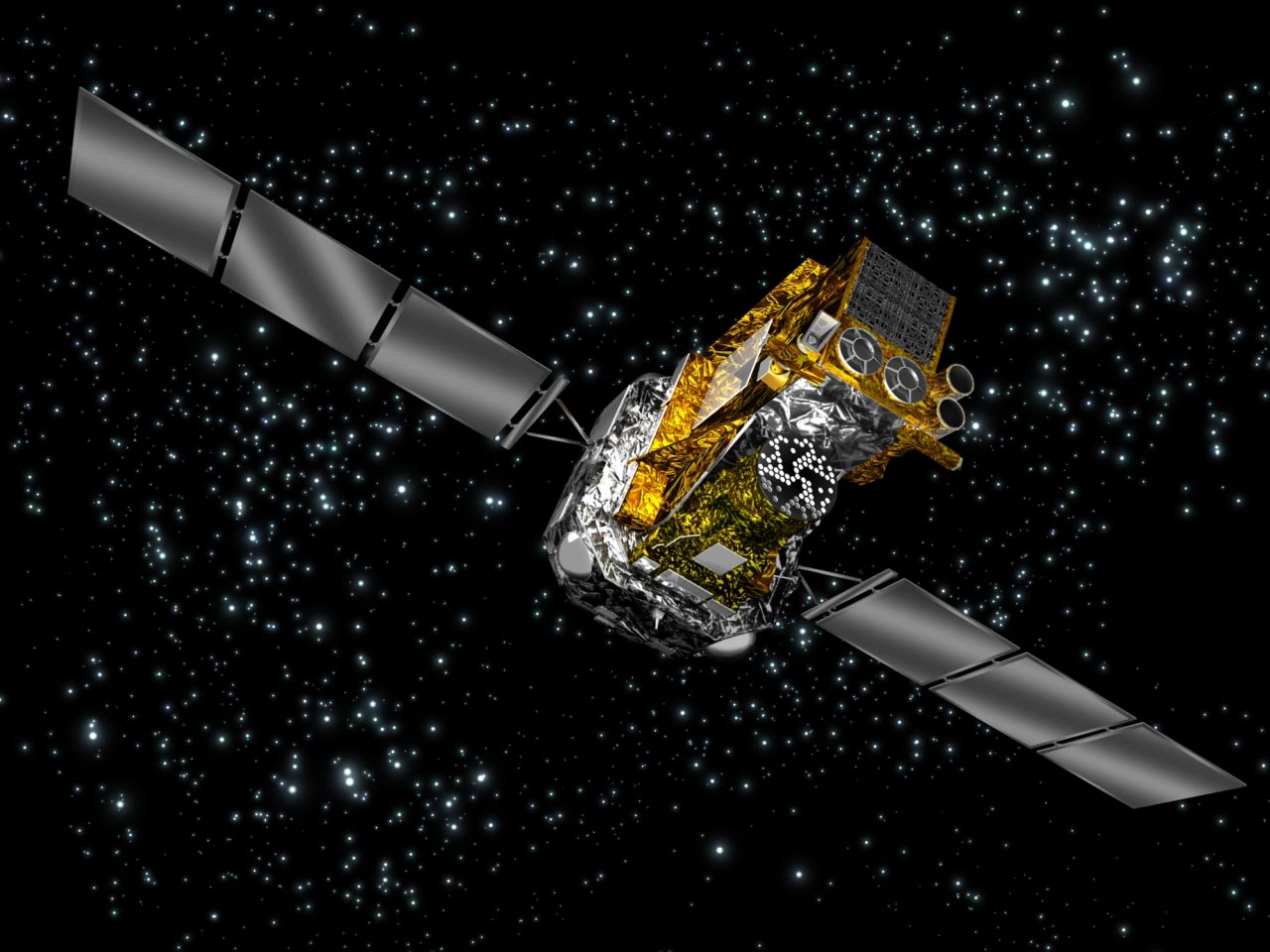
“The ‘Burst Alert System’ on Integral automatically alerted observatories worldwide about the discovery in just seconds. This was hours before any other alerts were issued, enabling the scientific community to act fast and explore this source in more detail.”
Astronomers on the ground spotted a short and extremely bright burst of radio waves from the direction of SGR 1935+2154 using the CHIME radio telescope in Canada on the same day, over the same timeframe as the X-ray emission. This was independently confirmed a few hours later by the Survey for Transient Astronomical Radio Emission 2 (STARE2) in the US.
“We’ve never seen a burst of radio waves, resembling a Fast Radio Burst, from a magnetar before,” adds Sandro.
“Crucially, the IBIS imager on Integral allowed us to precisely pinpoint the origin of the burst, nailing its association with the magnetar,” says co-author Volodymyr Savchenko from the Integral Science Data Centre at the University of Geneva, Switzerland.
“Most of the other satellites involved in the collaborative study of this event weren’t able to measure its position in the sky — and this was crucial in identifying that the emission did indeed come from SGR1935+2154.”
“This is the first-ever observational connection between magnetars and Fast Radio Bursts,” explains Sandro.
“It truly is a major discovery, and helps to bring the origin of these mysterious phenomena into focus.”

This connection strongly supports the idea that Fast Radio Bursts emanate from magnetars, and demonstrates that bursts from these highly magnetized objects can also be spotted at radio wavelengths. Magnetars are increasingly popular with astronomers, as they are thought to play a key role in driving a number of different transient events in the Universe, from super-luminous supernova explosions to distant and energetic gamma-ray bursts.
Launched in 2002, Integral carries a suite of four instruments able to simultaneously observe and take images of cosmic objects in gamma rays, X-rays, and visible light.
At the time of the burst, the magnetar happened to be in the 30-degree by 30-degree field of view of the IBIS instrument, leading to an automatic detection by the satellite’s Burst Alert System software package – operated by the Integral Science Data Centre in Geneva – immediately alerting observatories worldwide. At the same time, the Spectrometer on Integral (SPI) also detected the X-rays burst, along with another space mission, China’s Insight Hard X-ray Modulation Telescope (HXMT).
“This kind of collaborative, multi-wavelength approach and resulting discovery highlights the importance of timely, large-scale coordination of scientific research efforts,” adds ESA’s Integral project scientist Erik Kuulkers.
“By bringing together observations from the high-energy part of the spectrum all the way to radio waves, from across the globe and in space, scientists have been able to elucidate a long-standing mystery in astronomy. We’re thrilled that Integral played a key role in this.”
More information
Reference: “INTEGRAL Discovery of a Burst with Associated Radio Emission from the Magnetar SGR 1935+2154” by S. Mereghetti, V. Savchenko, C. Ferrigno, D. Götz, M. Rigoselli, A. Tiengo, A. Bazzano, E. Bozzo, A. Coleiro, T. J.-L. Courvoisier, M. Doyle, A. Goldwurm, L. Hanlon, E. Jourdain, A. von Kienlin, A. Lutovinov, A. Martin-Carrillo, S. Molkov, L. Natalucci, F. Onori, F. Panessa, J. Rodi, J. Rodriguez, C. Sánchez-Fernández, R. Sunyaev and P. Ubertini, 27 July 2020, The Astrophysical Journal Letters.
DOI: 10.3847/2041-8213/aba2cf
Never miss a breakthrough: Join the SciTechDaily newsletter.
Follow us on Google and Google News.
4 Comments
Earthquake. On a magnetar, a 1/4 inch crack occurring 100 light years from earth could release enough energy to disintegrate our entire solar system. That’s some serious energy.
Maybe, but that would happen in neutron stars after they may have – depending on progenitor star magnetic field – passed the magnetar state.
There are models where the bursts are due to magnetar spin wobbling (magnetars are beileved to have very narrow jets) but also models based on evidence there “it” – whatever it is – seems to happen on the way between the star and us.
“beileved” = believed.
R+C/RC<=D2CD1