
Close Menu
    Facebook X (Twitter) Instagram
    SciTechDaily
    • Biology
    • Chemistry
    • Earth
    • Health
    • Physics
    • Science
    • Space
    • Technology
    Facebook X (Twitter) Pinterest YouTube RSS
    SciTechDaily
    Home»Space»Cosmic Shield: How Our Solar System Survived a Supernova
    Space

    Cosmic Shield: How Our Solar System Survived a Supernova

    By National Institutes of Natural SciencesJune 30, 20232 Comments3 Mins Read
    Facebook Twitter Pinterest Telegram LinkedIn WhatsApp Email Reddit
    Share
    Facebook Twitter LinkedIn Pinterest Telegram Email Reddit
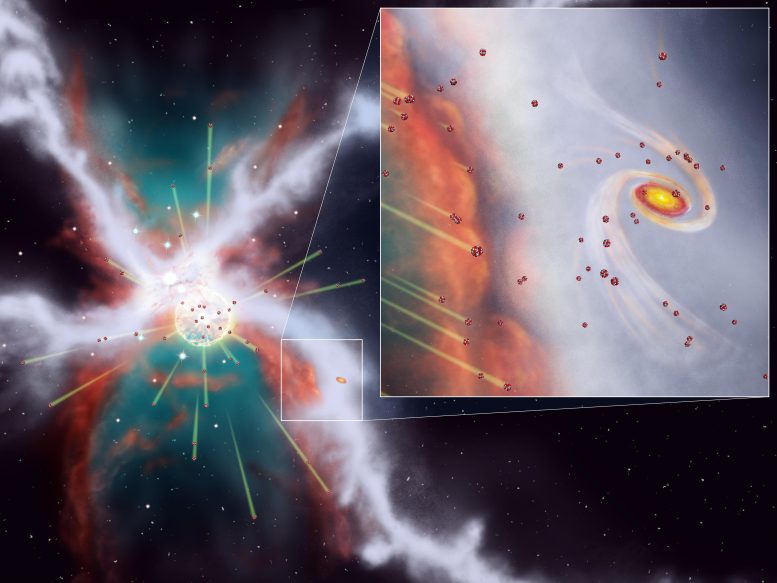
    Blast Wave From a Supernova Colliding With the Molecular Cloud Filament
    Artist’s impression of the blast wave from a supernova colliding with the molecular cloud filament where the Sun is forming. Credit: NAOJ

    A study suggests that a nearby supernova explosion enriched the early Solar System with radioactive isotopes while a dense molecular filament protected it from destruction.

    Evidence gleaned from isotope ratios within meteorites indicates that a supernova detonation occurred nearby while our Sun and Solar System were still in their formative stages. The resulting blast from that supernova could have potentially destroyed the nascent solar system.

    New calculations reveal that a filament of molecular gas, the birth cocoon of our Solar System, played a crucial role in trapping the isotopes discovered in meteorites. Simultaneously, this filament functioned as a shield, safeguarding the nascent Solar System from the destructive forces of the nearby supernova explosion.

    Primitive meteorites preserve information about the conditions at the birth of the Sun and planets. The meteorite components show an inhomogeneous concentration of a radioactive isotope of aluminum.

    This variation suggests that an additional amount of the radioactive aluminum was introduced shortly after the Solar System started forming. A nearby supernova explosion is the best candidate for this injection of new radioactive isotopes.

    But a supernova that was close enough to deliver the amount of isotopes seen in meteorites would have also created a blast wave strong enough to rip the nascent Solar System apart.

    A New Explanation: The Protective Role of Molecular Filaments

    A team led by Doris Arzoumanian at the National Astronomical Observatory of Japan proposed a new explanation of how the Solar System acquired the amount of isotopes measured in meteorites while surviving the supernova shock. Stars form in large groups called clusters inside giant clouds of molecular gas.

    These molecular clouds are filamentary. Small stars like the Sun usually form along the filaments and large stars, which will explode in a supernova, usually form at the hubs where multiple filaments cross.

    Assuming that the Sun formed along a dense molecular gas filament, and a supernova exploded at a nearby filament hub, the team’s calculation showed that it would take at least 300,000 years for the blast wave to break up the dense filament around the forming Solar System.

    The components of meteorites enriched in radioactive isotopes formed in approximately the first 100,000 years of Solar System formation inside the dense filament. The parent filament may have acted as a buffer to protect the young Sun and helped catch the radioactive isotopes from the supernova blast wave and channel them into the still-forming Solar System.

    Reference: “Insights on the Sun Birth Environment in the Context of Star Cluster Formation in Hub–Filament Systems” by Doris Arzoumanian, Sota Arakawa, Masato I. N. Kobayashi, Kazunari Iwasaki, Kohei Fukuda, Shoji Mori, Yutaka Hirai, Masanobu Kunitomo, M. S. Nanda Kumar and Eiichiro Kokubo, 25 April 2023, The Astrophysical Journal Letters.
    DOI: 10.3847/2041-8213/acc849

    Never miss a breakthrough: Join the SciTechDaily newsletter.
    Follow us on Google and Google News.

    Astronomy Astrophysics NAOJ National Institutes of Natural Sciences Popular Supernova
    Share. Facebook Twitter Pinterest LinkedIn Email Reddit

    Related Articles

    Cosmic Cradles and Graves: Tracing Life and Death of Stars in the Most Distant Galaxy

    Mysterious Cosmic Tadpole: A Strange Gas Cloud Dances With a Colossal Black Hole

    Unknown Physics on the Cosmic Scale? 1000 Supernova Explosions Chart the Expansion History of the Universe

    Natural Cosmic Telescope Helps ALMA Discover Rotating Infant Galaxy

    Astronomers Spot Stellar Eggs Near Center of the Milky Way Hatching Into Baby Stars

    Reclusive Neutron Star May Have Been Found in Famous Supernova SN 1987A

    Supercomputer Turns Back Cosmic Clock for Insights Into One of the Most Important Mysteries in Modern Astronomy

    Intriguing Remains of a Rare Stellar Explosion Discovered in Milky Way Center

    Second Alignment Plane of Solar System Discovered After Accounting for Galactic Gravity

    2 Comments

    1. Elon on June 30, 2023 8:05 pm

      $$$ Money $$$

      Reply
    2. John Bayer on July 2, 2023 5:02 am

      “These molecular clouds are filamentary. Small stars like the Sun usually form along the filaments and large stars, which will explode in a supernova, usually form at the hubs where multiple filaments cross.”

      Interesting info which I’ve never run across before.

      Reply
    Leave A Reply Cancel Reply

    • Facebook
    • Twitter
    • Pinterest
    • YouTube

    Don't Miss a Discovery

    Subscribe for the Latest in Science & Tech!

    Trending News

    The Best Exercise Combination for Longevity, According to a 30-Year Study

    Popular Weight-Loss Drug Found To Slow Biological Aging in Landmark Human Trial

    NASA’s Fermi Telescope Caught a Supernova Doing Something Never Seen Before

    This Dinosaur Had the Claws of a Raptor but Hunted Like a Heron

    Doctors May Need To Rethink Calcium and Vitamin D Recommendations After Major Review

    Scientists Discover a Hidden Cause of Cellular Aging That Can Be Reversed

    Archaeologists Have Found Something Unexpected Inside a 1,600-Year-Old Egyptian Mummy

    Scientists May Have Found a Completely New Way To Treat Depression

    Follow SciTechDaily
    • Facebook
    • Twitter
    • YouTube
    • Pinterest
    • Newsletter
    • RSS
    SciTech News
    • Biology News
    • Chemistry News
    • Earth News
    • Health News
    • Physics News
    • Science News
    • Space News
    • Technology News
    Recent Posts
    • Scientists Discover Gut Signal That Turns Off Sugar Cravings
    • NASA Captures Typhoon Jangmi’s Massive Eye in Stunning Nighttime Image
    • Super Typhoon Sinlaku Was So Powerful It Made the Sky Ripple With Gravity Waves
    • The World Praised This Wolverine Program. Then Everything Changed
    • This Giant Tropical Fruit Could Hold a Surprising Secret to Saving Teeth
    Copyright © 1998 - 2026 SciTechDaily. All Rights Reserved.
    • Science News
    • About
    • Contact
    • Editorial Board
    • Privacy Policy
    • Terms of Use

    Type above and press Enter to search. Press Esc to cancel.