
Close Menu
    Facebook X (Twitter) Instagram
    SciTechDaily
    • Biology
    • Chemistry
    • Earth
    • Health
    • Physics
    • Science
    • Space
    • Technology
    Facebook X (Twitter) Pinterest YouTube RSS
    SciTechDaily
    Home»Space»Cosmic Tug of War: Dark Energy Camera Captures Galaxies in a Prelude to Merger
    Space

    Cosmic Tug of War: Dark Energy Camera Captures Galaxies in a Prelude to Merger

    By Association of Universities for Research in Astronomy (AURA)August 6, 2023No Comments4 Mins Read
    Facebook Twitter Pinterest Telegram LinkedIn WhatsApp Email Reddit
    Share
    Facebook Twitter LinkedIn Pinterest Telegram Email Reddit
    Dark Energy Camera Captures Galaxies in Lopsided Tug of War
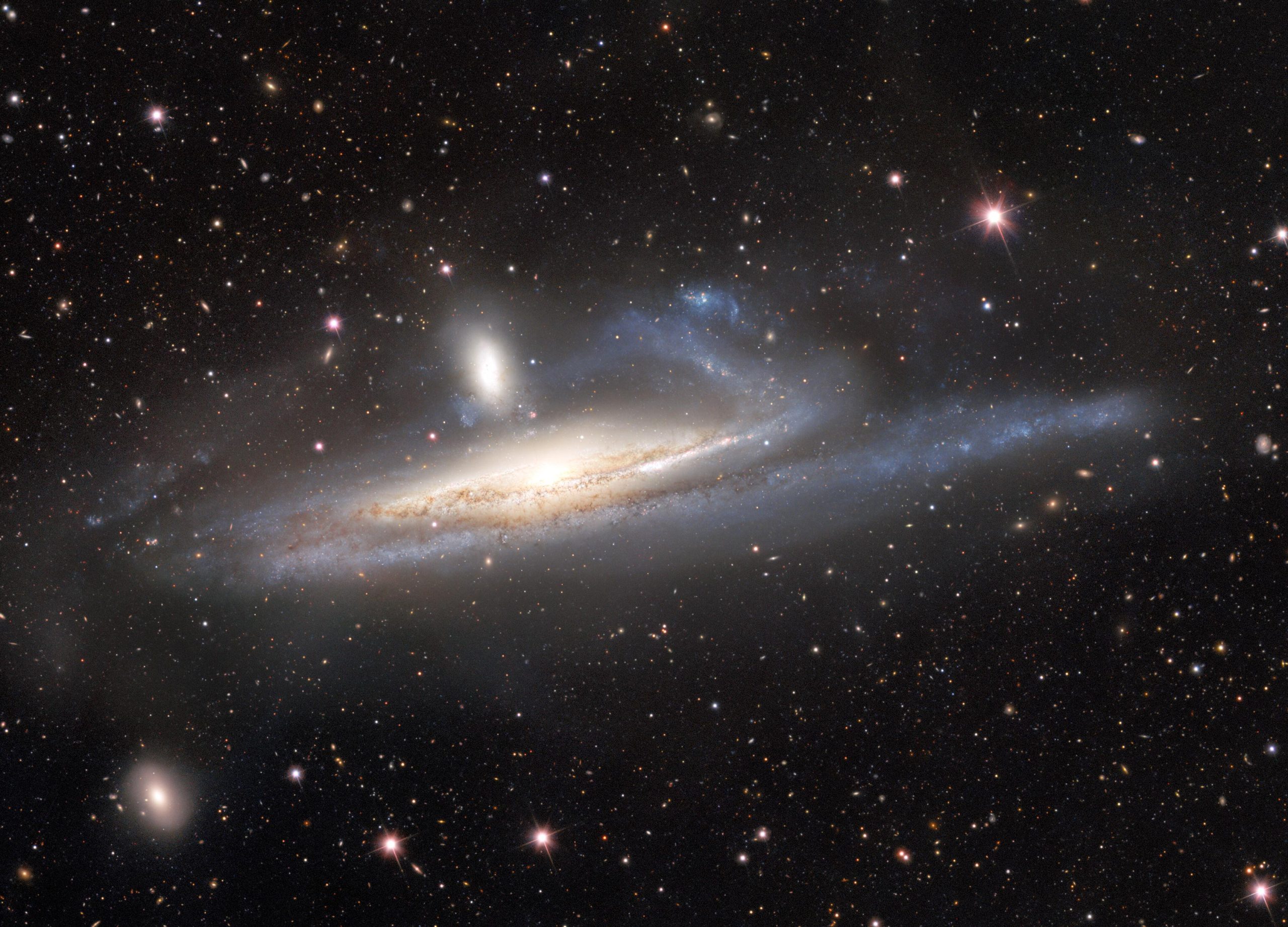
    The spiral galaxy NGC 1532, also known as Haley’s Coronet, is caught in a lopsided tug of war with its smaller neighbor, the dwarf galaxy NGC 1531. The image — taken by the US Department of Energy’s (DOE) Dark Energy Camera mounted on the National Science Foundation’s (NSF) Víctor M. Blanco 4-meter Telescope at Cerro Tololo Inter-American Observatory in Chile, a Program of NSF’s NOIRLab — captures the mutual gravitational influences of a massive- and dwarf-galaxy merger. Credit: CTIO/NOIRLab/DOE/NSF/AURA; R. Colombari, M. Zamani & D. de Martin (NSF’s NOIRLab)

    Haley’s Coronet and dwarf galaxy companion feel each other’s gravitational forces as they begin to coalesce.

    Galaxies undergo a process of growth and evolution spanning billions of years, a journey involving the absorption of nearby companions and merging with other galaxies. This intricate, cosmic lifecycle is beautifully captured in a recent image taken with the US Department of Energy’s (DOE) Dark Energy Camera (DECam), positioned on the National Science Foundation’s (NSF) Víctor M. Blanco 4-meter Telescope at Cerro Tololo Inter-American Observatory (CTIO), a program under NSF’s NOIRLab.

    A Closer Look at NGC 1532

    This breathtaking image features the massive barred spiral galaxy NGC 1532, also known as Haley’s Coronet, located about 55 million light-years away in the direction of the southern constellation Eridanus (the river). Its sweeping spiral arms are seen edge-on from Earth, with the nearer arm dipping downward and the receding arm lurching upward as it tugs upon its smaller, dwarf companion galaxy NGC 1531. These gravitationally bound galaxies will eventually become one, as NGC 1532 completely consumes its smaller companion.
    Víctor M. Blanco 4-meter Telescope With DECam
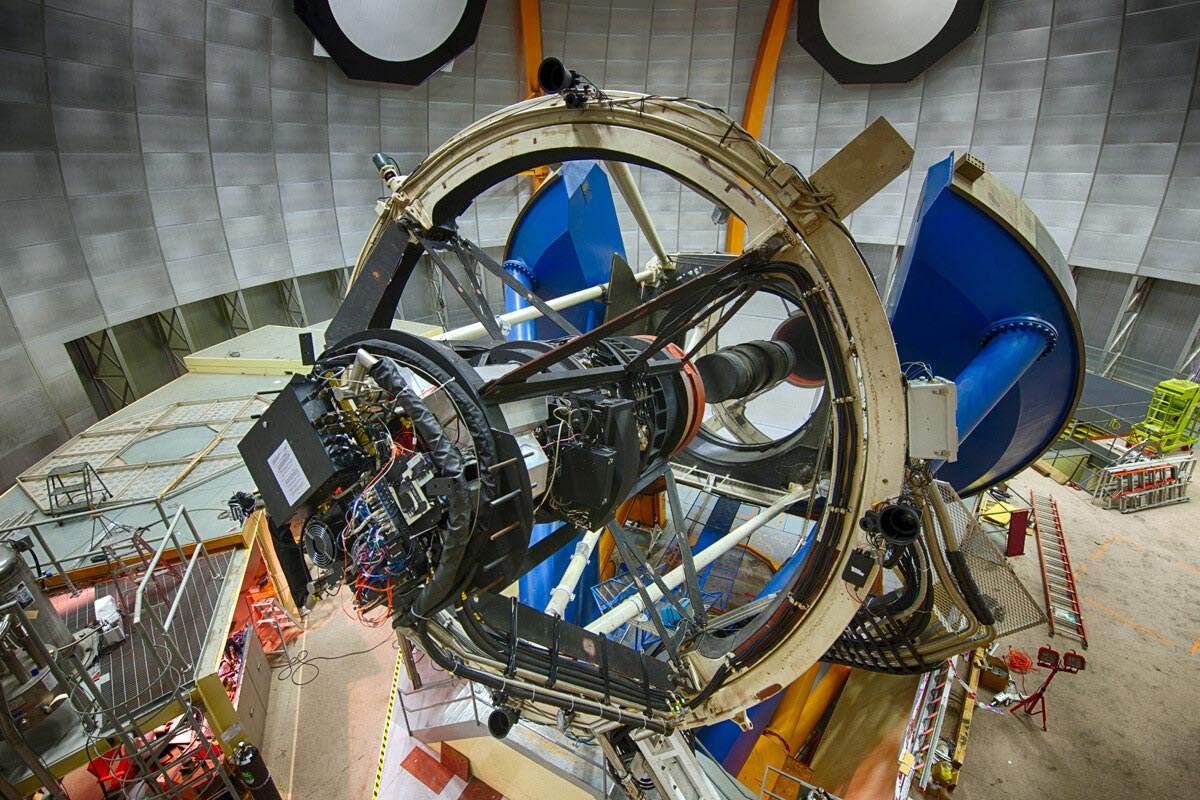
    The Víctor M. Blanco 4-meter Telescope has a 4-meter (13 feet) diameter mirror, which weighs 15,400 kg (34,000 lbs). It was designed in the 1960’s. The Dark Energy Camera (black paint) is mounted at the prime (first) focus near the top of the Serrurier truss (white paint). The blue-painted structure is the large bearing that allows the telescope to move in right ascension. The telescope declination axis is located at the level of the middle of the right ascension bearing and is best seen on the left side of the large u-shaped notch. The primary mirror is located a few feet lower than the declination axis. Credit: DOE/LBNL/DECam/R. Hahn/CTIO/NOIRLab/NSF/AURA

    The Dance of Gravitational Influence

    Despite its small stature, however, the dwarf galaxy has also been exerting a noticeable gravitational influence on its larger companion, distorting one of its spiral arms, which can be seen rising above the galactic plane. Additionally, plumes of gas and dust can be seen between the two galaxies, like a bridge of stellar matter held in place by the competing tidal forces. This interaction has also triggered bursts of star formation within both galaxies.

    The Growth and Evolution of Galaxies

    This lopsided cosmic tug of war is a snapshot of how large galaxies grow and evolve by devouring smaller galaxies, absorbing their stars and star-forming material. A similar process has happened in the Milky Way, possibly six times in the past, leaving vast streams of stars and other signs in the halo of the Milky Way.
    Víctor M. Blanco 4-Meter Telescope Under Stars
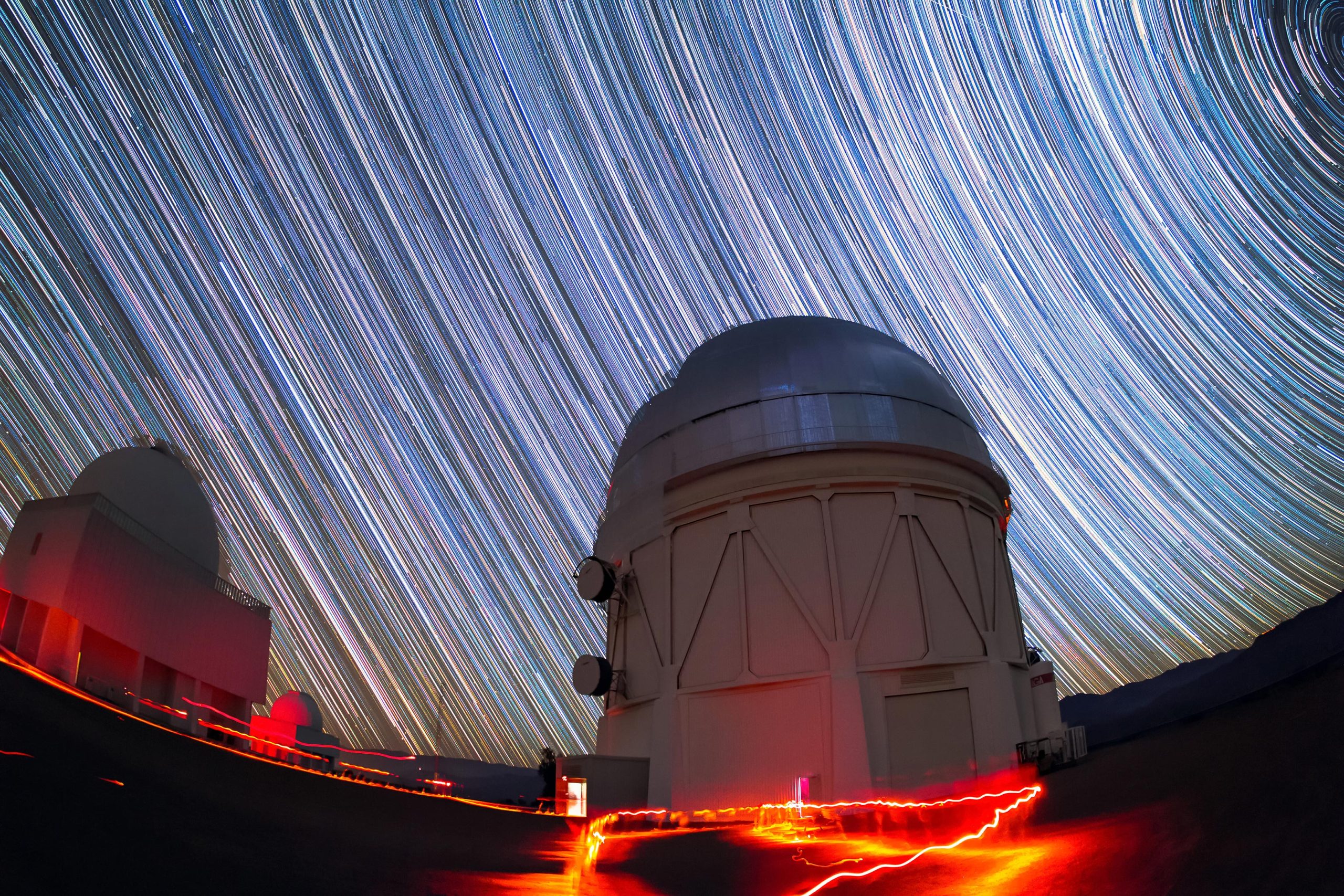
    Víctor M. Blanco 4-meter Telescope at the Cerro Tololo Inter-American Observatory (CTIO), a Program of NSF’s NOIRLab. Credit: CTIO/NOIRLab/NSF/AURA/R. Sparks

    Galactic Mergers and Their Impact

    The process of absorbing a smaller companion galaxy is starkly different from the cataclysmic merger of two spiral galaxies of comparable size. In the latter case, two massive galaxies collide to form an entirely distinct galaxy with its own shape and characteristics. This type of galactic merger will happen to the Milky Way when it merges with the Andromeda Galaxy four billion years from now.

    The Role of the Dark Energy Camera

    DECam’s unmatched wide-field imaging capabilities provide astronomers with remarkably detailed views of these large-scale galactic interactions. With the support of the 4-meter Blanco telescope, it exhibits the extraordinary sensitivity necessary to detect faint objects in our Solar System and to map the influence of dark matter on galaxies across the observable Universe. At present, DECam is utilized for a broad spectrum of scientific programs.

    See More: Top 15 Most Stunning Photos Taken by the Dark Energy Camera 

    Never miss a breakthrough: Join the SciTechDaily newsletter.
    Follow us on Google and Google News.

    Astronomy Astrophysics AURA Popular
    Share. Facebook Twitter Pinterest LinkedIn Email Reddit

    Related Articles

    The Universe Is Expanding Too Fast and Scientists Can’t Explain Why

    A Sun-Like Star Went Dark for 9 Months – Astronomers Just Found Out Why

    Blast From the Past: Breakthrough in Centuries-Old Effort to Unravel Astronomical Mystery

    Brown Dwarf Discovered by Radio Telescope Observations for the First Time

    A White Dwarf’s Surprise Planetary Companion: First-of-Its-Kind Exoplanet Detected Around Dead Star

    Nearly 100 Cool New Worlds Found in Our Cosmic Backyard With Key Help From Citizen Scientists

    Clever Trick Allows Precision Measurement of Exoplanet – Surprisingly High Density Challenges Planet Formation Theories

    Astronomical Mystery Deepens After Fast Radio Burst Detected From Unknown Source

    Dynamical Footprints in the Andromeda Galaxy Uncovered by Galactic Archaeologists

    Leave A Reply Cancel Reply

    • Facebook
    • Twitter
    • Pinterest
    • YouTube

    Don't Miss a Discovery

    Subscribe for the Latest in Science & Tech!

    Trending News

    Scientists May Have Discovered How To Heal Damaged Kidneys

    Interstellar Visitor 3I/ATLAS Is Bursting With an Unexpected Chemical

    Scientists Just Found All 5 Genetic “Letters” of DNA and RNA on an Asteroid

    The 4,000-Year-Old City That Defied History’s Rules on Wealth and Power

    The World’s Biggest Population Fear Has Flipped – and It Could Change Everything

    This “Fake” Pill Improved Memory and Physical Performance in Just 3 Weeks

    Scientists Say Frequent Ejaculation May Improve Sperm Quality and Fertility

    Scientists Have Found “The Heaven Sword” After Years of Looking

    Follow SciTechDaily
    • Facebook
    • Twitter
    • YouTube
    • Pinterest
    • Newsletter
    • RSS
    SciTech News
    • Biology News
    • Chemistry News
    • Earth News
    • Health News
    • Physics News
    • Science News
    • Space News
    • Technology News
    Recent Posts
    • Common Laxative May Help Reverse Depression-Related Brain Fog
    • The Surprising Reason Frozen Fruit May Be Just As Nutritious as Fresh
    • Scientists Discover the Oldest Known Fossils of Humans’ Closest Invertebrate Relatives
    • Watch What Happened When a Lost Elephant Calf Returned to Her Family
    • 17,000 Brain Scans Reveal Surprising Ethnic Differences in Alzheimer’s Biology
    Copyright © 1998 - 2026 SciTechDaily. All Rights Reserved.
    • Science News
    • About
    • Contact
    • Editorial Board
    • Privacy Policy
    • Terms of Use

    Type above and press Enter to search. Press Esc to cancel.