

Researchers at the University of Lausanne have discovered a new function of the brain’s “locus coeruleus” in regulating sleep and its disturbances. This region plays a key role in transitioning between NREM and REM sleep while maintaining a subtle, unconscious awareness of the external environment. However, stress impairs its activity, leading to a decline in sleep quality.
Sleep disorders are impacting a growing number of individuals, posing significant risks to their health. In mammals, sleep is characterized by cycles alternating between two distinct states: non-rapid eye movement (NREM) sleep and rapid eye movement (REM) sleep.
However, the rules governing these cycles remain poorly understood. A study led by Professor Anita Lüthi, a researcher at the Department of Fundamental Neurosciences at the Faculty of Biology and Medicine at the University of Lausanne (UNIL), shows for the first time that the locus coeruleus (LC), a brainstem region, is involved in the organization of sleep.
The LC has so far been known as the major regulator of the ability to react to challenging situations during wakefulness, not sleep. The study conducted by Anita Lüthi and published in Nature Neuroscience now shows that the LC determines when the transition between the two sleep states is possible, showing that this brain area is crucial for the normal cyclicity of sleep states.
Furthermore, the team discovered that experiences during the day, particularly stress, disrupt the activity of the LC during sleep and results in a disorganized sleep cycle and too frequent awakenings. These discoveries provide crucial insights for a better understanding of sleep disorders and could lead to improved treatments.
Sleep structure redefined
The LC, long recognized as the center of noradrenaline production — the primary hormone governing our ability to respond to environmental challenges by mobilizing the brain and body — is essential for cognitive wakefulness. During sleep, its activity becomes fluctuating, alternating between peaks and troughs at intervals of about 50 seconds.
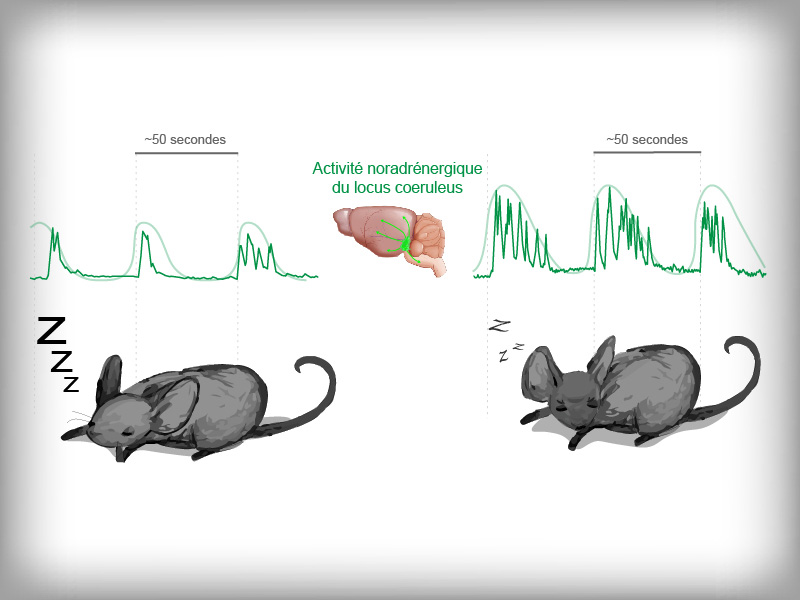
The role of this activity has remained poorly understood until now. Thanks to the implementation of advanced technologies, UNIL neuroscientists have been able to specifically target neuronal pathways in this brain region in mice. “We found that both peaks and troughs of the LC’s fluctuating activity play key roles in sleep organization. This is a new structural element of sleep; it functions somewhat like a clock,” explains Georgios Foustoukos, one of the study’s three lead authors.
Their results show that sleep is composed of previously unknown structural units, during which two functions are sequentially coordinated. During peaks of LC activity, part of the subcortical brain enters a more wake-like state, thanks to noradrenaline, allowing unconscious vigilance toward the environment and potential dangers. Conversely, during troughs, transitions to REM sleep are possible.
Two key functions for restorative sleep
Under normal conditions, human NREM sleep consists of four distinct stages that include the deepest stages of sleep. REM sleep, on the other hand, is characterized by high brain activity associated with dreams and occupies about a quarter of the night. A typical night alternates, in a coordinated manner, between NREM and REM states, allowing the body and mind to rest and recover. UNIL’s neuroscientists have identified the LC as the gatekeeper of these transitions, precisely controlling when the shift from NREM to REM sleep can occur, notably at moments when its activity is low.
Conversely, the scientists discovered that when LC activity is elevated, more noradrenaline is released into the brain, making certain areas of the brain more prone to become aroused, yet without actually waking up the organism. This state represents a previously unknown type of arousal that generates a vigilance toward the environment and body during sleep, facilitating a complete and rapid awakening in case of emergency. “In other words, the brain is semi-awake at the subcortical level while being asleep at the cortical level,” says Anita Lüthi.
A hope for sleep disorders
Another major insight of this study is the observation that stressful experiences during wakefulness in mice can disrupt sleep by increasing LC activity, which delays the onset of REM sleep and fragments NREM sleep by causing too many awakenings. These concern both subcortical and cortical parts of the brain. For Anita Lüthi, the results pave the way for new clinical applications for people suffering from sleep disorders: “Our discoveries can help better understand sleep disturbances associated with mental health disorders such as anxiety or other sleep disorders. Moreover, they offer avenues for new treatments, like using the LC as a biomarker to monitor and potentially correct sleep cycles. The strength of our work is that we bring the neural activity of the sleeping brain a big step closer to human sleep measures that we know from the hospital.” Clinical collaborations with the Lausanne University Hospital (CHUV) have been initiated to assess whether the mechanisms identified in mice can be applied to human sleep.
Finally, the study also provides cues to better understand sleep through the evolution of species. Unlike mammals with their two clearly distinct sleep states, some archaic species like reptiles do not show such a well-defined duality. However, several reptiles exhibit two types of sleep that alternate over a period of about 50 seconds. This suggests that precursors of LC activity already existed to structure their ancient sleep.
Reference: “Infraslow noradrenergic locus coeruleus activity fluctuations are gatekeepers of the NREM–REM sleep cycle” by Alejandro Osorio-Forero, Georgios Foustoukos, Romain Cardis, Najma Cherrad, Christiane Devenoges, Laura M. J. Fernandez and Anita Lüthi, 25 November 2024, Nature Neuroscience.
DOI: 10.1038/s41593-024-01822-0
Never miss a breakthrough: Join the SciTechDaily newsletter.
Follow us on Google and Google News.