
Close Menu
    Facebook X (Twitter) Instagram
    SciTechDaily
    • Biology
    • Chemistry
    • Earth
    • Health
    • Physics
    • Science
    • Space
    • Technology
    Facebook X (Twitter) Pinterest YouTube RSS
    SciTechDaily
    Home»Health»COVID-19: Microwaves Used to Deactivate Coronavirus, Flu, Other Aerosolized Viruses
    Health

    COVID-19: Microwaves Used to Deactivate Coronavirus, Flu, Other Aerosolized Viruses

    By American Institute of PhysicsJanuary 29, 2021No Comments3 Mins Read
    Facebook Twitter Pinterest Telegram LinkedIn WhatsApp Email Reddit
    Share
    Facebook Twitter LinkedIn Pinterest Telegram Email Reddit
    Abstract Microbe Concept
    Researchers have created tools to expose aerosolized viral particles to electromagnetic waves, allowing them to vary power, energy, and frequency. This helps determine the energy levels needed to deactivate and reduce viral spread.

    Tool uses electromagnetic energy to help study inactivation of aerosolized viral particles and reduce the spread of infection.

    As the pandemic has continued to spread globally, studies indicate the COVID-19 virus may be contained in aerosols that can be generated and spread through breathing, coughing, sneezing, or talking by infected individuals. Researchers are increasingly focused on developing tools and methods to assist in decontaminating surfaces and spaces.

    While scientists have previously explored the use of electromagnetic energy to deactivate flu virus in bulk fluids, less work has been done to understand the role of nonionizing radiation, such as microwaves, in reducing the infectivity of viral pathogens in aerosols. The tools required to both safely contain contaminated aerosol streams and expose these aerosols to controlled, well-characterized microwave doses have not been readily available.

    New Experimental Tools

    In Review of Scientific Instruments, by AIP Publishing, researchers from the Air Force Research Laboratory report the development of a set of experimental tools capable of presenting electromagnetic waves to an aerosol mixture of biological media and virus with the capability to vary power, energy, and frequency of the electromagnetic exposure. The researchers seek to better characterize the threshold levels of microwave energy needed to inactivate aerosolized viral particles and, thus, reduce their ability to spread infection.
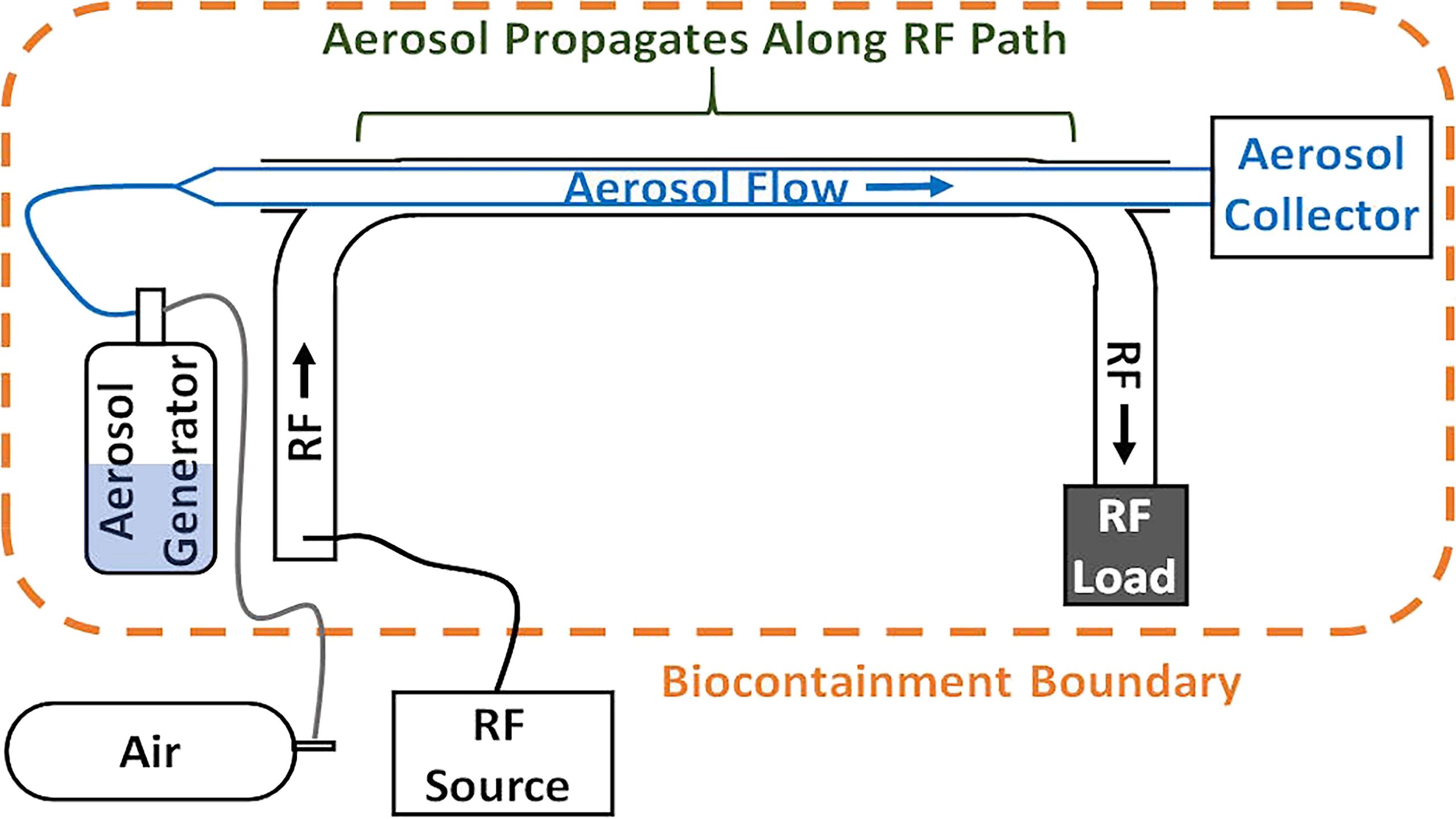
    Viral Aerosol Microwave Inactivation Experiment
    Conceptual schematic showing key portions of the viral aerosol microwave inactivation experiment. Credit: Air Force Research Laboratory

    “In this way, we believe our experimental design is capable of a fundamental investigation of a wide variety of inactivation mechanisms. This range of capability is especially important given the range of potential interaction mechanisms found in the literature,” said co-author John Luginsland.

    Containment and Safety Measures in Design

    The key portions of each system fit within standard biosafety cabinets, ensuring multiple layer containment of pathogens. Additionally, the systems are designed to prevent release of microwave radiation into the laboratory environment, which, at elevated levels, could potentially interfere with diagnostic equipment and other electronics.

    During initial experiments, the AFRL researchers are exposing a human-safe coronavirus surrogate, bovine coronavirus, to a range of microwave waveforms at frequencies ranging from 2.8 GHz to 7.5 GHz.

    “The bovine coronavirus is similar in size and configuration to human coronavirus but is safe to humans,” said co-author Brad Hoff.

    If exposure to microwaves is demonstrated to be sufficiently effective in reducing infectivity, experimental efforts could then proceed to use aerosols containing COVID-19 coronavirus or other human-infecting pathogens.

    “If shown to be effective, the use of microwaves may enable the potential for rapid decontamination not currently addressed by ultraviolet light or chemical cleaning for highly cluttered areas, while potentially operating at levels safely compatible with human occupancy,” said Hoff.

    Reference: “Apparatus for controlled microwave exposure of aerosolized pathogens” by Brad W. Hoff, Jeremy W. McConaha, Zane W. Cohick, Matthew A. Franzi, Daniel A. Enderich, David Revelli, Jason Cox, Hammad Irshad, Hugh H. Pohle, Andreas Schmitt-Sody, Samuel C. Schaub, Anthony E. Baros, Naomi C. Lewis, John W. Luginsland, Michael T. Lanagan and Steven Perini, 26 January 2021, Review of Scientific Instruments.
    DOI: 10.1063/5.0032823

    Never miss a breakthrough: Join the SciTechDaily newsletter.
    Follow us on Google and Google News.

    American Institute of Physics COVID-19 Electromagnetics Infectious Diseases Virology
    Share. Facebook Twitter Pinterest LinkedIn Email Reddit

    Related Articles

    COVID Vaccination Strategies: When Is One Dose Better Than Two?

    LEDs Light the Way to COVID-19 Coronavirus Disinfection

    Tree Pollen Facilitates COVID-19 Virus Spread – Carries SARS-CoV-2 Particles Farther

    Deactivating COVID-19 Virus Cough Droplets With UV-C Lamps

    Temperature, Humidity & Wind Predict Second Wave of COVID-19 Pandemic

    Disposable Helmet Designed to Retain Cough Droplets, Minimize COVID-19 Transmission

    Hand-Held Particle Detector Measures Aerosols for Coronavirus Risk Assessment

    There Many Different COVID-19 Tests – Which One to Choose?

    The Latest Science on How to Keep COVID-19 Out of School Classrooms

    Leave A Reply Cancel Reply

    • Facebook
    • Twitter
    • Pinterest
    • YouTube

    Don't Miss a Discovery

    Subscribe for the Latest in Science & Tech!

    Trending News

    Your Blood Pressure Reading Could Be Wrong Because of One Simple Mistake

    Astronomers Stunned by Ancient Galaxy With No Spin

    Physicists May Be on the Verge of Discovering “New Physics” at CERN

    Scientists Solve 320-Million-Year Mystery of Reptile Skin Armor

    Scientists Say This Daily Walking Habit May Be the Secret to Keeping Weight Off After Dieting

    New Therapy Rewires the Brain To Restore Joy in Depression Patients

    Giant Squid Detected off Western Australia in Stunning Deep-Sea Discovery

    Popular Sugar-Free Sweetener Linked to Liver Disease, Study Warns

    Follow SciTechDaily
    • Facebook
    • Twitter
    • YouTube
    • Pinterest
    • Newsletter
    • RSS
    SciTech News
    • Biology News
    • Chemistry News
    • Earth News
    • Health News
    • Physics News
    • Science News
    • Space News
    • Technology News
    Recent Posts
    • Hidden Warm Water Beneath Antarctica Could Rapidly Raise Global Sea Levels
    • Scientists Revive Ancient Chemistry Trick To Engineer Next-Generation Glass
    • Scientists Use AI To Supercharge Ultrafast Laser Simulations by More Than 250x
    • Scientists Just Found a Surprising Way To Destroy “Forever Chemicals”
    • Popular Supplement Ingredient Linked to Shorter Lifespan in Men
    Copyright © 1998 - 2026 SciTechDaily. All Rights Reserved.
    • Science News
    • About
    • Contact
    • Editorial Board
    • Privacy Policy
    • Terms of Use

    Type above and press Enter to search. Press Esc to cancel.