
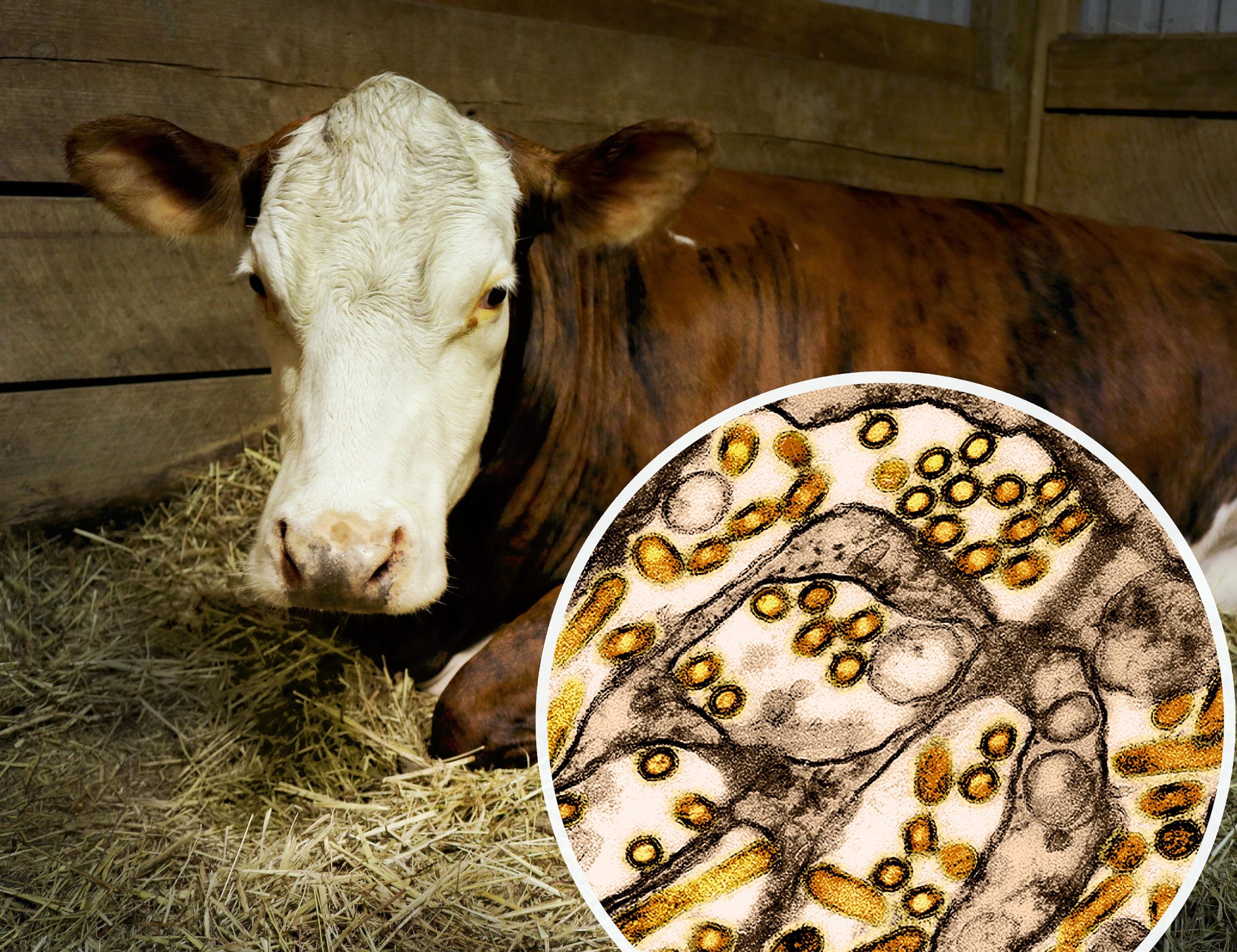
Research on H5N1 influenza in U.S. dairy cattle shows the virus can cause severe disease in mice and ferrets but lacks efficient transmission through respiratory droplets. This finding suggests a limited potential for these bovine-derived viruses to cause widespread disease among mammals.
Experimental Findings From H5N1 Infection in U.S. Dairy Cattle
A series of experiments with highly pathogenic H5N1 avian influenza (HPAI H5N1) viruses circulating in infected U.S. dairy cattle found that viruses derived from lactating dairy cattle induced severe disease in mice and ferrets when administered via intranasal inoculation. The virus from the H5N1-infected cows bound to both avian (bird) and human-type cellular receptors, but, importantly, did not transmit efficiently among ferrets exposed via respiratory droplets.
The findings, published on July 8 in the journal Nature, suggest that bovine (cow) HPAI H5N1 viruses may differ from previous HPAI H5N1 viruses and that these viruses may possess features that could facilitate infection and transmission among mammals. However, they currently do not appear capable of efficient respiratory transmission between animals or people.
In March 2024, an outbreak of HPAI H5N1 was reported among U.S. dairy cattle which spread across herds and led to fatal infections among some cats on affected farms, spillover into poultry, and four reported infections among dairy workers. The HPAI H5N1 viruses isolated from affected cattle are closely related to H5N1 viruses that have circulated in North American wild birds since late 2021. Over time, those avian viruses have undergone genetic changes and have spread throughout the continent causing outbreaks in wild birds and mammals—sometimes with mortality rates and suspected transmission within species.
Research Methods and Animal Model Results
To better understand the characteristics of the bovine H5N1 viruses, researchers from the University of Wisconsin-Madison, Japan’s Shizuoka and Tokyo Universities, and Texas A&M Veterinary Medical Diagnostic Laboratory conducted experiments to determine the ability of bovine HPAI H5N1 to replicate and cause disease in mice and ferrets, which are routinely used for influenza A virus studies. Ferrets are thought to be a good model for understanding potential influenza transmission patterns in people because they exhibit similar clinical symptoms, immune responses and develop respiratory tract infections like humans.
The researchers intranasally administered to mice doses of bovine HPAI H5N1 influenza of increasing strength (5 mice per dosage group), and then monitored the animals for body weight changes and survival for 15 days. All the mice that received the higher doses died of infection. Some of the mice that received lower doses survived, and those that received the lowest dose experienced no body weight loss and survived.
Comparative Studies and Transmission Tests
The researchers also compared the effects of the bovine HPAI H5N1 virus to a Vietnamese H5N1 strain that is typical of H5N1 avian influenza virus in humans and to an H1N1 influenza virus, both delivered intranasally to mice. The mice that received either the bovine HPAI H5N1 virus or the Vietnamese avian H5N1 virus experienced high virus levels in respiratory and non-respiratory organs, including in the mammary glands and muscle tissues, and sporadic detection in the eyes. The H1N1 virus was found only in the respiratory tissues of the animals.
Ferrets intranasally infected with the bovine HPAI H5N1 virus experienced elevated temperatures and loss of body weight. As with the mice, the scientists discovered high virus levels in the ferrets’ upper and lower respiratory tracts and other organs. Unlike the mice, however, no virus was found in the ferrets’ blood or muscle tissues.
“Together, our pathogenicity studies in mice and ferrets revealed that HPAI H5N1 derived from lactating dairy cattle may induce severe disease after oral ingestion or respiratory infection, and infection by either the oral or respiratory route can lead to systemic spread of virus to non-respiratory tissues including the eye, mammary gland, teat and/or muscle,” the authors write.
To test whether bovine H5N1 viruses transmit among mammals via respiratory droplets, such as emitted by coughs and sneezes, the researchers infected groups of ferrets (four animals per group) with either bovine HPAI H5N1 virus or H1N1 influenza, which is known to transmit efficiently via respiratory droplets. One day later, uninfected ferrets were housed in cages next to the infected animals. Ferrets infected with either of the influenza viruses showed clinical signs of disease and high virus levels in nasal swabs collected over multiple days. However, only ferrets exposed to the H1N1-infected group showed signs of clinical disease, indicating that the cow influenza virus does not transmit efficiently via respiratory droplets in ferrets.
Typically, avian and human influenza A viruses do not attach to the same receptors on cell surfaces to initiate infection. The researchers found, however, that the bovine HPAI H5N1 viruses can bind to both, raising the possibility that the virus may have the ability to bind to cells in the upper respiratory tract of humans.
“Collectively, our study demonstrates that bovine H5N1 viruses may differ from previously circulating HPAI H5N1 viruses by possessing dual human/avian-type receptor-binding specificity with limited respiratory droplet transmission in ferrets,” the authors said.
Reference: “Pathogenicity and transmissibility of bovine H5N1 influenza virus” by Amie J. Eisfeld, Asim Biswas, Lizheng Guan, Chunyang Gu, Tadashi Maemura, Sanja Trifkovic, Tong Wang, Lavanya Babujee, Randall Dahn, Peter J. Halfmann, Tera Barnhardt, Gabriele Neumann, Yasuo Suzuki, Alexis Thompson, Amy K. Swinford, Kiril M. Dimitrov, Keith Poulsen and Yoshihiro Kawaoka, 8 July 2024, Nature.
DOI: 10.1038/s41586-024-07766-6
The National Institute of Allergy and Infectious Diseases (NIAID), part of the National Institutes of Health, funded the work of the University of Wisconsin-Madison researchers.
Never miss a breakthrough: Join the SciTechDaily newsletter.
Follow us on Google and Google News.
1 Comment
“Research on H5N1 influenza in U.S. dairy cattle shows the virus can cause severe disease in mice and ferrets but lacks efficient transmission through respiratory droplets”
OK, guys – back to the lab for some more GOF work!