
Close Menu
    Facebook X (Twitter) Instagram
    SciTechDaily
    • Biology
    • Chemistry
    • Earth
    • Health
    • Physics
    • Science
    • Space
    • Technology
    Facebook X (Twitter) Pinterest YouTube RSS
    SciTechDaily
    Home»Health»Creating Better Drugs With Deep Learning, 3D Technology and Improved Protein Modeling
    Health

    Creating Better Drugs With Deep Learning, 3D Technology and Improved Protein Modeling

    By Purdue UniversityJanuary 9, 2020No Comments2 Mins Read
    Facebook Twitter Pinterest Telegram LinkedIn WhatsApp Email Reddit
    Share
    Facebook Twitter LinkedIn Pinterest Telegram Email Reddit
    DOVE Purdue University Drug Development
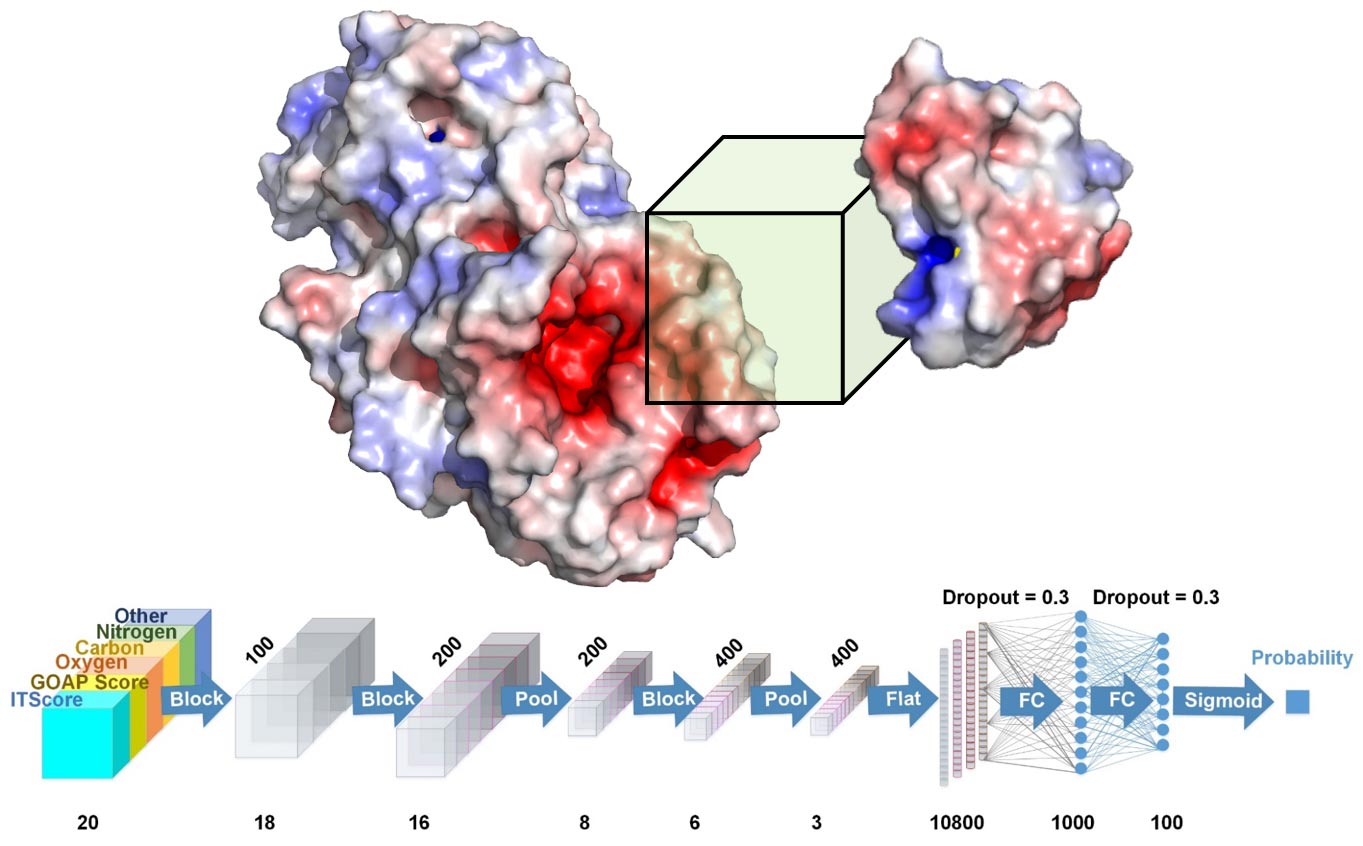
    DOVE, created by Purdue researchers, captures structural and energetic features of the interface of a protein docking model with a 3D box and judges if the model is more likely to be correct or incorrect using 3D convolutional neural network. Credit: Daisuke Kihara/Purdue University

    Proteins are often called the working molecules of the human body. A typical body has more than 20,000 different types of proteins, each of which is involved in many functions essential to human life.

    Now, Purdue University researchers have designed a novel approach to use deep learning to better understand how proteins interact in the body – paving the way to producing accurate structure models of protein interactions involved in various diseases and to design better drugs that specifically target protein interactions. The work is released online in Bioinformatics.

    “To understand molecular mechanisms of functions of protein complexes, biologists have been using experimental methods such as X-rays and microscopes, but they are time- and resource-intensive efforts,” said Daisuke Kihara, a professor of biological sciences and computer science in Purdue’s College of Science, who leads the research team. “Bioinformatics researchers in our lab and other institutions have been developing computational methods for modeling protein complexes. One big challenge is that a computational method usually generates thousands of models, and choosing the correct one or ranking the models can be difficult.”

    Kihara and his team developed a system called DOVE, DOcking decoy selection with Voxel-based deep neural nEtwork, which applies deep learning principles to virtual models of protein interactions. DOVE scans the protein-protein interface of a model and then uses deep learning model principles to distinguish and capture structural features of correct and incorrect models.

    “Our work represents a major advancement in the field of bioinformatics,” said Xiao Wang, a graduate student and member of the research team. “This may be the first time researchers have successfully used deep learning and 3D features to quickly understand the effectiveness of certain protein models. Then, this information can be used in the creation of targeted drugs to block certain protein-protein interactions.”

    Reference: “Protein docking model evaluation by 3D deep convolutional neural networks” by Xiao Wang, Genki Terashi, Charles W Christoffer, Mengmeng Zhu and Daisuke Kihara, 20 November 2019, Bioinformatics.
    DOI: 10.1093/bioinformatics/btz870

    Kihara has worked with the Purdue Research Foundation Office of Technology Commercialization on some of his research and technology.

    Never miss a breakthrough: Join the SciTechDaily newsletter.
    Follow us on Google and Google News.

    Machine Learning Pharmaceuticals Purdue University
    Share. Facebook Twitter Pinterest LinkedIn Email Reddit

    Related Articles

    New Deep Learning Model Could Accelerate the Process of Discovering New Medicines

    Neural Network Helps Predict New Drug Combinations To Fight COVID-19

    MIT Develops Machine-Learning Approach to Finding New Treatment Options for COVID-19

    AI Machine Learning Innovation to Develop Chemical Library for Drug Discovery

    Quantum Computing Engaged to Discover Possible COVID-19 Treatments

    Supercomputer Simulations Identify Several Drugs as Potential Candidates Against COVID-19

    Creating Better Drugs With This ‘Lemon’ for Machine Learning

    MIT Biological Engineers Solve An Arthritis Drug Mystery

    MIT Spinout Develops Smart Needle-Free Drug Injector

    Leave A Reply Cancel Reply

    • Facebook
    • Twitter
    • Pinterest
    • YouTube

    Don't Miss a Discovery

    Subscribe for the Latest in Science & Tech!

    Trending News

    Largest-Ever Study Finds Medicinal Cannabis Ineffective for Anxiety, Depression, PTSD

    250-Million-Year-Old Egg Solves One of Evolution’s Biggest Mysteries

    Living With Roommates Might Be Changing Your Gut Microbiome Without You Knowing

    Century-Old Cleaning Chemical Linked to 500% Increased Risk of Parkinson’s Disease

    What if Your Memories Never Happened? Physicists Take a New Look at the Boltzmann Brain Paradox

    One of the Universe’s Largest Stars May Be Getting Ready To Explode

    Scientists Discover Enzyme That Could Supercharge Ozempic-Like Weight Loss Drugs

    Popular Sweetener Linked to DNA Damage – “It’s Something You Should Not Be Eating”

    Follow SciTechDaily
    • Facebook
    • Twitter
    • YouTube
    • Pinterest
    • Newsletter
    • RSS
    SciTech News
    • Biology News
    • Chemistry News
    • Earth News
    • Health News
    • Physics News
    • Science News
    • Space News
    • Technology News
    Recent Posts
    • What Did Prehistoric Europeans Eat? Scientists Uncover Surprising Answers
    • Scientists Say This Overlooked Organ Could Hold the Key to Longer Life
    • Want Less Stress? Landmark Study Points to a Simple Habit
    • Scientists Reveal Eating Fruits and Vegetables May Increase Your Risk of Lung Cancer
    • AI Reveals Explosive Growth of Floating Algae Across the World’s Oceans
    Copyright © 1998 - 2026 SciTechDaily. All Rights Reserved.
    • Science News
    • About
    • Contact
    • Editorial Board
    • Privacy Policy
    • Terms of Use

    Type above and press Enter to search. Press Esc to cancel.