
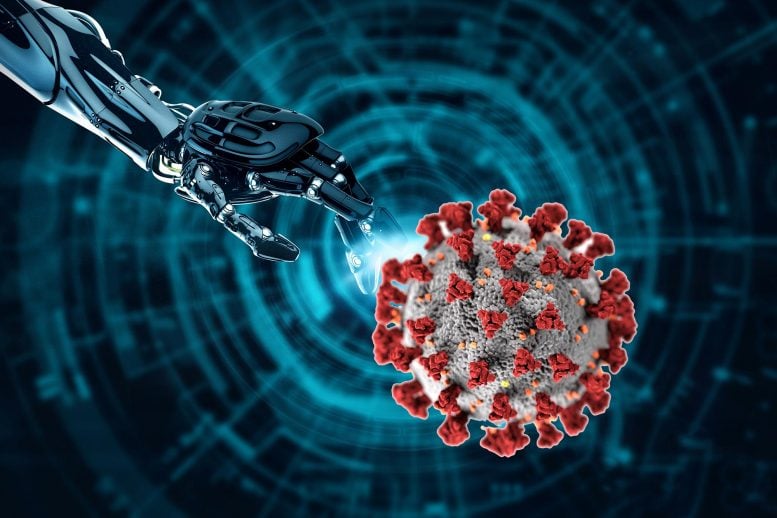
Deep Learning Identifies Synergistic Drug Blends for Treating Viruses Like SARS-CoV-2
The existential threat of COVID-19 has highlighted an acute need to develop working therapeutics against emerging health concerns. One of the luxuries deep learning has afforded us is the ability to modify the landscape as it unfolds — so long as we can keep up with the viral threat, and access the right data.
As with all new medical maladies, oftentimes the data need time to catch up, and the virus takes no time to slow down, posing a difficult challenge as it can quickly mutate and become resistant to existing drugs. This led scientists from MIT’s Computer Science and Artificial Intelligence Laboratory (CSAIL) and the Jameel Clinic for Machine Learning in Health to ask: How can we identify the right synergistic drug combinations for the rapidly spreading SARS-CoV-2?
Typically, data scientists use deep learning to pick out drug combinations with large existing datasets for things like cancer and cardiovascular disease, but, understandably, they can’t be used for new illnesses with limited data.
A Dual-Function Neural Network Approach
Without the necessary facts and figures, the team needed a new approach: a neural network that wears two hats. Since drug synergy often occurs through inhibition of biological targets (like proteins or nucleic acids), the model jointly learns drug-target interaction and drug-drug synergy to mine new combinations. The drug-target predictor models the interaction between a drug and a set of known biological targets that are related to the chosen disease. The target-disease association predictor learns to understand a drug’s antiviral activity, which means determining the virus yield in infected tissue cultures. Together, they can predict the synergy of two drugs.
Two new drug combinations were found using this approach: remdesivir (currently approved by the FDA to treat COVID-19) and reserpine, as well as remdesivir and IQ-1S, which, in biological assays, proved powerful against the virus. The study has been published in the Proceedings of the National Academy of Sciences.
“By modeling interactions between drugs and biological targets, we can significantly decrease the dependence on combination synergy data,” says Wengong Jin SM ’18, a postdoc at the Broad Institute of MIT and Harvard who recently completed his doctoral work in CSAIL, and who is the lead author on a new paper about the research. “In contrast to previous approaches using drug-target interaction as fixed descriptors, our method learns to predict drug-target interaction from molecular structures. This is advantageous since a large proportion of compounds have incomplete drug-target interaction information.”
Benefits of Combination Therapy Against Resistance
Using multiple medications to maximize potency, while also decreasing side effects, is practically ubiquitous for aforementioned cancer and cardiovascular disease, including a host of others such as tuberculosis, leprosy, and malaria. Using specialized drug cocktails can, quite importantly, reduce the grave and sometimes public threat of resistance (think methicillin-resistant Staphylococcus aureus known as “MRSA”), since many drug-resistant mutations are mutually exclusive. It’s much harder for a virus to develop two mutations at the same time and then become resistant to two drugs in a combination therapy.
Importantly, the model isn’t limited to just one SARS-CoV-2 strain — it could also potentially be used for the increasingly contagious Delta variant or other variants of concern that may arise. To extend the model’s efficacy against these strains, you’d only need additional drug combination synergy data for the relevant mutation(s). In addition, the team applied their approach to HIV and pancreatic cancer.
To further refine their biological modeling down the line, the team plans to incorporate additional information such as protein-protein interaction and gene regulatory networks.
Another direction for future work they’re exploring is something called “active learning.” Many drug combination models are biased toward certain chemical spaces due to their limited size, so there’s high uncertainty in predictions. Active learning helps guide the data collection process and improve accuracy in a wider chemical space.
Reference: “Deep learning identifies synergistic drug combinations for treating COVID-19” by Wengong Jin, Jonathan M. Stokes, Richard T. Eastman, Zina Itkin, Alexey V. Zakharov, James J. Collins, Tommi S. Jaakkola and Regina Barzilay, 15 September 2021, Proceedings of the National Academy of Sciences.
DOI: 10.1073/pnas.2105070118
Jin wrote the paper alongside Jonathan M. Stokes, Banting Fellow at The Broad Institute of MIT and Harvard; Richard T. Eastman, a scientist at the National Center for Advancing Translational Sciences; Zina Itkin, a scientist at National Institutes of Health; Alexey V. Zakharo, informatics lead at the National Center for Advancing Translational Sciences (NCATS); James J. Collins, professor of biological engineering at MIT; and Tommi S. Jaakkola and Regina Barzilay, MIT professors of electrical engineering and computer science at MIT.
This project is supported by the Abdul Latif Jameel Clinic for Machine Learning in Health; the Defense Threat Reduction Agency; Patrick J. McGovern Foundation; the DARPA Accelerated Molecular Discovery program; and in part by the Intramural/Extramural Research Program of the National Center for Advancing Translational Sciences within the National Institutes of Health.
Never miss a breakthrough: Join the SciTechDaily newsletter.
Follow us on Google and Google News.