
Researchers have developed a new way to improve lithium-ion battery efficiency. Through the growth of a cubic crystal layer, the scientists have created a thin and dense connecting layer between the electrodes of the battery.
Professor Nobuyuki Zettsu from the Center for Energy and Environmental Science in the Department of Materials Chemistry of Shinshu University in Japan and the director of the center, Professor Katsuya Teshima, led the research. The authors published their results online in January this year in Scientific Reports.
“Owing to some intrinsic characteristics of liquid electrolytes, such as low lithium transport number, complex reaction at the solid/liquid interface, and thermal instability, it has not been possible to simultaneously achieve high energy and power in any of the current electrochemical devices,” said Nobuyuki Zettsu, as first author on the paper.
Lithium-ion batteries are rechargeable and power such devices as cell phones, laptops, power tools, and even store power for the electrical grid. They’re particularly sensitive to temperature fluxes, and have been known to cause fires or even explosions. In response to the problems with liquid electrolytes, scientists are working toward developing a better all-solid-state battery without liquid.
“Despite the expected advantages of all-solid-state batteries, their power characteristic and energy densities must be improved to allow their application in such technologies as long-range electric vehicles,” Zettsu said. “The low rate capabilities and low energy densities of the all-solid-state batteries are partly due to a lack of suitable solid-solid heterogeneous interface formation technologies that exhibit high ionic conductivity comparable to liquid electrolyte systems.”
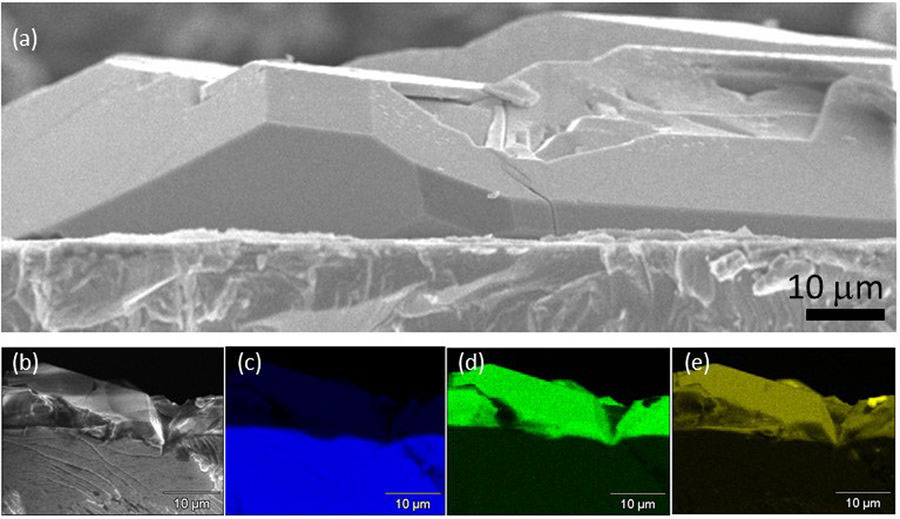
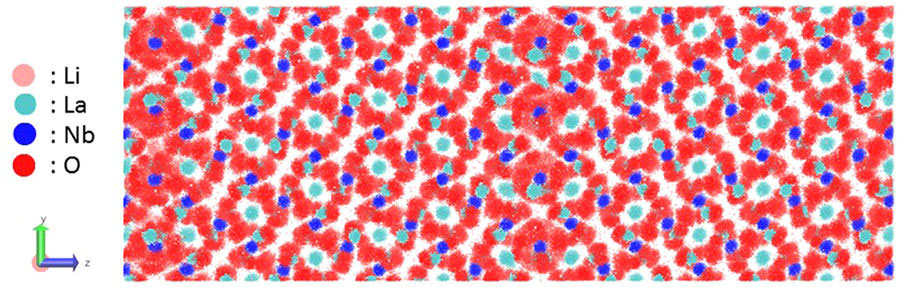
Zettsu and his team grew garnet-type oxide solid electrolyte crystals in molten LiOH used as a solvent (flux) on a substrate that bonded the electrode into a solid state as they grew. A specific crystal compound known to grow cubically allowed the researchers to control the thickness and connection area within the layer, which acts as a ceramic separator.
“Electron microscopy observations revealed that the surface is densely covered with well-defined polyhedral crystals. Each crystal is connected to neighboring ones,” wrote Zettsu.
Zettsu also said that the newly grown crystal layer could be the ideal ceramic separator when stacking the electrolyte layer on the electrode layer.
“We believe that our approach having robustness against side reactions at the interface could possibly lead to the production of ideal ceramic separators with a thin and dense interface,” wrote Zettsu, noting that the ceramics used in this particular experiment were too thick to be used in solid batteries. “However, as long as the electrode layer can be made as thin as 100 microns, the stacking layer will operate as a solid battery.”
One hundred microns is about the width of a human hair, and slightly less than twice the thickness of a standard electrode layer in contemporary lithium-ion batteries.
“All-solid-state batteries are promising candidates for energy storage devices,” Zettsu said, noting that several collaborations between researchers and private companies are already underway with the ultimate goal of displaying all-solid-state battery samples at the 2020 Olympic games in Tokyo.
Zettsu and other researchers plan to fabricate prototype cells for electric vehicle use and for wearable devices by 2022.
Reference: “Thin and Dense Solid-solid Heterojunction Formation Promoted by Crystal Growth in Flux on a Substrate” by Nobuyuki Zettsu, Hiromasa Shiiba, Hitoshi Onodera, Kazune Nemoto, Takeshi Kimijima, Kunio Yubuta, Masanobu Nakayama and Katsuya Teshima, 8 January 2018, Scientific Reports.
DOI: 10.1038/s41598-017-18250-9
Never miss a breakthrough: Join the SciTechDaily newsletter.
Follow us on Google and Google News.