
Including fathers in strategies to improve infant health could help narrow disparities.
- Findings highlight racial disparities in sudden unexpected infant death in the U.S.
- Only 16% fathers followed all three AAP-recommended infant sleep practices
- Rates of breastfeeding initiation and breastfeeding at eight weeks were much higher among fathers who wanted their infant’s mother to breastfeed than those who did not or had no opinion
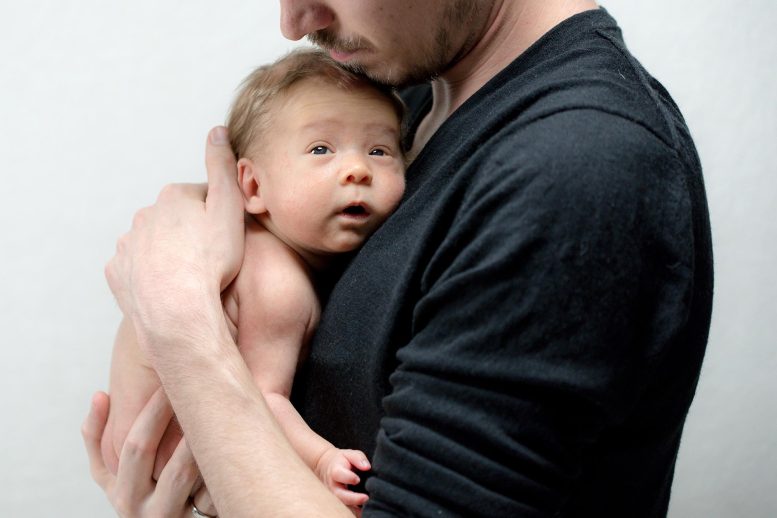
Fathers can make a huge difference in whether an infant is breastfed and placed to sleep safely, according to a recent survey of new fathers led by scientists at Northwestern University and the Ann & Robert H. Lurie Children’s Hospital of Chicago.
The study included 250 fathers who were surveyed two to six months after the birth of their infant. The survey findings are among the first to describe father-reported attitudes toward and experiences with breastfeeding and infant sleep practices in a state-representative sample. They were published on June 16 in the journal Pediatrics.
Among fathers who wanted their infant’s mother to breastfeed, 95% reported breastfeeding initiation and 78% reported breastfeeding at eight weeks. This is significantly higher than the rates reported by fathers who had no opinion or did not want their infant’s mother to breastfeed – 69% of these fathers reported breastfeeding initiation and 33% reported breastfeeding at eight weeks.
The scientists also found that 99% of fathers reported placing their infant to sleep, but only 16% implemented all three American Academy of Pediatrics-recommended infant sleep practices (using the back sleep position, an approved sleep surface, and avoiding soft bedding). Almost a third of fathers surveyed were missing at least one key component of safe sleep education.
“Our findings underscore that new fathers are a critical audience to promote breastfeeding and safe infant sleep,” said lead study author Dr. John James Parker, an instructor of pediatrics at Northwestern University Feinberg School of Medicine, pediatrician at Lurie Children’s and an internist at Northwestern Medicine. “Many families do not gain the health benefits from breastfeeding because they are not provided the support to breastfeed successfully. Fathers need to be directly engaged in breastfeeding discussions, and providers need to describe the important role fathers play in breastfeeding success.”
Racial Disparities in Rates of SIDS in the U.S.
Black fathers were less likely to use the back sleep position and more likely to use soft bedding than white fathers. More than 3,000 infants die of sleep-related deaths per year in the U.S. Nationally, the rate of sudden unexpected infant death (SIDS) of Black infants is more than twice that of white infants, and unsafe sleep practices may contribute to this disparity, the study authors said.
“Fathers need to receive counseling on all the safe sleep practices for their infants,” Parker said. “To reduce racial disparities in sudden unexpected infant death, we need tailored strategies to increase safe infant sleep practices in the Black community, including public campaigns to increase awareness and home visiting programs. These interventions must involve both parents to be most effective.”
New Survey Highlights Unique Needs of New Fathers
Recognizing that new dads play an important role in the health and well-being of children and families, senior author Dr. Craig Garfield, professor of pediatrics and medical social sciences at Feinberg and a Lurie Children’s pediatrician, partnered with the Centers for Disease Control and Prevention (CDC) and the Georgia Department of Public Health to develop and pilot the new survey tool used in this study called Pregnancy Risk Assessment Monitoring System (PRAMS) for Dads.
The tool was modeled after PRAMS, an annual surveillance tool the CDC and public health departments have used for more than 35 years to survey new mothers. PRAMS for Dads is, for the first time, providing data on the unique needs of new fathers. The survey gathers data on the health behaviors and experiences of men as they enter fatherhood.
“As pediatricians, we focus on how to ensure the best health outcomes for children, with successful breastfeeding and safe sleep practices being two key behaviors that impact children’s health,” said Garfield, who also is the founder of the Family & Child Health Innovations Program (FCHIP) at Lurie Children’s. “Our study highlights the fact that fathers play a big role in both these behaviors, but there is more to be done to support fathers.”
For example, Garfield said they found that fathers with college degrees were more likely to report that their baby breastfed, and they were more likely to receive guidance on infant sleep safety.
“To improve child health outcomes, we need to make sure breastfeeding and safe sleep guidance reach all new parents equitably,” Garfield said.
Reference: “Fathers, Breastfeeding, and Infant Sleep Practices: Findings From a State-Representative Survey” by John James Parker, MD; Clarissa Simon, PhD, MPH; Anne Bendelow, MPH; Michael Bryan, PhD, MPH; Ruben A. Smith, PhD, MS; Katherine Kortsmit, PhD, MPH, RD; Beatriz Salvesen von Essen, MPH; Letitia Williams, MPH; Ada Dieke, DrPH; Lee Warner, PhD, MPH and Craig F. Garfield, MD, MAPP, 16 June 2023, Pediatrics.
DOI: 10.1542/peds.2022-061008
This project was supported by the CDC (Cooperative agreement #U38OT00140) and CDC Innovation Fund, Office of Science/Office of Technology and Innovation.
Never miss a breakthrough: Join the SciTechDaily newsletter.
Follow us on Google and Google News.