
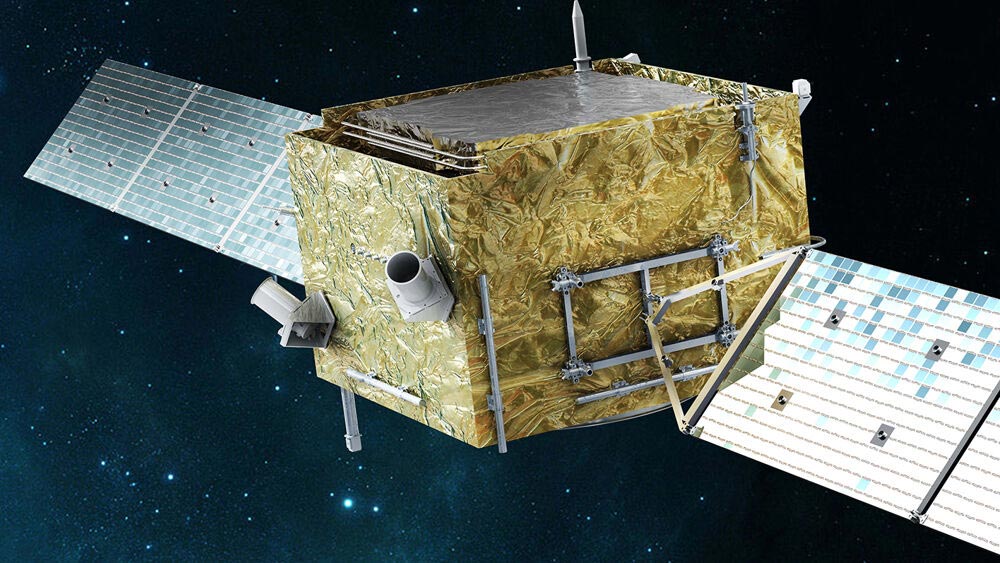
DAMPE revealed a spectral softening in helium at 34 TeV, implying nearby cosmic-ray sources with energy ceilings for particle acceleration.
Dark Matter Particle Explorer (DAMPE) Collaboration directly observed a spectral softening of helium nuclei at about 34TeV for the first time. This work was based on measurements data of the helium spectrum with kinetic energies from 70 GeV to 80 TeV (17.5 GeV/n to 20 TeV/n for per nucleon) recorded by the DAMPE.
The relevant results were published in Physical Review Letters.
Galactic cosmic rays (GCRs) offers important ways to deeply understand the astrophysical particle origin and accelerators and the interstellar medium of the Galaxy. Helium nuclei, the second most abundant nuclear element of cosmic rays, is a distinguishing feature of space.
As for GCRs, the energy spectrum is supposed to follow a negative power law distribution when energies are below the “knee” (at 3-4 PeV). Nevertheless, recent experiments observed a hardening of the spectrum at kinetic energy of several hundred GeV/n, indicating possible new sources and acceleration mechanism of GCRs.
DAMPE Data Reveal Dual Spectral Features
In this study, the GCR helium spectrum from 70 GeV to 80 TeV was measured using 4.5 years of the DAMPE flight data. The maximum measurable rigidity reached by DAMPE improved to 10 times higher than that detected by the Alpha Magnetic Spectrometer (AMS-02) led by DING Zhaozhong. The results confirmed the hardening feature of the helium spectrum, reported previously in experiments measured by AMS-02, at around 1.2 TeV given a high significance of 24.6σ. Besides, a softening feature was further revealed at around 34 TeV with a significance of 4.3σ.
DAMPE Collaboration published the measurement results of cosmic-ray proton spectrum in 2019 (Science Advances) and observed changes of the spectral index at about 14 TeV. Compared with the DAMPE proton spectrum, The DAMPE helium nuclei spectrum showed similar trend, which means the changes of power-law spectral indices γ may be dependent on particle charge, though a mass-dependent softening could not be excluded limited by current data.
In this work, the team led by Prof. HUANG Guangshun and Prof. ZHANG Yunlong from the State Key Laboratory of Particle Detection and Electronics of the University of Science and Technology of China (USTC) first identified the quenching effect of BGO crystals on relativistic heavy ions by investigating the ionization energy response of BGO calorimeter to ions. Prof. WEI Yifeng quantified quenching factors of ions with different energies. This work efficiently helped the reconstruction of helium energy spectrum.
BGO calorimeter, the main sub-detector for energy measurement of DAMPE, was designed by the team led by Prof. AN Qi and Prof. LIU Shubin from USTC. It covers wider range of energies, and has better energy resolution and particle discrimination ability than other on-orbit detectors.
These results suggest the existence of an accelerator for cosmic rays near earth producing protons and helium nuclei, and the softening energy is related to its upper limit value, which extends our understanding of GCR sources and acceleration mechanisms.
Reference: “Measurement of the Cosmic Ray Helium Energy Spectrum from 70 GeV to 80 TeV with the DAMPE Space Mission” by F. Alemanno et al. (DAMPE Collaboration), 18 May 2021, Physical Review Letters.
DOI: 10.1103/PhysRevLett.126.201102
Never miss a breakthrough: Join the SciTechDaily newsletter.
Follow us on Google and Google News.
4 Comments
The numerical data used for detection and measurement of cosmic ray origined in universe in inþergalactic spàce by the galaxy,here to mention our own galaxy milkyway are eye soothing.This is mere to say that energy value obtained for this,say 34 TeV is perfectly accurate.So,thanks for good and precise experiment with fine observation.
The numerical data used for detection and measurement of cosmic ray origined in universe in inþergalactic spàce by the galaxy,here to mention our own galaxy milkyway are eye soothing.This is mere to say that energy value obtained for this,say 34 TeV is perfectly accurate.So,thanks for good and precise experiment with fine observation.However,an explanation may be be produced that,here gravity has been balanced to mobilize the cosmic ray to any point intra- or inter- galactic in space.
The numerical data used for detection and measurement of cosmic ray origined in universe in inþergalactic spàce by the galaxy,here to mention our own galaxy milkyway are eye soothing.This is mere to say that energy value obtained for this,say 34 TeV is perfectly accurate.So,thanks for good and precise experiment with fine observation.However,an explanation may be be produced that,here gravity has been balanced to mobilize the cosmic ray to any point intra- or inter- galactic in space.Again if compaed,the energy values for
lines(softening) differently for- 1.proton & 2.helium
then there is a notion of havig some process that initites at proton(hydrogen) and quantizedly changing for helium.
There is a certain well defined process or phenomena occuring that is changing(softening) indivisual spectrum lines for- 1.Protons(Hydrògen nuclei) & 2.Helium nuclei quantizedly,initiating at the protons.