
Deep Oceans Dissolve the Rocky Shell of Water-Ice Planets
What is happening deep beneath the surface of ice planets? Is there liquid water, and if so, how does it interact with the planetary rocky “seafloor?” New experiments show that on water-ice planets between the size of our Earth and up to six times this size, water selectively leaches magnesium from typical rock minerals. The conditions with pressures of a hundred thousand atmospheres and temperatures above one thousand degrees Celsius were recreated in a lab and mimicked planets similar, but smaller than Neptune and Uranus.
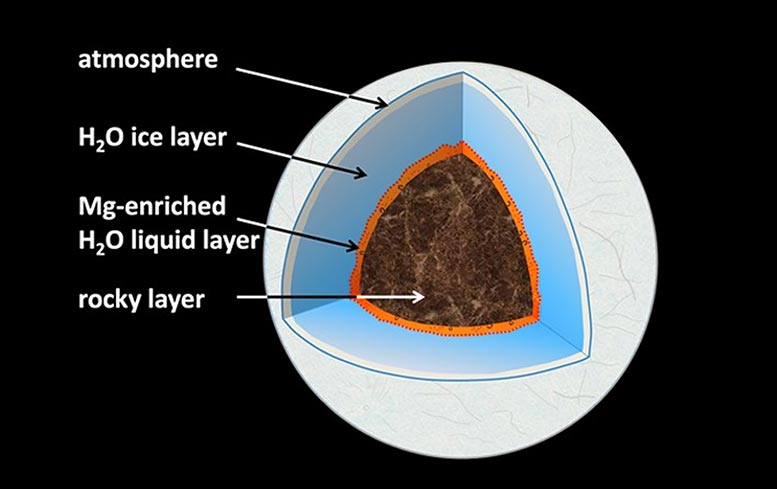
The mechanisms of water-rock interaction at the Earth’s surface are well known, and the picture of the complex cycle of H2O in the deep interior of our and other terrestrial planets is constantly improving. However, we do not know what happens at the interface between hot, dense H2O and the deep rocky shell of water-ice planets at pressures and temperatures orders of magnitude higher than at the bottom of the deepest oceans on Earth. In the solar system, Neptune and Uranus are classified as ice-giants; they have a thick external water-ice layer, which is underlain by a deep rocky layer, and it is still discussed whether the temperature at the interface is high enough to form liquid water.
An international research team lead by Taehyun Kim of the Yonsei University of Seoul, Korea, including scientists from the University of Arizona, DESY, Argonne National Laboratory, and Sergio Speziale of the GFZ German Research Centre for Geosciences, conducted a series of challenging experiments both at PETRA III (Hamburg) and the Advanced Photon Source (Argonne, U.S.A.) showing how water strongly leaches magnesium oxide (MgO) from certain minerals, i.e. ferropericlase (Mg,Fe)O and olivine (Mg,Fe)2SiO4 at pressures between 20 and 40 Gigapascal (GPa). This equals 200,000 to 400,000 times the atmospheric pressure on Earth and temperatures above 1500 K (~ 1230 °C), conditions which are present at the interface between deep oceans and the rocky mantle in sub-Neptune class of water planets.
Implications for Thermal Histories of Ice Giants
Sergio Speziale says: “These findings open new scenarios for the thermal history of large icy planets such as Neptune and Uranus.” The results of this study are published in the scientific journal Nature Astronomy.
Tiny pellets of either ferropericlase or olivine powder were loaded together with water in a tiny sample chamber (less than a millimeter in diameter) drilled in a metal foil and squeezed between two gem-quality diamonds culets using a diamond anvil cell (DAC). The samples were heated by shining an infrared laser through the diamond anvils. Synchrotron x-ray diffraction was used to determine minerals transformation and breakdown induced by reactions with water.
A sudden decrease of diffraction signal from the starting minerals, and the appearance of new solid phases including brucite (magnesium hydroxide) were observed across full heating and quenching cycles. Sergio Speziale explains: “This demonstrated the onset of chemical reactions and the dissolution of the magnesium oxide component of both ferropericlase and olivine; the dissolution was strongest in a specific pressure-temperature range between 20 to 40 Gigapascal and 1,250 to 2,000 Kelvin (1,800 to 3,140 Fahrenheit).”
The details of the reaction process and the consequent chemical segregation of MgO from the residual phases, were confirmed by thorough Scanning Electron Microscopy (SEM) and X-ray spectroscopy of the recovered samples. “At these extreme pressures and temperatures the solubility of magnesium oxide in water reaches levels similar to that of salt at ambient conditions,” Sergio Speziale says.
Planetary Evolution Shaped by Early Water-Rock Chemistry
The scientists conclude that the intensive dissolution of MgO at the interface between the H2O layer and underlying rocky mantle could produce, in water-rich sub-Neptune exo-planets with appropriate size and composition such as TRAPPIST-1f, chemical gradients in the early hot phases of the planets’ history. These gradients with differentiated distribution of magnesium oxide at the planetary seafloor could be partially preserved across their long cooling evolution. Tracks of initial relatively shallow interactions between water and rocky material during planetary accretion could be also preserved for billions of years in large icy planets of the size of Uranus.
Reference: “Atomic-scale mixing between MgO and H2O in the deep interiors of water-rich planets” by Taehyun Kim, Stella Chariton, Vitali Prakapenka, Anna Pakhomova, Hanns-Peter Liermann, Zhenxian Liu, Sergio Speziale, Sang-Heon Shim and Yongjae Lee, 17 May 2021, Nature Astronomy.
DOI: 10.1038/s41550-021-01368-2
Never miss a breakthrough: Join the SciTechDaily newsletter.
Follow us on Google and Google News.