
Close Menu
    Facebook X (Twitter) Instagram
    SciTechDaily
    • Biology
    • Chemistry
    • Earth
    • Health
    • Physics
    • Science
    • Space
    • Technology
    Facebook X (Twitter) Pinterest YouTube RSS
    SciTechDaily
    Home»Space»Dawn of a Galactic Collision – Hubble Views Markarian 266
    Space

    Dawn of a Galactic Collision – Hubble Views Markarian 266

    By Hubble Space TelescopeDecember 14, 2017No Comments3 Mins Read
    Facebook Twitter Pinterest Telegram LinkedIn WhatsApp Email Reddit
    Share
    Facebook Twitter LinkedIn Pinterest Telegram Email Reddit
    Hubble Views NGC 5256
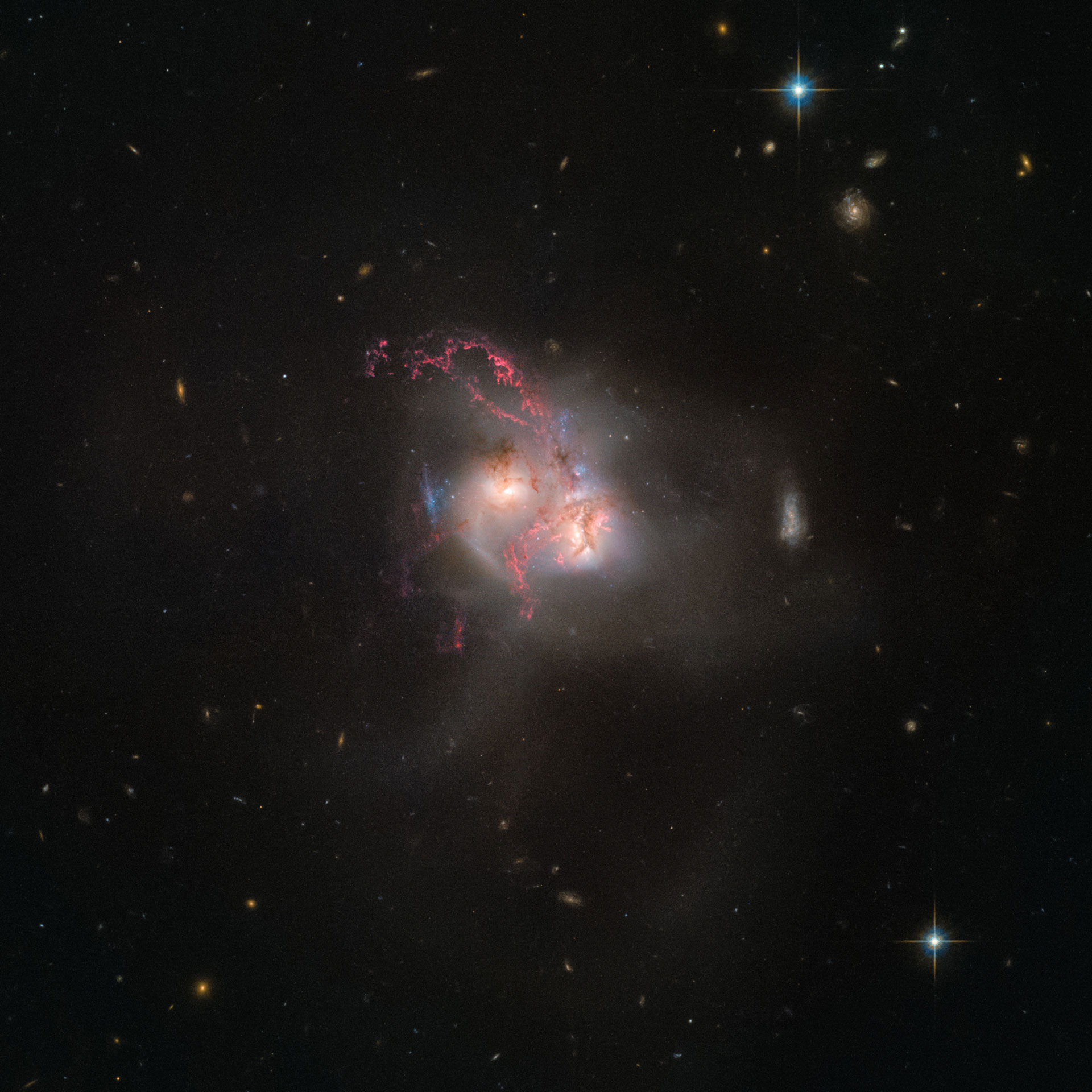
    NGC 5256 is a pair of galaxies in its final stage of merging. It was previously observed by Hubble as part of a collection of 59 images of merging galaxies, released on Hubble’s 18th anniversary on 24 April 2008. The new data make the gas and dust being whirled around inside and outside the galaxy more visible than ever before. This image is composed of data gathered with the Advanced Camera for Surveys and the Wide-Field Camera 3. Credit: ESA/Hubble, NASA

    A riot of color and light dances through this peculiarly shaped galaxy, NGC 5256. Its smoke-like plumes are flung out in all directions and the bright core illuminates the chaotic regions of gas and dust swirling through the galaxy’s center. Its odd structure is due to the fact that this is not one galaxy, but two — in the process of a galactic collision.

    NGC 5256, also known as Markarian 266, is about 350 million light-years away from Earth, in the constellation of Ursa Major (The Great Bear). It is composed of two disc galaxies whose nuclei are currently just 13,000 light-years apart. Their constituent gas, dust, and stars are swirling together in a vigorous cosmic blender, igniting newborn stars in bright star formation regions across the galaxy.

    Interacting galaxies can be found throughout the Universe, producing a variety of intricate structures. Some are quiet, with one galaxy nonchalantly absorbing another. Others are violent and chaotic, switching on quasars, detonating supernovae, and triggering bursts of star formation.

    While these interactions are destructive on a galactic scale, stars very rarely collide with each other in this process because the distances between them are so vast. But as the galaxies entangle themselves, strong tidal effects produce new structures — like the chaotic-looking plumes of NGC 5256 — before settling into a stable arrangement after millions of years.

    In addition to the bright and chaotic features, each merging galaxy of NGC 5256 contains an active galactic nucleus, where gas and other debris are fed into a hungry supermassive black hole. Observations from NASA’s Chandra X-ray Observatory show that both of these nuclei — and the region of hot gas between them — have been heated by shock waves created as gas clouds collide at high velocities.

    Galaxy mergers, like the one NGC 5256 is currently experiencing, were more common early in the Universe and are thought to drive galactic evolution. Today most galaxies show signs of past mergers and near-collisions. Our own Milky Way too has a long history of interaction: it contains the debris of many smaller galaxies it has absorbed in the past; it is currently cannibalizing the Sagittarius Dwarf Spheroidal Galaxy; and in a kind of cosmic payback, the Milky Way will merge with our neighbor, the Andromeda Galaxy in about two billion years.

    Also in this Hubble image is another pair of probably interacting galaxies — they are hiding to the right of NGC 5256 in the far distance, and have not yet been explored by any astronomer. From our perspective here on Earth, NGC 5256 is also just a few degrees away from another famous pair of interacting galaxies, Messier 51, which was observed by Hubble in 2005.

    Never miss a breakthrough: Join the SciTechDaily newsletter.
    Follow us on Google and Google News.

    Astronomy Cosmology Hubble Space Telescope
    Share. Facebook Twitter Pinterest LinkedIn Email Reddit

    Related Articles

    Hubble Image of the Week: Starburst Galaxy Messier 94

    ESO and Hubble Reveal Fast-Moving, Wave-Like Features in the Debris Disk Around AU Microscopii

    New Phoenix Cluster Observations Provide A Fresh Perspective

    Hubble Image of Arp 194 – Cosmic Optical Illusions in Ursa Major

    Hubble Image of the Week – Evolution in Slow Motion

    Hubble Explores the Wings of the Twin Jet Nebula

    Astronomers Discover Supernovae in ‘Wrong Place at Wrong Time’

    Hubble Reveals Diffusion of Stars Through the Core of the Globular Cluster 47 Tucanae

    Study Suggest Spiral Galaxies Are Larger Than Previously Thought

    Leave A Reply Cancel Reply

    • Facebook
    • Twitter
    • Pinterest
    • YouTube

    Don't Miss a Discovery

    Subscribe for the Latest in Science & Tech!

    Trending News

    New Pill Lowers Stubborn Blood Pressure and Protects the Kidneys

    Humans May Have Hidden Regenerative Powers, New Study Suggests

    Scientists Just Solved the Mystery of Why Crabs Walk Sideways

    Doctors Are Surprised by What This Vaccine Is Doing to the Heart

    This Popular Supplement May Boost Your Brain, Not Just Your Muscles

    Scientists Say This Simple Supplement May Actually Reverse Heart Disease

    Warming Oceans Could Trigger a Dangerous Methane Surge

    This Simple Movement Could Be Secretly Cleaning Your Brain

    Follow SciTechDaily
    • Facebook
    • Twitter
    • YouTube
    • Pinterest
    • Newsletter
    • RSS
    SciTech News
    • Biology News
    • Chemistry News
    • Earth News
    • Health News
    • Physics News
    • Science News
    • Space News
    • Technology News
    Recent Posts
    • Astronomers Stunned by Ancient Galaxy With No Spin
    • Physicists May Be on the Verge of Discovering “New Physics” at CERN
    • AI Learns To Work Backward and Reveal Hidden Forces in Nature
    • Scientists Warn of Rising Male Childlessness As Global Fertility Changes
    • New Discovery Challenges Decades-Old Theory of DNA Damage and Aging
    Copyright © 1998 - 2026 SciTechDaily. All Rights Reserved.
    • Science News
    • About
    • Contact
    • Editorial Board
    • Privacy Policy
    • Terms of Use

    Type above and press Enter to search. Press Esc to cancel.