
Easter Island Inhabitants Found Ingenious Ways To Adapt to a Harsh Environment
Recent studies refute the long-held belief of ecological collapse on Easter Island, showing instead that the population remained stable through effective resource management.
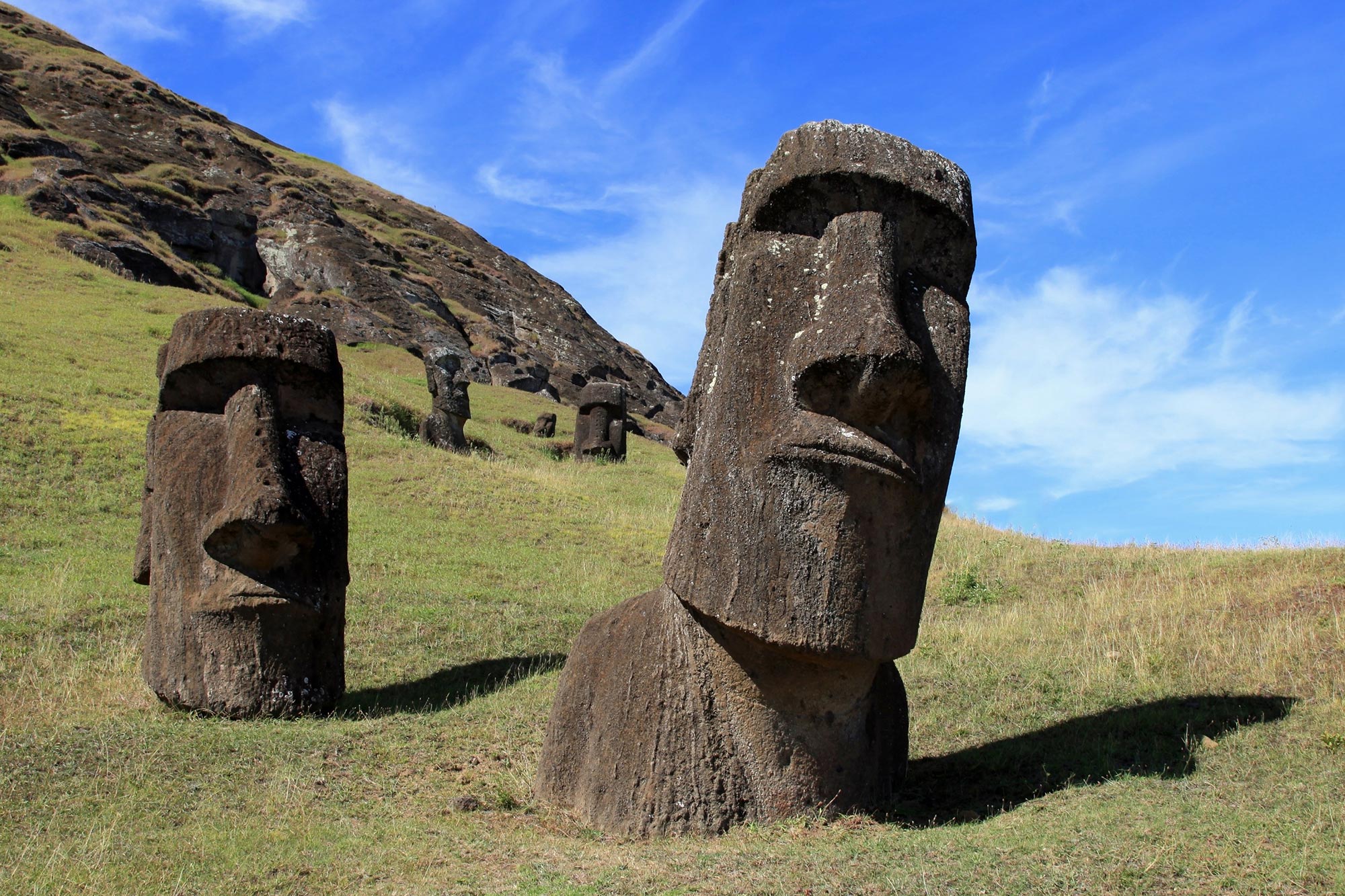
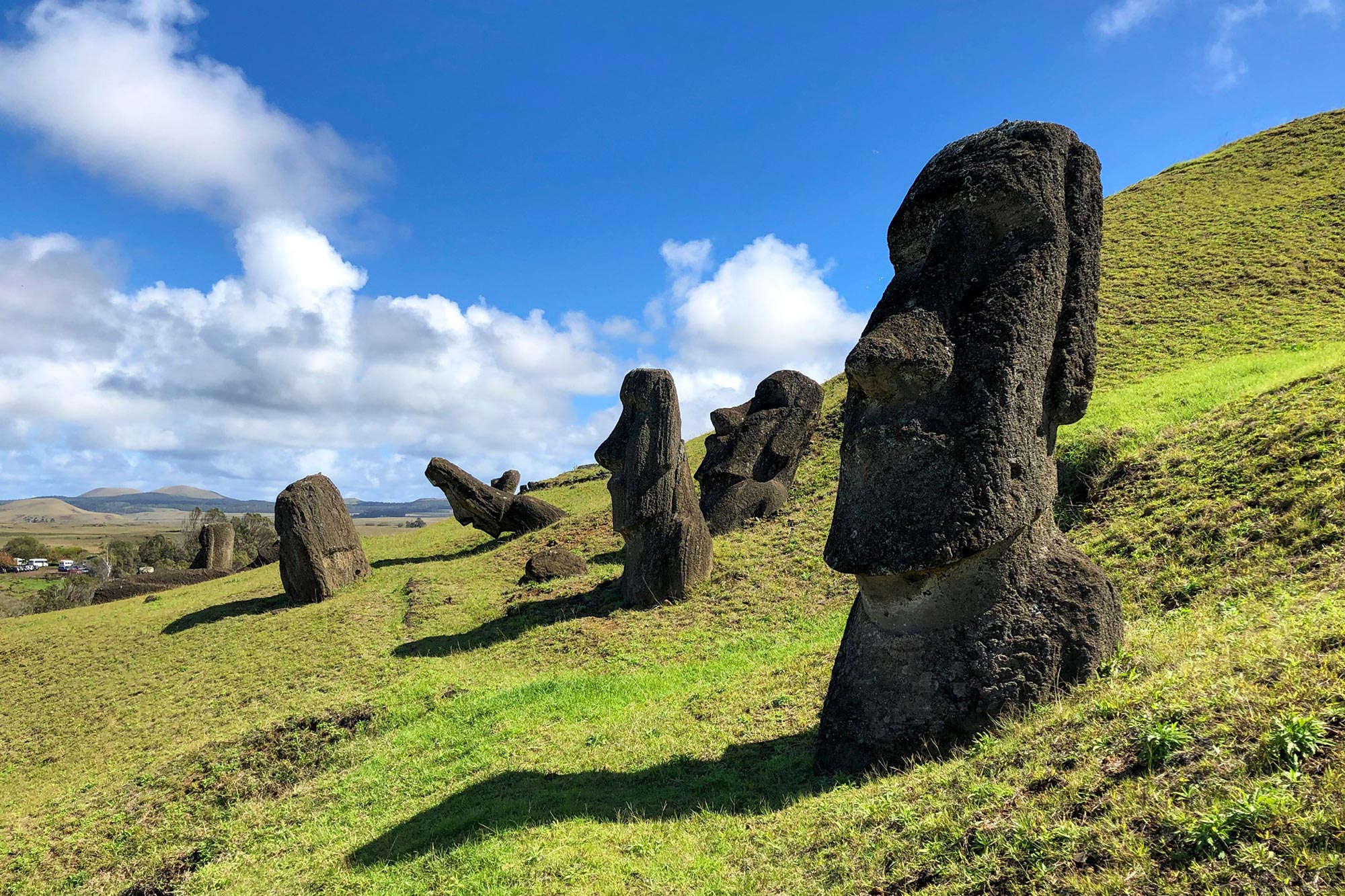
Some 1,000 years ago, a small band of Polynesians sailed thousands of miles across the Pacific to settle one of the world’s most isolated places—a small, previously uninhabited island they named Rapa Nui. There, they erected hundreds of “moai,” or gigantic stone statues that now famously stand as emblems of a vanished civilization. Eventually, their numbers ballooned to unsustainable levels; they chopped down all the trees, killed off the seabirds, exhausted the soils, and in the end, ruined their environment. Their population and civilization collapsed, with just a few thousand people remaining when Europeans found the island in 1722 and called it Easter Island. At least that is the longtime story, told in academic studies and popular books like Jared Diamond’s 2005 “Collapse.”
Revisiting the Ecocide Theory with New Research
A new study challenges this narrative of ecocide, saying that Rapa Nui’s population never spiraled to unsustainable levels. Instead, the settlers found ways to cope with the island’s severe limits, and maintained a small, stable population for centuries. The evidence: a newly sophisticated inventory of ingenious “rock gardens” where the islanders raised highly nutritious sweet potatoes, a staple of their diet. The gardens covered only enough area to support a few thousand people, say the researchers. The study was just published in the journal Science Advances.
“This shows that the population could never have been as big as some of the previous estimates,” said lead author Dylan Davis, a postdoctoral researcher in archaeology at the Columbia Climate School. “The lesson is the opposite of the collapse theory. People were able to be very resilient in the face of limited resources by modifying the environment in a way that helped.”
Geographic and Agricultural Challenges on Easter Island
Easter Island is arguably the remotest inhabited spot on Earth, and one of the last to be settled by humans, if not the last. The nearest continental landmass is central Chile, nearly 2,200 miles to the east. Some 3,200 miles to the west lie the tropical Cook Islands, where settlers are thought to have sailed from around 1200 CE.
The 63-square-mile island is made entirely of volcanic rock, but unlike lush tropical islands such as Hawaii and Tahiti, eruptions ceased hundreds of thousands of years ago, and mineral nutrients brought up by lava have long since eroded from soils. Located in the subtropics, the island is also dryer than its tropical brethren. To make things more challenging, surrounding ocean waters drop off steeply, meaning islanders had to work harder to harvest marine creatures than those living on Polynesian islands ringed with accessible and productive lagoons and reefs.
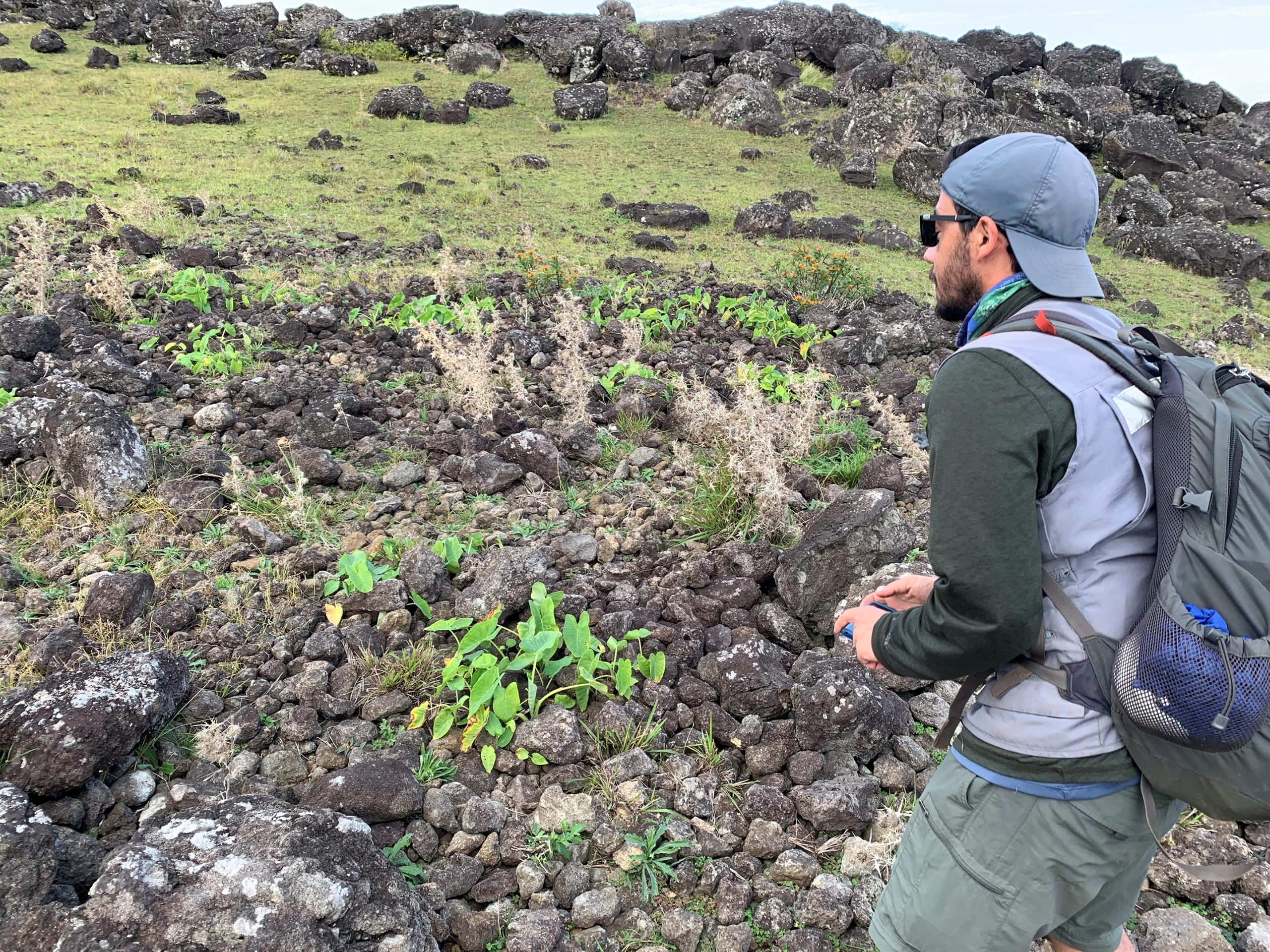
To cope, the settlers used a technique called rock gardening, or lithic mulching. This consists of scattering rocks over low-lying surfaces that are at least partly protected from salt spray and wind. In the interstices between rocks, they planted sweet potatoes. Research has shown that rocks from golf ball–size to boulders disrupt drying winds and create turbulent airflow, reducing the highest daytime surface temperatures and increasing the lowest nighttime ones. Smaller bits, broken up by hand, expose fresh surfaces laden with mineral nutrients that get released into the soil as they weather. Some islanders still use the gardens, but even with all this labor, their productivity is marginal. The technique has also been used by indigenous people in New Zealand, the Canary Islands and the U.S. Southwest, among other places.
Re-Evaluating Historical Population Estimates
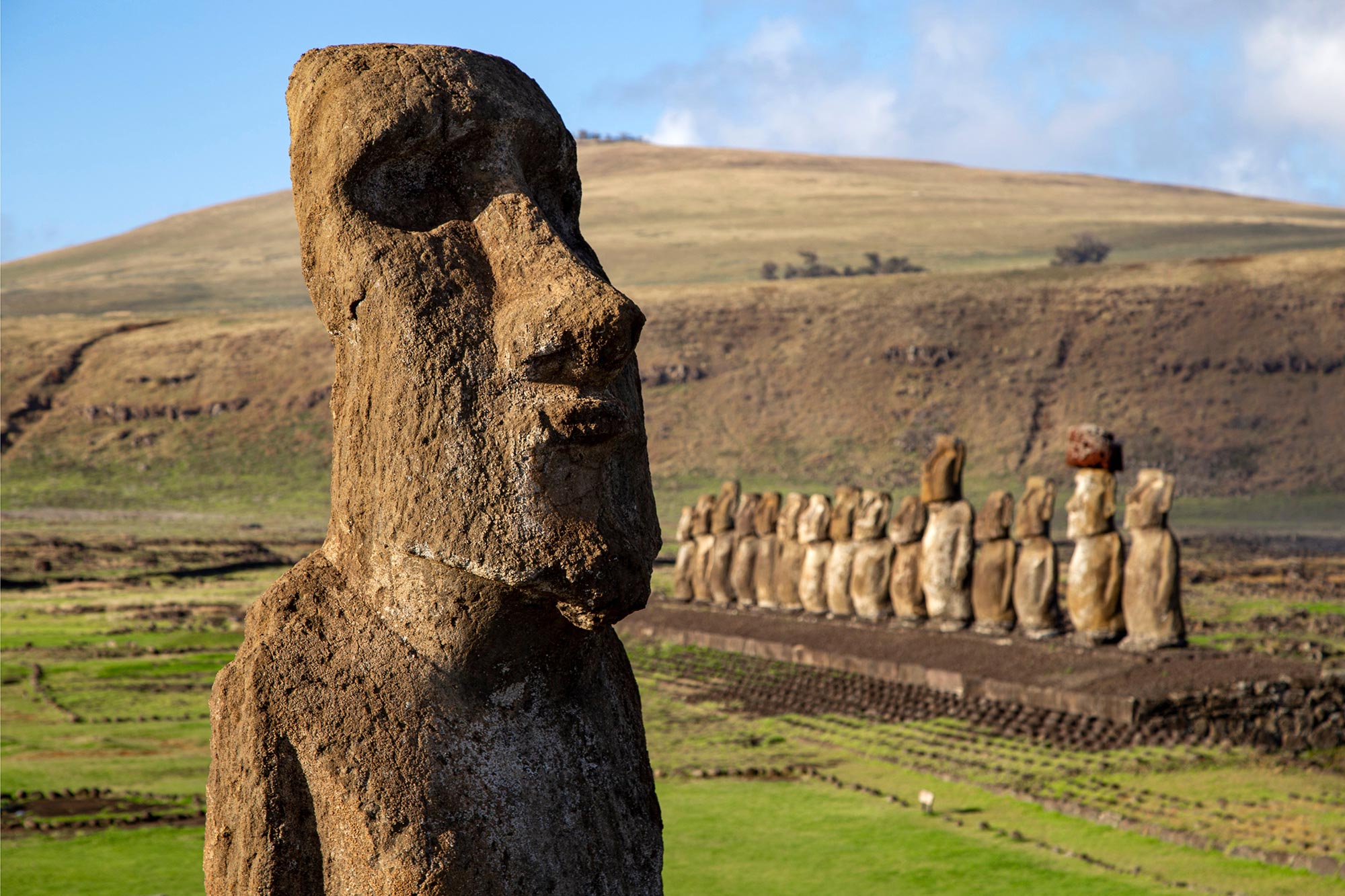
Some scientists have argued that the island’s population had to have once been much larger than the 3,000 or so residents first observed by Europeans in part because of the massive moai; it would have taken hordes of people to construct them, the reasoning goes. Thus in recent years, researchers have tried estimating these populations in part by investigating the rock gardens’ extent and production capacity. Early Europeans estimated they covered 10% of the island. A 2013 study based on visual and near-infrared satellite imagery came up with 2.5% to 12.5%―a wide margin of error because these spectra distinguish only areas of rock versus vegetation, not all of which are gardens. Another study in 2017 identified about some 7,700 acres, or 19% of the island, as suitable for sweet potatoes. Making various assumptions about crop yields and other factors, studies have estimated past populations might have risen as high as 17,500, or even 25,000, though they also could have been much lower.
In the new study, members of the research team did on-the-ground surveys of rock gardens and their characteristics over a five-year period. Using this data, they then trained a series of machine-learning models to detect gardens through satellite imagery tuned to newly available shortwave infrared spectra, which highlights not just rocks, but places of higher soil moisture and nitrogen, which are key features of gardens.
The researchers concluded that rock gardens occupy only about 188 acres—less than one half a percent of the island. They say they might have missed some small ones, but not enough to make a big difference. Making a series of assumptions, they say that if the entire diet were based on sweet potatoes, these gardens may have supported about 2,000 people. However, based on isotopes found in bones and teeth and other evidence, people in the past probably managed to get 35% to 45% of their diet from marine sources, and a small amount from other less nutritious crops including bananas, taro and sugar cane. Factoring in these sources would have raised the population carrying capacity to about 3,000―the number observed upon European contact.
Modern Perspectives and Ongoing Research
“There are natural rock outcrops all over the place that had been misidentified as rock gardens in the past. The short-wave imagery gives a different picture,” said Davis.
Carl Lipo, an archaeologist at Binghamton University and coauthor of the study, said that the population boom-and-bust idea is “still percolating in the public mind” and in fields including ecology, but archaeologists are quietly retreating from it. Accumulating evidence based on radiocarbon dating of artifacts and human remains does not support the idea of huge populations, he said. “People’s lifestyle must have been incredibly laborious,” he said. “Think about sitting around breaking up rocks all day.”
Current Status and Agricultural Practices on Easter Island
The island’s population is now nearly 8,000 (plus about 100,000 tourists a year). Most food is now imported, but some residents still grow sweet potatoes in the ancient gardens―a practice that grew during the 2020-2021 lockdowns of the Covid pandemic, when imports were restricted. Some also turned to mainland farming techniques, plowing soils and applying artificial fertilizer. But this is not likely to be sustainable, said Lipo, as it will further deplete the thin soil cover.
Seth Quintus, an anthropologist at the University of Hawaii who was not involved in the study, said he sees the island as “a good case study in human behavioral adaptation in the face of a dynamic environment.” The new study and others like it “provide an opportunity to better document the nature and extent of strategies of adaptation,” he said. “Surviving in the more arid subtropics on the more isolated and geologically old Rapa Nui was a heck of a challenge.”
Reference: “Island-wide characterization of agricultural production challenges the demographic collapse hypothesis for Rapa Nui (Easter Island)” by Dylan S. Davis, Robert J. DiNapoli, Gina Pakarati, Terry L. Hunt and Carl P. Lipo, 21 June 2024, Science Advances.
DOI: 10.1126/sciadv.ado1459
The study was also coauthored by Robert DiNapoli of Binghamton University; Gina Pakarati, an independent researcher on Rapa Nui; and Terry Hunt of the University of Arizona.
Never miss a breakthrough: Join the SciTechDaily newsletter.
Follow us on Google and Google News.
1 Comment
No more a myth than the “climate scare”.