
Close Menu
    Facebook X (Twitter) Instagram
    SciTechDaily
    • Biology
    • Chemistry
    • Earth
    • Health
    • Physics
    • Science
    • Space
    • Technology
    Facebook X (Twitter) Pinterest YouTube RSS
    SciTechDaily
    Home»Earth»Deep-Sea Volcanic Springs Aid the Search for Extraterrestrial Life
    Earth

    Deep-Sea Volcanic Springs Aid the Search for Extraterrestrial Life

    By Abby Tabor, NASA's Ames Research CenterMay 31, 2018No Comments3 Mins Read
    Facebook Twitter Pinterest Telegram LinkedIn WhatsApp Email Reddit
    Share
    Facebook Twitter LinkedIn Pinterest Telegram Email Reddit
    NASA Dives Deep into the Search for Life
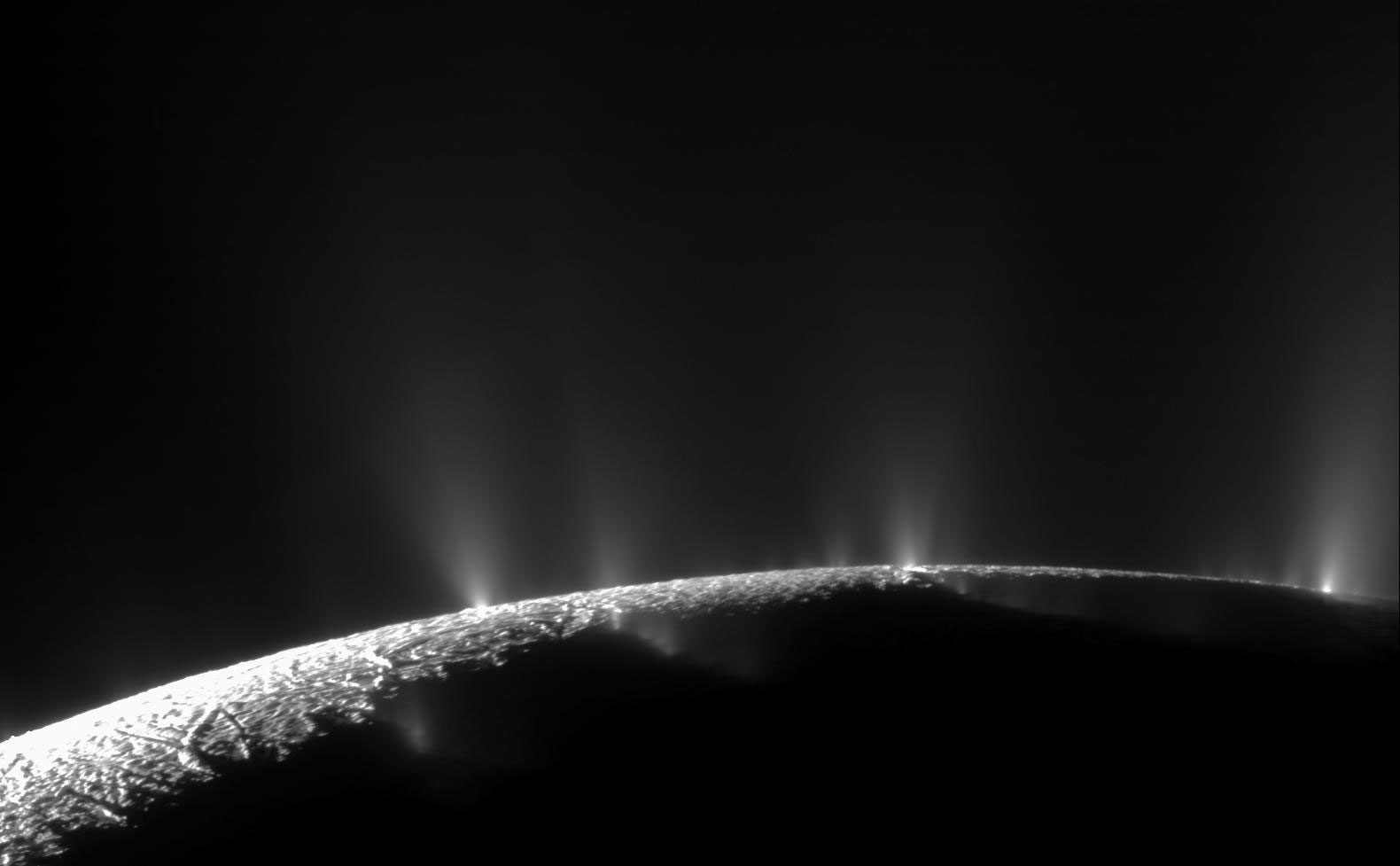
    Dramatic jets of ice, water vapor and organic compounds spray from the south pole of Saturn’s moon Enceladus in this image captured by NASA’s Cassini spacecraft in November 2009. Credit: NASA/JPL-Caltech/Space Science Institute

    Off the coast of Hawaii’s Big Island and more than 3,000 feet (900 meters) beneath the ocean surface lie the warm, bubbling springs of a volcano — a deep-sea location that may hold lessons for the search for extraterrestrial life.

    Here, NASA and its partners are blending ocean and space exploration, with a project called SUBSEA, short for Systematic Underwater Biogeochemical Science and Exploration Analog. Lessons learned in both fields will be mutually beneficial and could help design future science-focused missions across the solar system.

    Saturn’s moon Enceladus and Jupiter’s moon Europa are thought to have liquid oceans and hydrothermal activity under icy crusts. Locations on Earth with key similarities to future deep-space destinations are called analog environments. SUBSEA’s target, the springs emerging from a volcano forming the next Hawaiian island, called the Lō`ihi seamount, is an analog for these ocean worlds.
    Systematic Underwater Biogeochemical Science and Exploration Analog
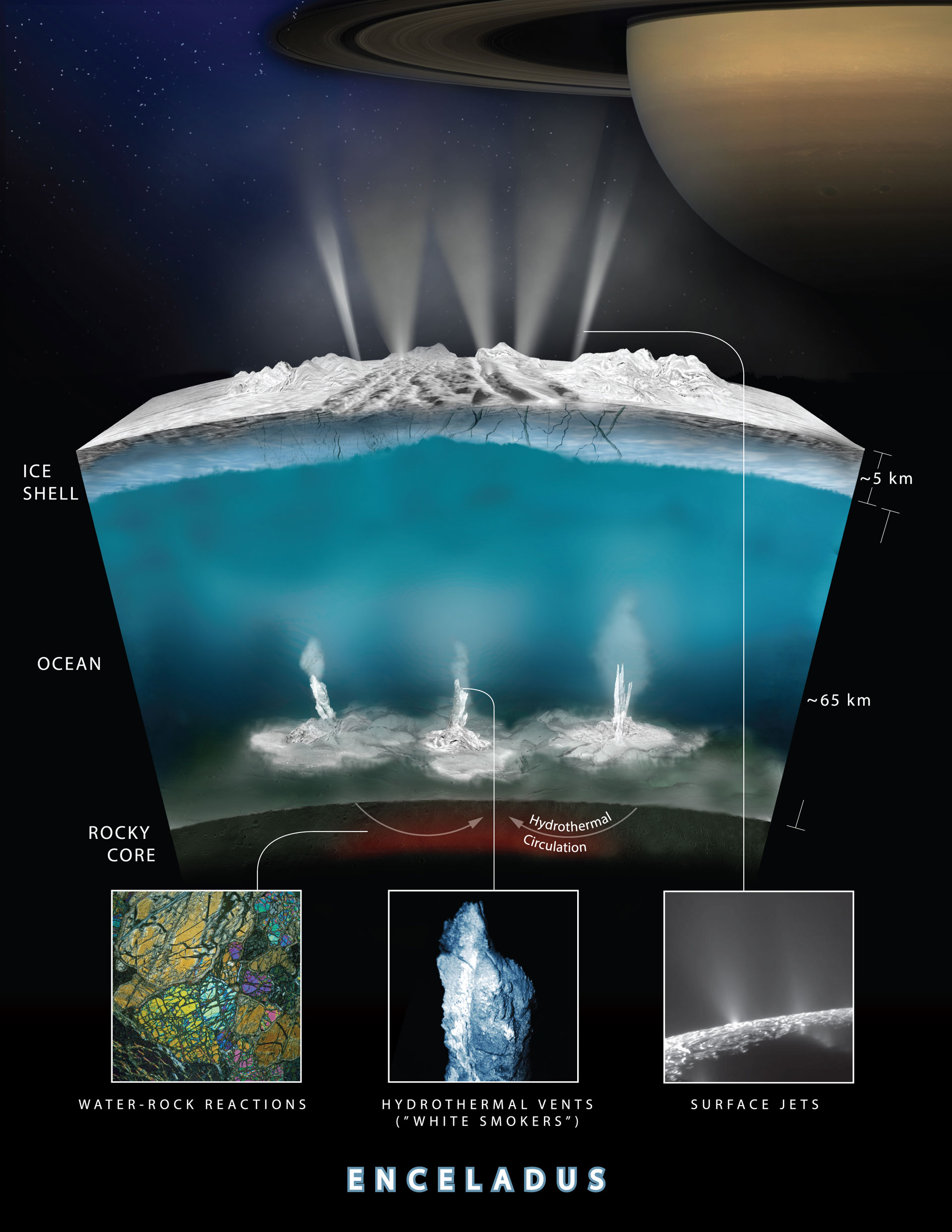
    Artist rendering showing an interior cross-section of the crust of Enceladus, which shows how hydrothermal activity may be causing the plumes of water at the moon’s surface. Credit: NASA-GSFC/SVS, NASA/JPL-Caltech/Southwest Research Institute

    When NASA’s Cassini mission to Saturn discovered a plume of water erupting from beneath the icy surface of Enceladus, the characteristics of the plume told scientists what conditions might be like on the sea floor. This included the temperature, pressure, and composition, and suggested the presence of hydrothermal activity. Scientists think these moons are good places to look for potential life, because water interacting with rock on their sea floors could yield chemical reactions that would make microbial metabolism possible.

    Lō`ihi is an especially good place to test predictions about seafloor hydrothermal systems and their ability to support life. Previous research focused more on locations where tectonic plates come together, but the Lō`ihi seamount involves molten magma erupting from the middle of one of these plates. This is the type of volcanic activity scientists think could be similar to seafloor volcanoes that may exist on Europa and Enceladus. The zones where plates meet may actually be too hot to provide a realistic representation of hydrothermal activity on the moons of Jupiter and Saturn.

    Throughout the 2018 SUBSEA expedition aboard the vessel Nautilus, the team’s scientists from NASA, the National Oceanic and Atmospheric Administration, and various academic institutions will study the conditions around Lō`ihi’s seafloor springs across a range of pressures and temperatures. What they learn here will increase our understanding of the potential for conditions that could support life forms on other ocean worlds.

    Learn more: Systematic Underwater Biogeochemical Science and Exploration Analog (SUBSEA)

    Never miss a breakthrough: Join the SciTechDaily newsletter.
    Follow us on Google and Google News.

    Astronomy Earth Science Enceladus Planetary Science SUBSEA
    Share. Facebook Twitter Pinterest LinkedIn Email Reddit

    Related Articles

    “We Were Truly Astonished”: New Discovery Rewrites Earth’s Origin Story

    Scientists Find Nebular Gases Preserved in Deep-Mantle Neon

    Counting Down to the Ionospheric Connection Explorer (ICON) Launch

    Lunar Rocks Reveal a Different Story About Earth’s Early Days

    Scientists Discover Bits of the Solar System in an Antarctic Glacier

    NASA Heliophysics Research Details Substorm Activity Around Earth

    Scientists Untangle the Volatile Processes That Shaped Earth

    Is Life on Earth Premature from a Cosmic Perspective?

    NASA Probes Reveal Source of Particle Acceleration in Van Allen Radiation Belts

    Leave A Reply Cancel Reply

    • Facebook
    • Twitter
    • Pinterest
    • YouTube

    Don't Miss a Discovery

    Subscribe for the Latest in Science & Tech!

    Trending News

    Mezcal “Worm” in a Bottle Mystery: DNA Testing Reveals a Surprise

    New Research Reveals That Your Morning Coffee Activates an Ancient Longevity Switch

    This Is What Makes You Irresistible to Mosquitoes

    Shockingly Powerful Giant Octopuses Ruled the Seas 100 Million Years Ago

    Scientists Stunned by New Organic Molecules Found on Mars

    Rewriting Dinosaur Evolution: Scientists Unearth Remarkable 150-Million-Year-Old Stegosaur Skull

    Omega-3 Supplements Linked to Cognitive Decline in Surprising New Study

    First-of-Its-Kind Discovery: Homer’s Iliad Found Embedded in a 1,600-Year-Old Egyptian Mummy

    Follow SciTechDaily
    • Facebook
    • Twitter
    • YouTube
    • Pinterest
    • Newsletter
    • RSS
    SciTech News
    • Biology News
    • Chemistry News
    • Earth News
    • Health News
    • Physics News
    • Science News
    • Space News
    • Technology News
    Recent Posts
    • Male Birth Control Breakthrough: Scientists Find Way To Turn Sperm Production Off and Back On
    • A Common Vitamin Could Hold the Key to Treating Fatty Liver Disease
    • New Research Shows Vitamin B12 May Hold the Key to Healthy Aging
    • Scientists Map Thousands of Brain Connections With RNA Barcodes
    • This Gene Tweak Turns Strawberries Into Healthier, Tastier Superfruit
    Copyright © 1998 - 2026 SciTechDaily. All Rights Reserved.
    • Science News
    • About
    • Contact
    • Editorial Board
    • Privacy Policy
    • Terms of Use

    Type above and press Enter to search. Press Esc to cancel.