
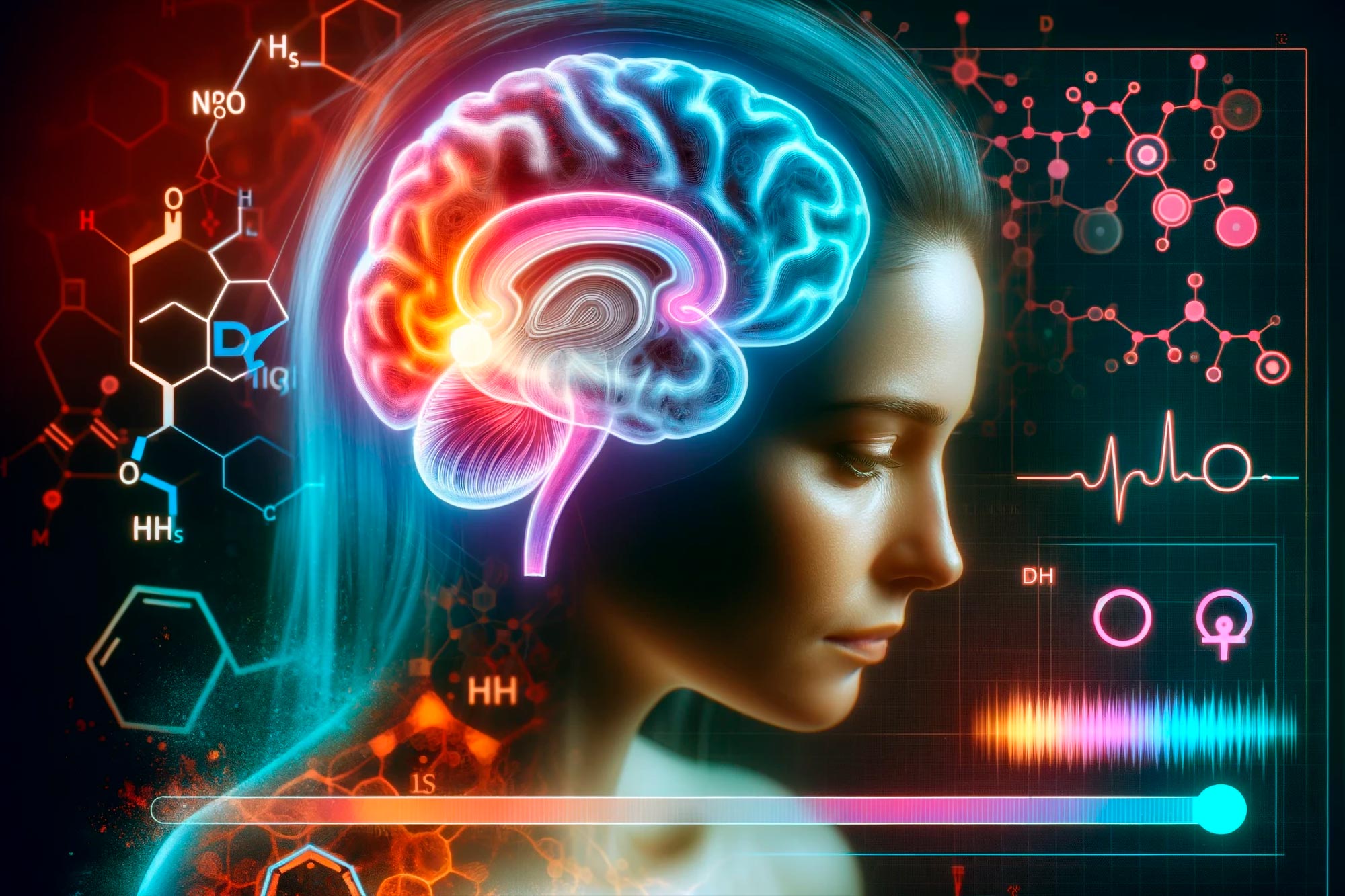
Precise observation using ultra-high magnetic field 7T MRI.
For the first time, a research team in Korea has discovered there is a significant relationship between depression and the taurine concentration in the hippocampus, an area of the brain responsible for memory and learning functions. This discovery provides the opportunity to publicize the role and importance of taurine in future prevention, diagnosis, and treatment of depression.
Advanced Imaging Techniques Reveal Key Insights
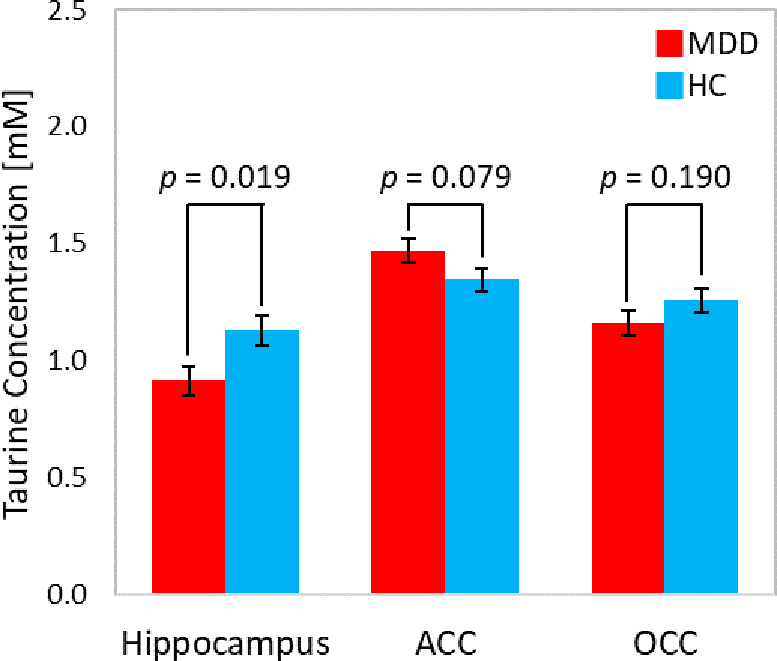
Using ultra-high magnetic field 7T human MRI (7T MRI), researchers (Drs. Youngkyu Song, Jee-Hyun Cho, and Chaejoon Cheong) in the Korea Basic Science Institute (KBSI, President Seong-Kwang Yang) Biochemical Analysis Team have confirmed that the taurine concentration was significantly lower in the hippocampus of young females suffering from depression.
The study, conducted in collaboration with research teams led by Dr. Hyungjun Kim at the Korea Institute of Oriental Medicine (KIOM) and Prof. Jin-Hun Sohn at Chungnam National University (CNU), is the result of comparing two groups of female participants, a group of 36 female patients with major depressive disorder, and a control group of 40 healthy females. All participants were aged 19 to 29.
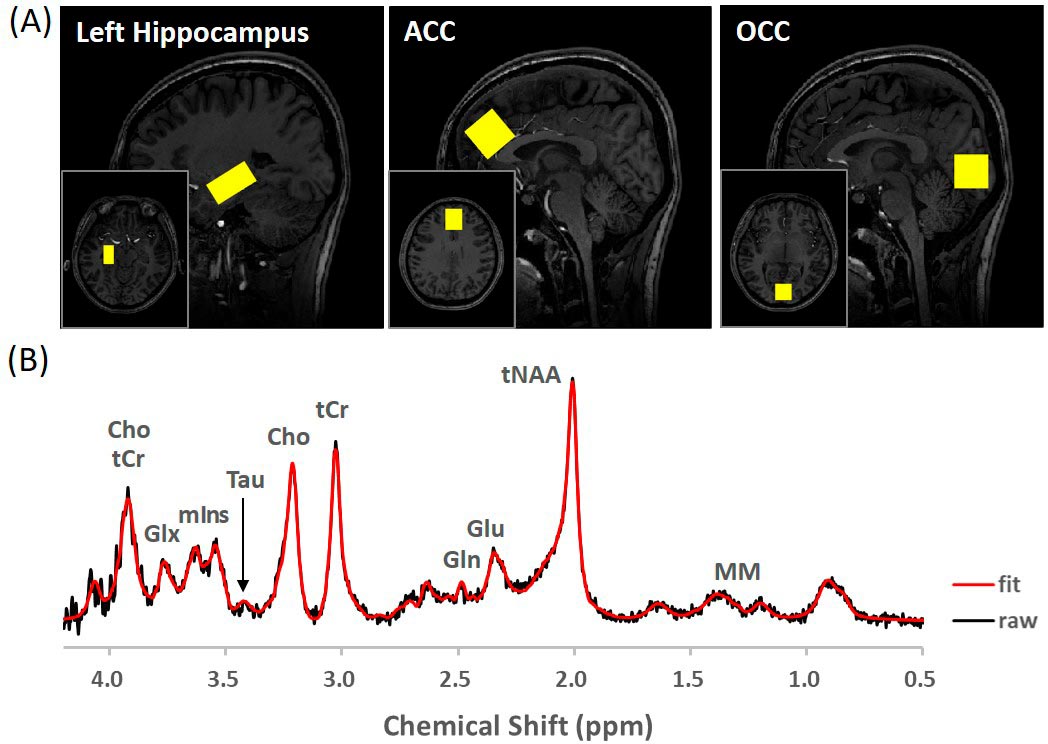
Abbreviation: Tau, taurine; Cho, choline; tCr, total creatine (creatine + phosphocreatine); Gln, glutamine; Glu, glutamate; Glx, Gln+Glu; mlns, myo-inositol, tNAA, total N-acetyl aspartate (N-acetyl aspartate + N-acetyl aspartyl glutamate); MM, macromolecule. Credit: Korea Basic Science Institute (KBSI)
The Global Impact of Depression
Depression is a disease that causes serious damage and loss, not only personally, but also socially and economically. According to the World Health Organization (WHO), there are more than 260 million people suffering from depression around the world, and more than 800,000 people take their own lives every year. In Korea, the increase in depression among young people is notable. Of the total 1,000,744 patients with depression, 185,942 individuals in their 20s accounted for the largest demographic, and the rate of increase has more than doubled in five years.
What Is Taurine?
Taurine is an amino sulfonic acid, which, unlike most other amino acids, does not build proteins. Instead, it plays several crucial roles in the body. It’s found naturally in the brain, heart, eyes, and muscle tissue. The body can synthesize taurine, and it’s also obtained through diet, particularly from meat, fish, and dairy products. It is also a common ingredient in energy drinks.
Taurine acts as a neurotransmitter in the brain, where it can exert a sedative effect on the nervous system. It’s also involved in the regulation of calcium levels in certain cells, contributes to heart function, and has antioxidant properties, protecting cells from damage. Taurine’s role in health, especially in heart and brain health, makes it a focus of numerous medical studies.
Credit: Korea Basic Science Institute (KBSI)
Pioneering Research Methods
MRI is widely used in brain disease research as it can precisely scan specific locations in the body and obtain a variety of quantitative information. Previous MRI studies on depression have focused on revealing changes in metabolites mainly limited to the cerebral cortex area, at the edge of the brain. This study is the first to disclose the relationship between metabolites and depression in the hippocampus, located inside the brain.
Detailed Analysis of Brain Metabolites
To identify substances closely related to depression, the research team measured and compared concentrations of seven metabolites, taurine, choline, creatine, glutamine, glutamate, myo-inositol, and N-acetyl aspartate, present in the frontal, occipital, and hippocampus regions of young women.
When performing MRI scans, there are technical limitations in measuring metabolite concentration in the hippocampus due to its location in the brain. Also, it is particularly difficult to obtain a magnetic resonance spectroscopy (MRS) signal for taurine because it has a low concentration compared to other metabolites. Using 7T MRI, which achieves high signal sensitivity and resolution, and sLASER pulse sequence designed to reduce chemical shift displacement errors, the research team successfully measured the subtle differences in taurine signals in the hippocampus of the patient and control groups.

Credit: Korea Basic Science Institute (KBSI)
Implications for Future Research
The concentrations of metabolites were also accurately measured with consideration to the precise distributions of the constituents, white matter, gray matter, and cerebrospinal fluid (CSF) which are dependent on the individual. In the future, it is expected these measurements will be applied to customized brain disease research, tailored to individual characteristics.
The leader of KBSI’s research team, Dr. Jee-Hyun Cho declared, “This study will promote research on the role of taurine in the hippocampus and its relationship with depression, and contribute to the pathogenesis research and diagnosis development of depression.” She added, “By using KBSI’s cutting-edge research equipment, we plan to conduct follow-up research on changes of taurine concentrations in the brain via long-term observation of depression patients, as well as the effect of taurine intake as a treatment for depression.”
Collaborative Effort
The research team at KBSI proposed the initial research idea of the relationship between depression and taurine concentration in the hippocampus, conducted measurement of brain metabolites using 7T MRI, and carried out analysis of the resulting data. The KIOM and CNU research teams participated in recruiting depression patient and healthy control groups, conducted psychological tests and clinical interviews, and managed demographic information.
Reference: “Association between taurine level in the hippocampus and major depressive disorder in young women: a proton magnetic resonance spectroscopy study at 7 Tesla” by Youngkyu Song, Jee-Hyun Cho, Hyungjun Kim, Young-Ji Eum, E-Nae Cheong, Sunyoung Choi, Jeong-Heon Park, Sungho Tak, Bumwoo Park, Jin-Hun Sohn, Gyunggoo Cho and Chaejoon Cheong, 5 September 2023, Biological Psychiatry.
DOI: 10.1016/j.biopsych.2023.08.025
Never miss a breakthrough: Join the SciTechDaily newsletter.
Follow us on Google and Google News.
3 Comments
I have read about Taurine extensively and a lot of studies, the Taurine has a severe drop in amount shown after the age of 40 also the fact that this drop has been seen in the depression state of mind. I’m not in depression, I do want to stay ahead of any detrimental effects of deficient amino acids, what is not mentioned in most articles is how Taurine has an part in skin Health, I have what is called PurPura and Taurine showed a very distinct improvement of the abrasions no more unsightly Purpura on my arms, I have expanded my trust in the amino acid to my wife she has dermalogica serieses that are starting to show improvement, only time will tell but at this point all is well, as in any supplement, dosage has to be observed and the dosage is small compared to the supplements available.
Electroshock results in temporary euphoria, memory loss for problems that led to admission, and anosognosia which means one fails to see the severity of incurred damages. This is not a mental health improvement. It is an outcome of an acquired TBI from low voltage electrical mechanism of trauma. Electrical trauma is unique in that damages evolve over time even a decade or more out. Risks that are not in consent is the baseline of TBI based on mechanism with every procedure. Other risks include CTE, ALS, cardiac issues, structural brain changes per psychiatric research etc. Every system down to a cellular level is impacted by this electrical trauma. No FDA testing of devices used nor the procedure. They know the truth and would cut off a very lucrative practice and put other products similarly related to be called into question. See site ectjustice and many articles about electroshock on site Mad in America. The devices have been in the CA Supreme Court. Medical malpractice interest around consent and medical battery. This is fraud at best.