

New research based on decades of satellite observations reveals an unexpected atmospheric connection: mineral dust from distant deserts can trigger the freezing of clouds in the Northern Hemisphere.
A new study has found that tiny dust particles traveling from distant deserts can help trigger the freezing of clouds in the Northern Hemisphere. This subtle atmospheric process influences how much sunlight clouds reflect back into space and how they produce rain and snow. Because of these effects, the mechanism could play an important role in improving climate projections.
Using 35 years of satellite data, an international team led by ETH Zurich investigated how mineral dust affects cloud formation. These particles are lifted from desert surfaces by strong winds and transported high into the atmosphere. Once there, they can act as seeds that cause droplets inside clouds to freeze. The effect is particularly important in northern regions, where clouds frequently form at temperatures slightly below freezing.
“We found that where there’s more dust, clouds are much more likely to freeze at the top,” explains Diego Villanueva, a Post-doctoral researcher for Atmospheric Physics at ETH Zurich and lead author of the study. “This has a direct impact on how much sunlight is reflected back into space and how much precipitation is generated.”
Dust turns clouds to ice
The scientists concentrated on mixed phase clouds, which contain both supercooled liquid droplets and ice crystals. These clouds form in temperatures between −39 °C and 0 °C (−38 °F to 32 °F). They are widespread across mid and high latitude regions, particularly over the North Atlantic, Siberia, and Canada.
Mixed-phase clouds are extremely sensitive to environmental conditions. One key factor is the presence of ice nucleating particles, which often originate from desert dust aerosols that have traveled long distances through the atmosphere.
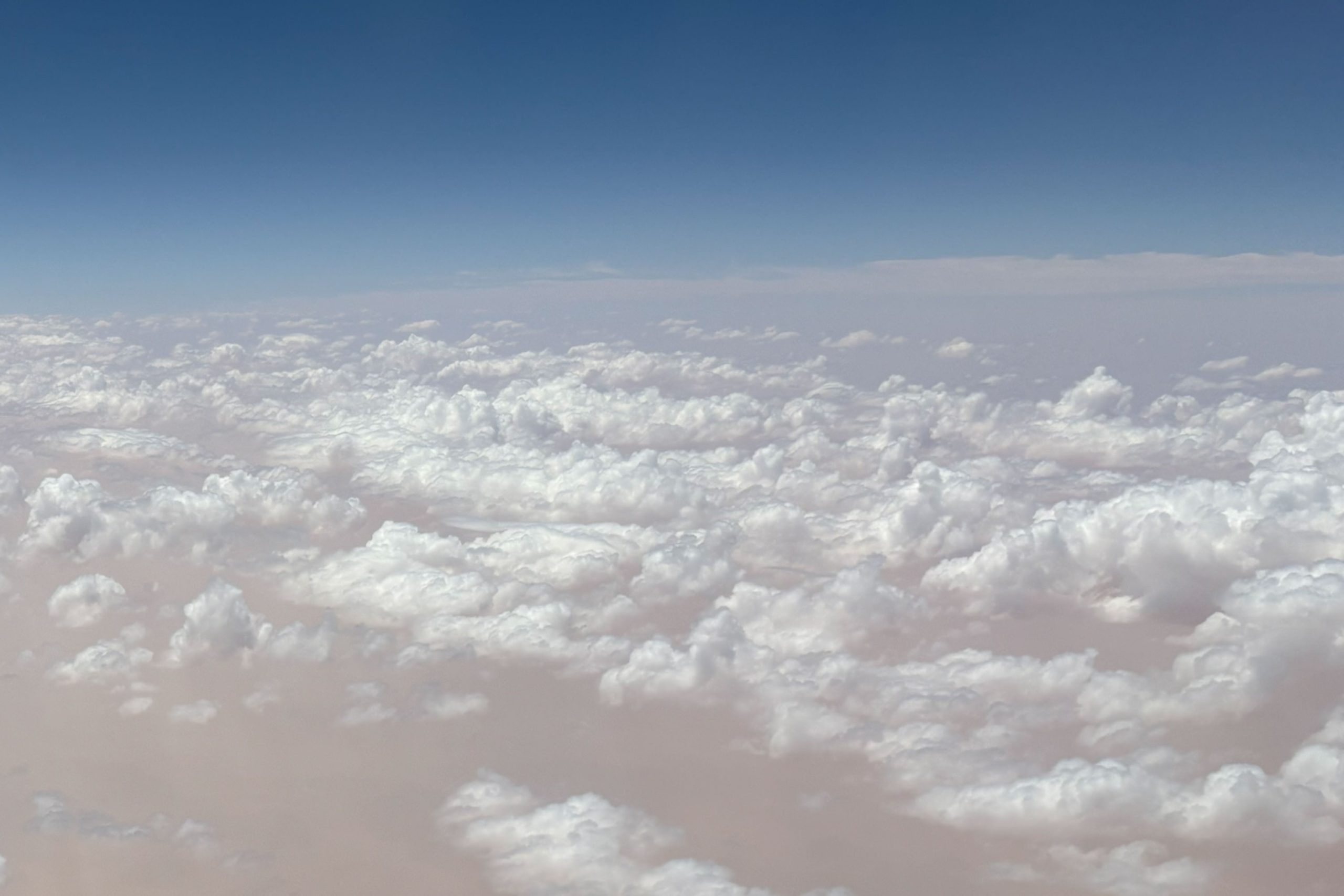
To investigate the relationship, the researchers compared satellite observations of dust concentrations with how often clouds developed ice at their tops. A clear pattern emerged. When dust levels were higher and temperatures were lower, ice-topped clouds appeared more frequently.
According to the team, this large-scale pattern closely matched predictions from laboratory studies that examine how mineral dust causes water droplets to freeze.
“This is one of the first studies to show that satellite measurements of cloud composition match what we’ve known from lab work,” says Ulrike Lohmann, senior co-author and Professor of Atmospheric Physics at ETH Zurich.
A new benchmark for climate models
The freezing of clouds plays a key role in the climate system. It affects the amount of sunlight clouds reflect into space and determines how efficiently they release precipitation. Climate models rely on accurate descriptions of these processes, yet researchers have long lacked global observations that clearly connect airborne dust with cloud freezing.
The new results establish a measurable relationship between atmospheric dust and the occurrence of ice at cloud tops. This provides an important reference point that could help scientists refine climate simulations.
“It helps identify one of the most uncertain pieces of the climate puzzle,” says Villanueva.
A complex picture – with a clear signal
Scientists have studied the freezing of individual water droplets for decades, often focusing on microscopic processes. The new research shows that cloud glaciation follows the same basic behavior seen in those small-scale experiments, but across far larger atmospheric systems.
This connection links extremely small structures on the surfaces of dust particles, measured in nanometers (1 nanometer equals about 0.00000004 inches), with cloud systems that extend for kilometers (1 kilometer equals about 0.62 miles) and can be observed from satellites in orbit.
However, the influence of dust on cloud freezing is not uniform worldwide. In desert regions such as the Sahara, clouds are relatively rare, and rising warm air may limit freezing. In the Southern Hemisphere, sea salt and other marine aerosols may play a larger role than desert dust.
The researchers say additional studies are needed to determine how other factors, including updraft strength and atmospheric humidity, shape the freezing process. Even so, the study highlights an important conclusion. Tiny grains of dust from distant deserts help influence the clouds overhead, and those clouds play a role in shaping Earth’s future climate.
Reference: “Dust-driven droplet freezing explains cloud-top phase in the northern extratropics” by D. Villanueva, M. Stengel, C. Hoose, O. Bruno, K. Jeggle, A. Ansmann and U. Lohmann, 31 July 2025, Science.
DOI: 10.1126/science.adt5354
Never miss a breakthrough: Join the SciTechDaily newsletter.
Follow us on Google and Google News.
9 Comments
If entire clouds should we expect falling ice blocks?
Global deserts appeared as result of humans activity – just in last 2O-30 year before our planet was much greener. Now mining activities is the most dangerous for our planet.
You don’t know what you are talking about. If you are under 30-years-old I can see how you might believe that. However, if one is coming from the perspective of having lived nearly 3X that amount of time, like myself, it is obvious that your claim of deserts being a new phenomenon is wrong. Actually, the situation is almost the opposite of what you ignorantly claim. NASA has demonstrated that the rising atmospheric CO2 concentration is resulting in ‘greening’ of the Earth. That is, the Leaf Area Index has been increasing since at least 1982: https://www.nasa.gov/centers-and-facilities/goddard/carbon-dioxide-fertilization-greening-earth-study-finds/
Similarly, your claim about mining is unfounded. With the start of the California Gold Rush in 1849, the magnitude of land use disturbance has been MUCH greater in the past than currently, especially in the USA. You should explore what has been done in the Masabi range to obtain steel for buildings, bridges, and automobiles, starting before I was even born. Much of the mining has shifted to other countries, and while admittedly there are some environmental problems, they don’t rise to the level of being dangerous for our planet.
Ignorant comments such as yours are inaccurate and irresponsible. You should probably read this:
https://thehill.com/opinion/education/5783255-americans-decline-in-reading/
If you would like some obvious evidence of the antiquity of deserts, look at the cliffs of Zion National Park. They are eroded remnants of cross-bedded, 180-million-year-old sand dunes, characteristic of deserts large deserts.
Thank you great resource of information.
TERRIBLY REPETITIVE ARTICLE. Perhaps because it lacks any substance that goes beyond a headline.
How about publishing some articles on science that is progressive and could make a difference, instead of hollow studies that make you wonder how they swindled the funding.
How about stating the reason(s) and providing an example of why you feel the article is repetitive? The substance that you claim is lacking can be summed up in empirical measurements (in situ) confirming laboratory experiments. Are you familiar with the Scientific Method?
What do you mean by “progressive.” I’m led to believe that you think that political activism is somehow a part and parcel of science, which isn’t the case. The ideal scientist is typically described as being “disinterested” or objective. You advocating making a difference sounds like the campaign slogan of a politician — someone who promotes the behavior of ‘Fire, Aim, Ready!’
How about describing the kind of difference you would make if you could, and why you believe that? There are still many unanswered questions about climate, and many of the assumptions, such as the energy exchanges in clouds, are poorly understood and are not amenable to exact solution. Therefore, they have to be “parameterized” in models to be able to calculate estimates in a finite amount of time. I am left with the impression that you are a self-described Citizen Scientist who thinks that (s)he knows everything and is ready to charge ahead with all the answers to save the world. That attitude is sometimes called a Messiah Complex.
More global warming propaganda B’s. Thanks for nothing.
I am frequently critical of the poor quality of science articles, particularly in the field of climatology. However, I don’t see justification for your claim. It is a straight forward description of ongoing research on clouds, with no direct reference to anthropogenic warming. As close as they get is, “This provides an important reference point that could help scientists refine climate simulations.” No unsupported claims are made. Would you mind sharing why you feel that it is “global warming propaganda?”