
Close Menu
    Facebook X (Twitter) Instagram
    SciTechDaily
    • Biology
    • Chemistry
    • Earth
    • Health
    • Physics
    • Science
    • Space
    • Technology
    Facebook X (Twitter) Pinterest YouTube RSS
    SciTechDaily
    Home»Chemistry»Diagnostic Biosensor Detects SARS-CoV-2 From Nasopharyngeal Swab in Less Than a Minute
    Chemistry

    Diagnostic Biosensor Detects SARS-CoV-2 From Nasopharyngeal Swab in Less Than a Minute

    By American Chemical SocietyApril 21, 2020No Comments3 Mins Read
    Facebook Twitter Pinterest Telegram LinkedIn WhatsApp Email Reddit
    Share
    Facebook Twitter LinkedIn Pinterest Telegram Email Reddit
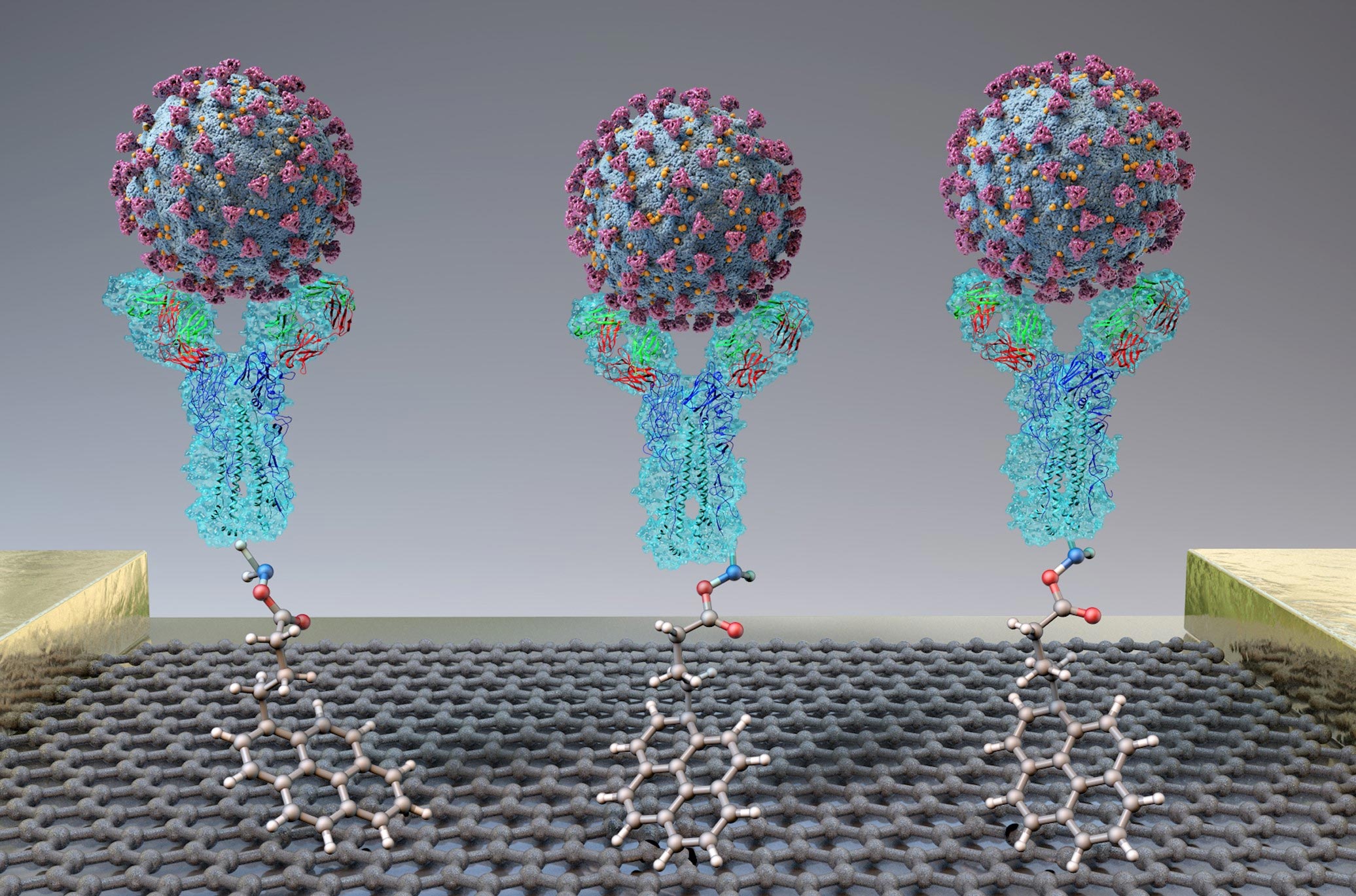
    Diagnostic Biosensor Detects SARS-CoV-2
    A new test quickly detects SARS-CoV-2 (spheres) through binding to antibodies (Y-shapes) on a field-effect transistor. Credit: Adapted from ACS Nano 2020, DOI: 10.1021/acsnano.0c02823

    According to many experts, early diagnosis and management are critical for slowing the spread of SARS-CoV-2, the new coronavirus that causes COVID-19. Therefore, the race is on to develop diagnostic tests for the virus that are faster, easier and more accurate than existing ones. Now, researchers reporting in ACS Nano have developed a field-effect transistor-based biosensor that detects SARS-CoV-2 in nasopharyngeal swabs from patients with COVID-19, in less than one minute.

    Currently, most diagnostic tests for COVID-19 rely on a technique called real-time reverse transcription-polymerase chain reaction (RT-PCR), which amplifies SARS-CoV-2 RNA from patient swabs so that tiny amounts of the virus can be detected. However, the method takes at least 3 hours, including a step to prepare the viral RNA for analysis. Edmond Changkyun Park, Seung Il Kim and colleagues wanted to develop a faster diagnostic test that could analyze patient samples directly from a tube of buffer containing the swabs, without any sample preparation steps.

    The team based their test on a field-effect transistor — a sheet of graphene with high electronic conductivity. The researchers attached antibodies against the SARS-CoV-2 spike protein to the graphene. When they added either purified spike protein or cultured SARS-CoV-2 virus to the sensor, binding to the antibody caused a change in the electrical current. Next, the team tested the technique on nasopharyngeal swabs collected from patients with COVID-19 or healthy controls. Without any sample preparation, the sensor could discriminate between samples from sick and healthy patients. The new test was about 2-4 times less sensitive than RT-PCR, but different materials could be explored to improve the signal-to-noise ratio, the researchers say.

    Reference: “Rapid Detection of COVID-19 Causative Virus (SARS-CoV-2) in Human Nasopharyngeal Swab Specimens Using Field-Effect Transistor-Based Biosensor” by Giwan Seo, Geonhee Lee, Mi Jeong Kim, Seung-Hwa Baek, Minsuk Choi, Keun Bon Ku, Chang-Seop Lee, Sangmi Jun, Daeui Park, Hong Gi Kim, Seong-Jun Kim, Jeong-O Lee, Bum Tae Kim, Edmond Changkyun Park and Seung Il Kim, 15 April 2020, ACS Nano.
    DOI: 10.1021/acsnano.0c02823

    The authors acknowledge funding from the National Research Council of Science and Technology funded by the Ministry of Science and ICT, Korea and the Korea Health Technology R&D Project through the Korea Health Industry Development Institute funded by the Ministry of Health & Welfare, Korea.

    Never miss a breakthrough: Join the SciTechDaily newsletter.
    Follow us on Google and Google News.

    American Chemical Society COVID-19 Genetics Nanotechnology Popular Virology
    Share. Facebook Twitter Pinterest LinkedIn Email Reddit

    Related Articles

    How Three Mutations Work Together To Spur New COVID-19 Variants

    Ending the COVID-19 Pandemic: Progress Toward One Drug To Treat All Coronaviruses

    Disinfected by the Sun: New Cotton Face Mask Kills Up to 99.9999% of Bacteria and Viruses in Daylight

    Small Molecule Identified That Targets Genes of COVID-19 Virus for Destruction

    Scientists Discover Sugar Molecules in SARS-CoV-2 Coronavirus Spike Protein Play Active Role in Infection

    COVID-19 Coronavirus Breathalyzer Test Developed

    Researchers Develop a Replaceable, More Efficient Filter for N95 Masks

    New COVID-19 Test Accurately Detects Viral DNA in Minutes

    Does Soap Actually ‘Kill’ the Coronavirus? Here’s the Chemistry [Video]

    Leave A Reply Cancel Reply

    • Facebook
    • Twitter
    • Pinterest
    • YouTube

    Don't Miss a Discovery

    Subscribe for the Latest in Science & Tech!

    Trending News

    Hair Loss May Be an Overlooked Side Effect of Ozempic and Mounjaro

    Scientists Develop a Groundbreaking Chip That Operates at Brain-Like Speed

    Viagra May Block a Hidden Pathway Cancer Cells Need To Spread

    How Brown Tree Snakes Became an Unstoppable Invasive Species

    Earth’s First Complex Organisms May Hold Clues to Life Beyond Our Planet

    A 25,000-Year-Old Ritual Tradition Was Hidden Beneath This Cave Floor

    Plant Compounds in Berries, Tea, and Cocoa May Support Healthy Brain Aging

    Scientists Turn an Old Antibiotic Back Into a Superbug Killer

    Follow SciTechDaily
    • Facebook
    • Twitter
    • YouTube
    • Pinterest
    • Newsletter
    • RSS
    SciTech News
    • Biology News
    • Chemistry News
    • Earth News
    • Health News
    • Physics News
    • Science News
    • Space News
    • Technology News
    Recent Posts
    • NASA’s Curiosity Finds a Vast Sea of Mysterious Polygons on Mars
    • Astronomers May Have Found the First Moon Beyond Our Solar System
    • Underwater Cameras Expose the Secret Lives of Whale Sharks
    • A Massive Study Reveals the Brain Is Far More Flexible Than We Thought
    • Why Dreaming Leaves the Brain Running Low on Energy
    Copyright © 1998 - 2026 SciTechDaily. All Rights Reserved.
    • Science News
    • About
    • Contact
    • Editorial Board
    • Privacy Policy
    • Terms of Use

    Type above and press Enter to search. Press Esc to cancel.