
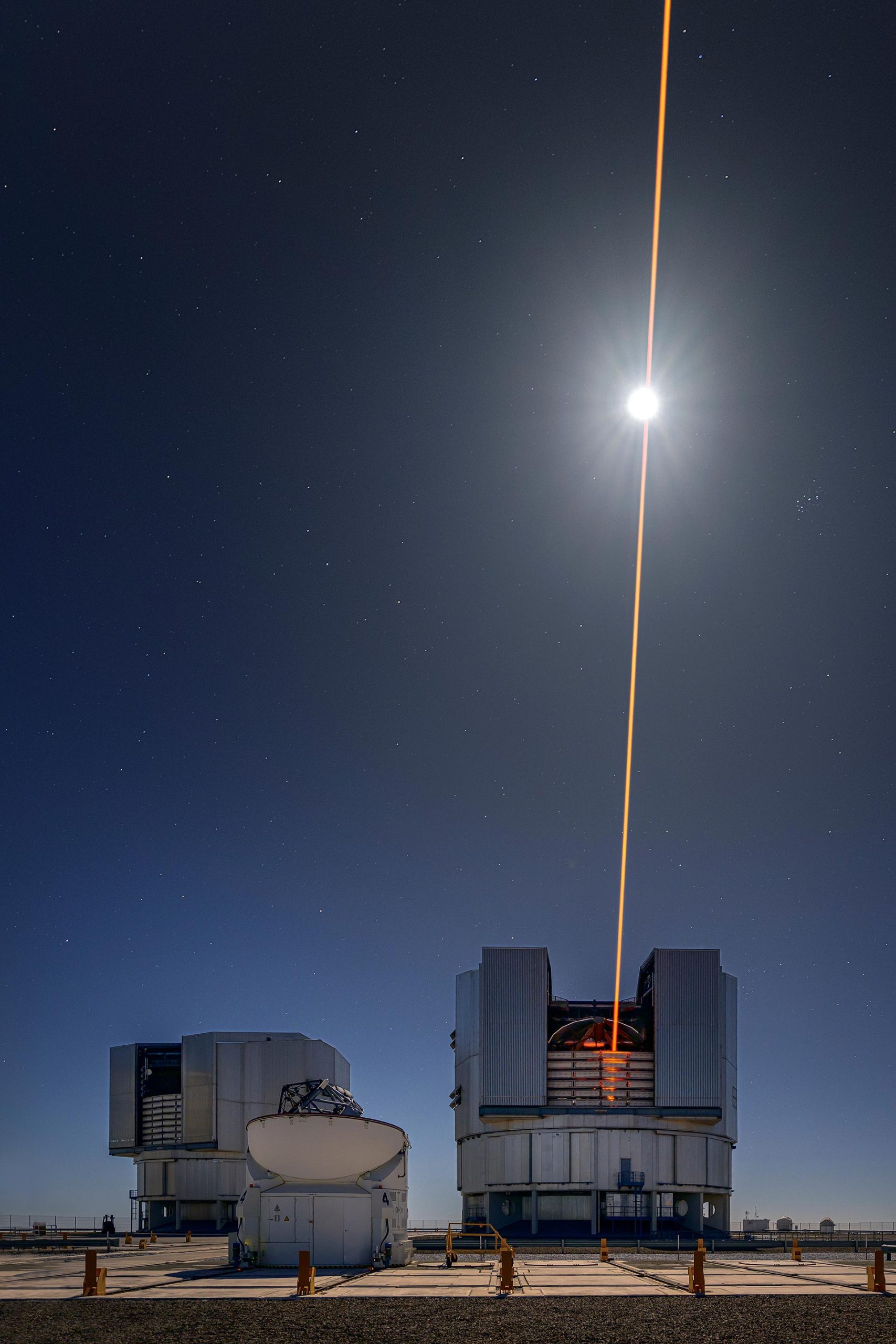
It looks like a laser is slicing the Moon in half, but it’s actually a high-tech tool used to improve telescope clarity.
The Very Large Telescope (VLT) fires powerful beams into the sky, creating artificial stars to correct for atmospheric distortion. These lasers help astronomers capture ultra-sharp images of space while an automated system ensures no airplanes are affected.
Slicing Through the Moon? Not Quite!
In this captivating image, a laser beam appears to slice through the Moon. In reality, it’s part of the laser guide star system on Unit Telescope 4 (UT4), also known as Yepun — one of the four 8.2-meter telescopes that make up ESO’s Very Large Telescope (VLT).
Ground-based telescopes, no matter their location, face the challenge of atmospheric distortion, which blurs incoming light from space. To correct this, astronomers use adaptive optics, a technology that adjusts a flexible mirror in real time to compensate for these distortions, producing much sharper images.
The Power of Laser Guide Stars
The laser in the image is a powerful beam of light that excites sodium atoms located about 90 kilometers above Earth. This interaction creates a glowing artificial star, which astronomers use as a reference point to measure atmospheric blurring. The data collected then guides the adaptive optics system, allowing the telescope to correct distortions and capture clearer views of the universe.
To avoid disturbing airplanes, these lasers rely on an automated aircraft avoidance system. This system continuously monitors the sky and instantly switches the lasers off whenever an aircraft’s trajectory is predicted to enter the region of the sky where the lasers are pointed. In any case, the lasers wouldn’t be able to slice the Moon even if it was made of cheese!
Never miss a breakthrough: Join the SciTechDaily newsletter.
Follow us on Google and Google News.