
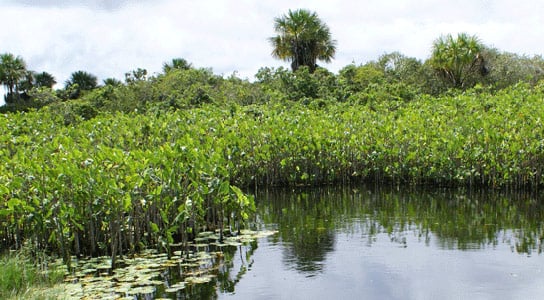
A team of researchers has established a direct link between climate change and the emergence of infectious diseases, showing a correlation between epidemic peaks and rainy periods for Buruli ulcer observed over a 40-year period in French Guyana.
New diseases
Climate change may affect human health directly or indirectly. In addition to increased threats of storms, flooding, droughts, and heat waves, other health risks are being identified. In particular, new diseases are appearing, caused by infectious agents (viruses, bacteria, parasites) heretofore unknown or that are changing, especially under the effect of changes in the climate (change of host, vector, pathogenicity, or strain). These are so-called “emerging” or “re-emerging” infectious diseases, such as leishmaniasis, West Nile fever, etc. According to the WHO, these diseases are causing one third of deaths around the world, and developing countries are on the front line.
A difficult relationship to establish
Several parameters may be behind this increased spread of pathogens and their hosts (vectors, reservoirs, etc.). Climate change modifies temperature and humidity conditions in natural environments, and therefore alters the transmission dynamics for the infectious agents. It also affects the range, abundance, behavior, biological cycles, and life history traits of the microbes or related host species, changing balances between pathogens, vectors, and reservoirs. However, these effects remain poorly explained, in particular because they require an understanding of the long-term spatial or temporal changes to the phenomena. Therefore, it is difficult to establish a direct link between climate change and the overall evolution of infectious pathologies.
Decreased rainfall rhymes with epidemic
Providing some clarification on this question for the first time, a study by IRD researchers and their partners has shown the relationship over a 40-year period between climate change and epidemics of a disease emerging in Latin America: Buruli ulcer. Rising surface temperatures in the Pacific Ocean tend to increase the frequency of El Niño events, which especially affect Central and South America approximately every five to seven years, causing waves of droughts. The research team compared changes in rainfall in the region with changes in the number of cases of Buruli ulcer recorded in French Guyana since 1969 and observed the statistical correlations.
In fact, the decrease in rainfall and runoff led to an increase in areas of residual stagnant water, where the bacteria responsible, Mycobacterium ulcerans, proliferates. The greater access to swampy habitats that results from this facilitates frequentation by humans (fishing, hunting, etc.) and thus intensifies human exposure to the microorganism living in this type of aquatic environment. This result, published in Emerging Microbes and Infections – Nature, was made possible through long-term time series data.
In light of the rainfall conditions in recent years, the researchers fear a potential new outbreak of Buruli ulcer in the region. Beyond an improvement in forecasting the risk of an epidemic, this study highlights the need to consider a set of parameters and their interactions. Contrary to the accepted idea, less rainfall does not mean a certain decrease in the prevalence of infectious diseases, as shown by this example. Similarly, the expected warming of the atmosphere could provide temperature conditions unsuitable to the development cycle of some pathogenic agents, such as for malaria in Africa.
Reference: “Complex temporal climate signals drive the emergence of human water-borne disease” by Aaron Morris, Rodolphe E Gozlan, Hossein Hassani, Demetra Andreou, Pierre Couppié and Jean-François Guégan, 2 November 2015, Emerging Microbes & Infections.
DOI: 10.1038/emi.2014.56
Never miss a breakthrough: Join the SciTechDaily newsletter.
Follow us on Google and Google News.
1 Comment
This is nonsense it a nutshell! Why do I not see more reporting on the Maunder or Dalton minimum and how they directly affect climate? The facts are staggering that the earth is in fact in a cooling stage after the last warming period.