
Close Menu
    Facebook X (Twitter) Instagram
    SciTechDaily
    • Biology
    • Chemistry
    • Earth
    • Health
    • Physics
    • Science
    • Space
    • Technology
    Facebook X (Twitter) Pinterest YouTube RSS
    SciTechDaily
    Home»Chemistry»New Sodium-Conducting Material Significantly Outperforms All Others in Its Class
    Chemistry

    New Sodium-Conducting Material Significantly Outperforms All Others in Its Class

    By National Institute of Standards and TechnologyNovember 5, 20141 Comment3 Mins Read
    Facebook Twitter Pinterest Telegram LinkedIn WhatsApp Email Reddit
    Share
    Facebook Twitter LinkedIn Pinterest Telegram Email Reddit
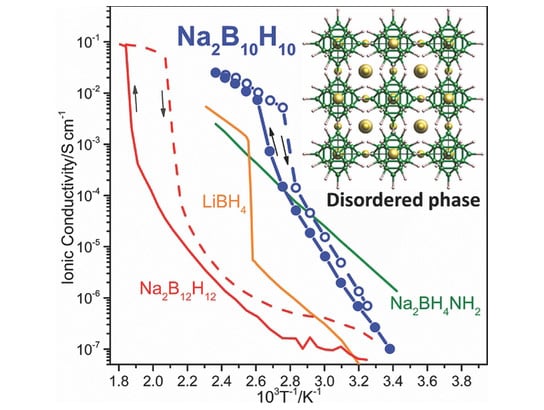
    New Sodium-Conducting Material Could Improve Rechargeable Batteries
    Na2B10H10 exhibits exceptional superionic conductivity above ca. 360 K (e.g., ≈0.01 S cm−1 at 383 K) concomitant with its transition from an ordered monoclinic structure to a face-centered-cubic arrangement of orientationally disordered B10H10 2− anions harboring a vacancy-rich Na+ cation sublattice. This discovery represents a major advancement for solid-state Na+ fast-ion conduction at technologically relevant device temperatures. Credit: Terrence J. Udovic, et al.

    Scientists have discovered a sodium-based complex metal hydride material that has the potential to be a much cheaper alternative to the lithium-based conductors used in many rechargeable batteries today.

    Rechargeable battery manufacturers may get a jolt from research performed at the National Institute of Standards and Technology (NIST) and several other institutions, where a team of scientists has discovered a safe, inexpensive, sodium-conducting material that significantly outperforms all others in its class.

    The team’s discovery is a sodium-based, complex metal hydride, a material with potential as a much cheaper alternative to the lithium-based conductors used in many rechargeable batteries. Because lithium is a comparatively rare commodity near the earth’s surface, the industry would prefer to build reusable batteries out of common ingredients that are both economical and inexhaustible.

    The novel hydride—which has the formula Na2B10H10—might fit the bill, and not only because it is formed of the three easily obtainable elements of sodium, boron, and hydrogen. There are other practical reasons as well: It is a stable inorganic solid, meaning it would pose fewer of the risks carried by many flammable liquids in traditional batteries, such as the potential for leaking or exploding. And compared to other sodium-based solids, it can enable more power output.

    This last advantage stems from its unusual ability to conduct sodium ions exceptionally well when heated. At room temperature, the hydride’s atoms are tightly packed together. But when heated to near water’s boiling point, they repack to create numerous corridors through which the sodium ions can flow easily. Because charged ions are what carry electricity in a battery, this “phase change,” as physicists call it, allows the team’s material to outperform others.

    “It’s more than 20 times better at doing its job than other known sodium-based complex hydrides in this temperature range,” says Terrence Udovic of the NIST Center for Neutron Research (NCNR). “It’s also as good as the best solid lithium-based hydride that has been measured, so it’s quite promising.”

    Udovic had been exploring metal hydride materials as candidates for hydrogen storage, and while this particular compound performed poorly at that task, he hit upon the idea of testing it as an ion conductor. NCNR research hinted at its abilities, but clarifying them took an international effort among collaborators from Japan’s Tohoku University, Russia’s Institute of Metal Physics, the University of Maryland, and Sandia National Laboratories.

    Udovic says that future work will involve chemically tweaking the hydride’s properties in order to optimize its performance. At this point, it would be necessary to operate a battery above the phase transition temperature, so one goal will be to bring the transition temperature down to as close to room temperature as possible—a goal he is confident is within reach.

    “You could probably use this material in a battery right now,” he says. “But the lower the temperature required to make it work, the more useful it will be.”

    Reference: “Exceptional Superionic Conductivity in Disordered Sodium Decahydro-closo-decaborate” by Terrence J. Udovic, Motoaki Matsuo, Wan Si Tang, Hui Wu, Vitalie Stavila, Alexei V. Soloninin, Roman V. Skoryunov, Olga A. Babanova, Alexander V. Skripov, John J. Rush, Atsushi Unemoto, Hitoshi Takamura and Shin-ichi Orimo, 13 October 2014, Advanced Materials.
    DOI: 10.1002/adma.201403157


    Never miss a breakthrough: Join the SciTechDaily newsletter.
    Follow us on Google and Google News.

    Battery Technology Materials Science National Institute of Standards and Technology
    Share. Facebook Twitter Pinterest LinkedIn Email Reddit

    Related Articles

    Selective Separation Could Help Alleviate Critical Shortage of Rare-Earth and Other Key Metals

    A New Way to Synthesize Hydrocarbons Could Reduce CO2 Emissions and Slash Costs of Chemical Manufacturing

    A New Way to Synthesize Hydrocarbons Could Reduce Dioxide Emissions and Slash Costs of Chemical Manufacturing

    Solar Flow Battery: Single Device Generates, Stores and Redelivers Renewable Electricity From the Sun

    Researchers Use Salmon DNA to Develop Next-Generation High-Capacity Battery Material

    Organic Battery Breakthrough Makes Lithium-Ion Batteries More Environmentally Friendly

    New Solid Polymer-Based Electrolyte Helps Batteries Become Self-Healing, Recyclable

    Novel Carbon Coating Technology of Li-Rich Layered Oxide Cathode

    Using X-Ray Imaging to Help Improve Lithium-Sulfur Battery Technology

    1 Comment

    1. Joe on December 1, 2014 3:38 pm

      This is a good result but not a surprise theoretically. Another element is a good candidate to replace Na.

      Reply
    Leave A Reply Cancel Reply

    • Facebook
    • Twitter
    • Pinterest
    • YouTube

    Don't Miss a Discovery

    Subscribe for the Latest in Science & Tech!

    Trending News

    Scientists Uncover Potential Brain Risks of Popular Fish Oil Supplements

    Scientists Discover a Surprising Way To Make Bread Healthier and More Nutritious

    After 60 Years, Scientists Uncover Unexpected Brain Effects of Popular Diabetes Drug Metformin

    New Research Uncovers Hidden Side Effects of Popular Weight-Loss Drugs

    Scientists Rethink Extreme Warming After Surprising Ocean Discovery

    Landmark Study Links Never Marrying to Significantly Higher Cancer Risk

    Researchers Discover Unknown Beetle Species Just Steps From Their Lab

    Largest-Ever Study Finds Medicinal Cannabis Ineffective for Anxiety, Depression, PTSD

    Follow SciTechDaily
    • Facebook
    • Twitter
    • YouTube
    • Pinterest
    • Newsletter
    • RSS
    SciTech News
    • Biology News
    • Chemistry News
    • Earth News
    • Health News
    • Physics News
    • Science News
    • Space News
    • Technology News
    Recent Posts
    • Scientists Discover a “Protector” Protein That Could Help Reverse Hair Loss
    • Powerful Lasers Reveal How Matter Becomes Plasma in Trillionths of a Second
    • A Simpler Path to Super-Resolution: Scientists Reinvent Microscopy
    • Scientists Uncover Hidden Genetic Cause of Diabetes in Babies
    • Amazonian Chocolate Could Become the Next Superfood, Scientists Say
    Copyright © 1998 - 2026 SciTechDaily. All Rights Reserved.
    • Science News
    • About
    • Contact
    • Editorial Board
    • Privacy Policy
    • Terms of Use

    Type above and press Enter to search. Press Esc to cancel.