
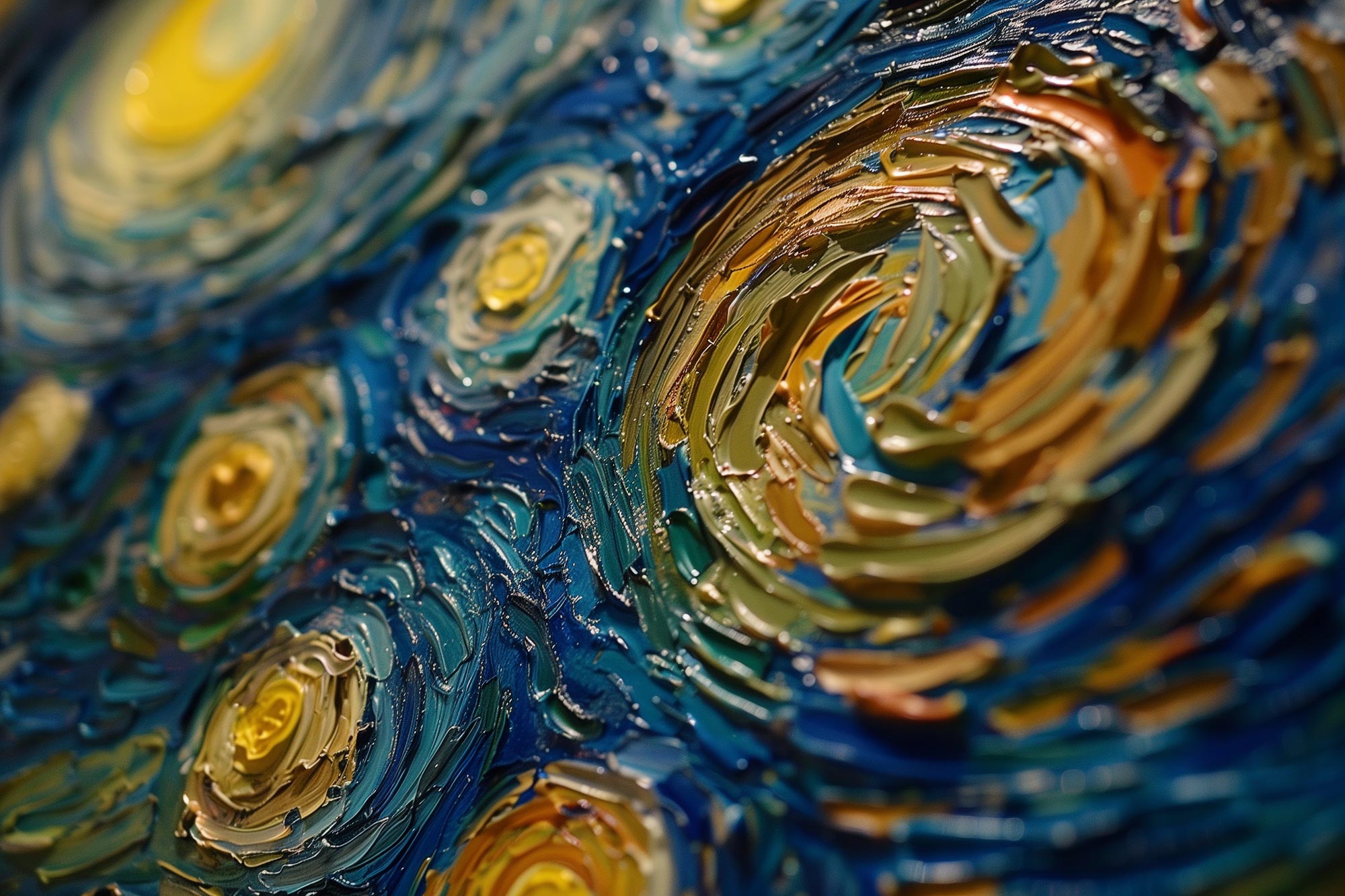
Vincent van Gogh’s use of scale and brightness accurately captures cascading energy and turbulence.
Researchers have delved into the swirling skies of Vincent van Gogh’s “The Starry Night,” uncovering layers of hidden turbulence that mirror real atmospheric phenomena. By analyzing the painting’s brushstrokes, luminance, and structure, they have discovered alignments with Kolmogorov’s and Batchelor’s scaling laws, revealing a deeper understanding of both art and atmospheric dynamics.
Capturing the Celestial: Van Gogh’s “The Starry Night”
Vincent van Gogh’s painting “The Starry Night” depicts a swirling blue sky with yellow moon and stars. The sky is an explosion of colors and shapes, each star encapsulated in ripples of yellow, gleaming with light like reflections on water.
Van Gogh’s brushstrokes create an illusion of sky movement so convincing it led atmospheric scientists to wonder how closely it aligns with the physics of real skies. While the atmospheric motion in the painting cannot be measured, the brushstrokes can.
Scientific Study of Artistic Technique
In an article published this week in the scientific journal Physics of Fluids, researchers specializing in marine sciences and fluid dynamics in China and France analyzed van Gogh’s painting to uncover what they call the hidden turbulence in the painter’s depiction of the sky.
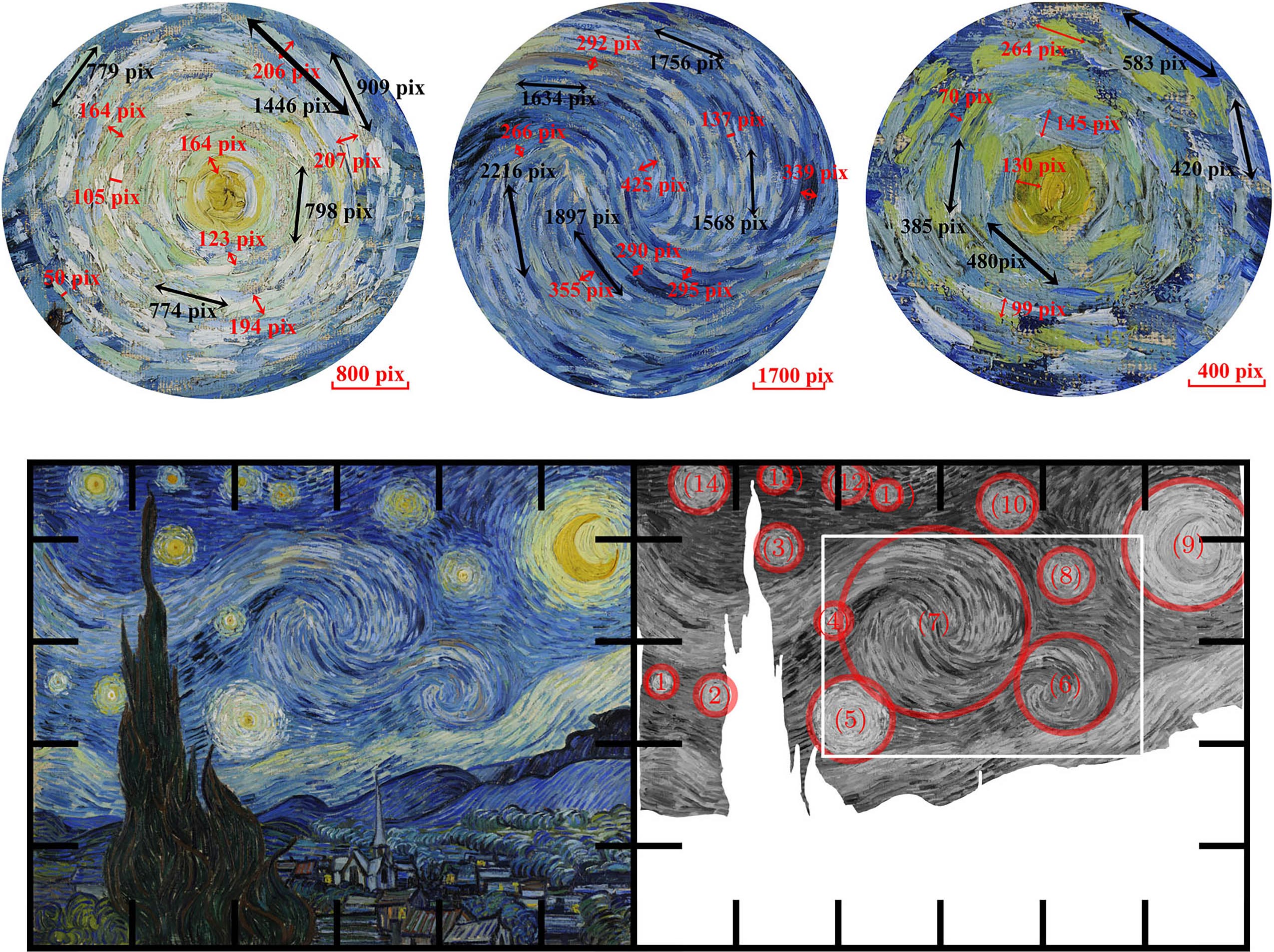
“The scale of the paint strokes played a crucial role,” author Yongxiang Huang said. “With a high-resolution digital picture, we were able to measure precisely the typical size of the brushstrokes and compare these to the scales expected from turbulence theories.”
Exploring the Dynamics of Van Gogh’s Skies
To reveal hidden turbulence, the authors used brushstrokes in the painting like leaves swirling in a funnel of wind to examine the shape, energy, and scaling of atmospheric characteristics of the otherwise invisible atmosphere. They used the relative brightness, or luminance, of the varying paint colors as a stand-in for the kinetic energy of physical movement.
“It reveals a deep and intuitive understanding of natural phenomena,” Huang said. “Van Gogh’s precise representation of turbulence might be from studying the movement of clouds and the atmosphere or an innate sense of how to capture the dynamism of the sky.”
Validation of Theories Through Art
Their study examined the spatial scale of the painting’s 14 main whirling shapes to find out if they align with the cascading energy theory that describes the kinetic energy transfer from large- to small-scale turbulent flows in the atmosphere.
They discovered the overall picture aligns with Kolmogorov’s law, which predicts atmospheric movement and scale according to measured inertial energy. Drilling down to the microcosm within the paint strokes themselves, where relative brightness is diffused throughout the canvas, the researchers discovered an alignment with Batchelor’s scaling, which describes energy laws in small-scale, passive scalar turbulence following atmospheric movement.
Finding both scalings in one atmospheric system is rare, and it was a big driver for their research.
Revisiting Turbulence Definitions
“Turbulence is believed to be one of the intrinsic properties of high Reynolds flows dominated by inertia, but recently, turbulence-like phenomena have been reported for different types of flow systems at a wide range of spatial scales, with low Reynolds numbers where viscosity is more dominant,” Huang said.
“It seems it is time to propose a new definition of turbulence to embrace more situations.”
Reference: “Article TitleHidden turbulence in van Gogh’s ‘The Starry Night’” by Yinxiang Ma, Wanting Cheng, Shidi Huang, François G. Schmitt, Xin Lin and Yongxiang Huang, 17 September 2024, Physics of Fluids.
DOI: 10.1063/5.0213627
Never miss a breakthrough: Join the SciTechDaily newsletter.
Follow us on Google and Google News.
2 Comments
And what’s the science behind him lopping his ear off?
Depression.