

Close Menu
    Facebook X (Twitter) Instagram
    SciTechDaily
    • Biology
    • Chemistry
    • Earth
    • Health
    • Physics
    • Science
    • Space
    • Technology
    Facebook X (Twitter) Pinterest YouTube RSS
    SciTechDaily
    Home»Science»Researchers Reveal Simple Trick To Make Your Coffee Stronger
    Science

    Researchers Reveal Simple Trick To Make Your Coffee Stronger

    By American Institute of PhysicsApril 11, 20253 Comments3 Mins Read
    Facebook Twitter Pinterest Telegram LinkedIn WhatsApp Email Reddit
    Share
    Facebook Twitter LinkedIn Pinterest Telegram Email Reddit
    Pouring Coffee Cup
    Researchers from the University of Pennsylvania have found that using a thick, laminar-flow water jet from a high pour height, such as that from a standard gooseneck kettle, improves mixing in pour-over coffee brewing. This technique recirculates grounds more effectively, enhancing flavor and strength while using fewer beans.

    The best way to brew strong pour-over coffee while using minimal coffee grounds.

    Each year, tens of billions of kilograms of coffee are consumed worldwide. Yet, because coffee plants require specific growing conditions, cultivation can be challenging, especially as climate change continues to disrupt traditional farming regions.

    To help meet the rising global demand for coffee, researchers from the University of Pennsylvania investigated how to optimize the use of coffee grounds in pour-over brewing. Their findings were published in Physics of Fluids by AIP Publishing.

    “What we recommend is making the pour height as high as possible, while still maintaining a laminar flow, where the jet doesn’t break up when it impacts the coffee grinds,” said author Ernest Park.
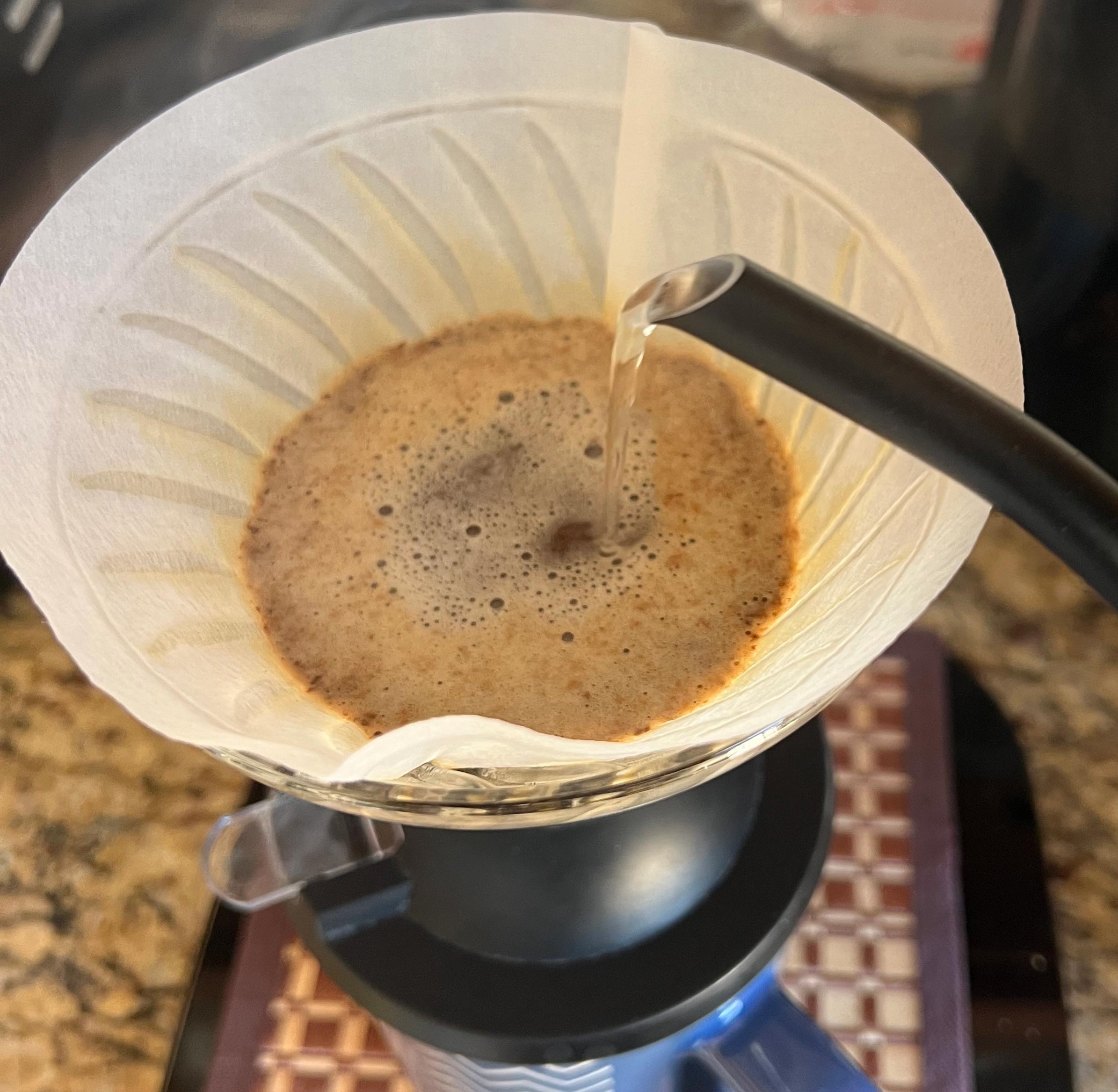
    Pour Over Coffee
    Pour-over coffee is made by flowing a strong, laminar water jet through a bed of ground coffee beans. Credit: Ernest Park

    In particular, the group found the thick water jets typical of standard gooseneck kettles are ideal for achieving this necessary height and laminar flow. Strong — but focused — water jets create an avalanche in the coffee grounds. Displaced grounds recirculate as the water digs deeper into the coffee bed, allowing for better mixing between the water and the grounds, and thus, results in a stronger coffee with fewer beans. If the water jet is too thin, it cannot adequately create this interaction to achieve a desirable strength and sensory experience.

    Visualizing the Coffee Brewing Process

    “If you have a thin jet, then it tends to break up into droplets,” said author Margot Young. “That’s what you want to avoid in these pour-overs, because that means the jet cannot mix the coffee grounds effectively.”

    The dark color of coffee beans — and of coffee itself — makes it hard to demystify. Along with creating pour-over drinks with actual coffee grounds, the scientists supplemented their study with laser-illuminated transparent particles in a glass funnel to help thoroughly visualize the mixing dynamics and understand how the liquid jet affects the grains.

    Though the group does not plan further studies related to coffee, they say there are many other parameters left to explore, such as the impacts of the size of the coffee grounds on the interplay between the physics and chemistry of the brewing process. When it comes to easy, accessible kitchen science, the researchers have some unorthodox advice: Do try this at home.

    “We can really learn something from both the chemistry and physics point of view by looking at the kitchen,” said author Arnold Mathijssen. “It leads to new science where you didn’t expect it.”

    Reference: “Pour-over coffee: Mixing by a water jet impinging on a granular bed with avalanche dynamics” by Ernest Park, Margot Young and Arnold J. T. M. Mathijssen, 8 April 2025, Physics of Fluids.
    DOI: 10.1063/5.0257924

    Never miss a breakthrough: Join the SciTechDaily newsletter.
    Follow us on Google and Google News.

    American Institute of Physics Coffee Fluid Dynamics Food Science
    Share. Facebook Twitter Pinterest LinkedIn Email Reddit

    Related Articles

    Avoiding Food Poisoning: How a Tiny Chip Can Make Your Food Safer Than Ever

    Why Is an Espresso So Good? Food Chemists Unravel Hidden Dynamics of Milk in Coffee

    A Simple Splash of Water: The Scientific Breakthrough for Superior Espresso

    Sizzling Sound of Deep-Frying Reveals Complex Physics of Vapor Cavities

    Scientists Create Ideal Pizza Dough That Rises Perfectly Without Yeast

    Climate Change Is Making It Harder to Get a Good Cup of Specialty Coffee

    The Problem With Microwaving Tea: Why Microwaving Liquids Is Different From Other Heating Techniques

    Scientists Clash in Coffee Roasting Competition [video]

    Better-Tasting Desserts: Complex Fluid Dynamics Update Century-Old Food Testing Method

    3 Comments

    1. Boba on April 12, 2025 4:41 am

      Yeah, put an extra spoon in it…

      Reply
      • Dawn on April 15, 2025 2:17 pm

        Are you serious?

        Reply
    2. Chris on April 17, 2025 1:03 pm

      I am sure proud of my son and the $180,000 I spent on his college education and they finally figured out that pouring it agitating the water as they’re pouring it more will make it stronger that’s just incredible I’m so happy. I think they may get the Nobel Peace prize for this too

      Reply
    Leave A Reply Cancel Reply

    • Facebook
    • Twitter
    • Pinterest
    • YouTube

    Don't Miss a Discovery

    Subscribe for the Latest in Science & Tech!

    Trending News

    New Study Reveals Why Ozempic Works Better for Some People Than Others

    Climate Change Is Altering a Key Greenhouse Gas in a Way Scientists Didn’t Expect

    New Study Suggests Gravitational Waves May Have Created Dark Matter

    Scientists Discover Why the Brain Gets Stuck in Schizophrenia

    Scientists Engineer “Tumor-Eating” Bacteria That Devour Cancer From Within

    Even “Failed” Diets May Deliver Long-Term Health Gains, Study Finds

    NIH Scientists Discover Powerful New Opioid That Relieves Pain Without Dangerous Side Effects

    Collapsing Plasma May Hold the Key to Cosmic Magnetism

    Follow SciTechDaily
    • Facebook
    • Twitter
    • YouTube
    • Pinterest
    • Newsletter
    • RSS
    SciTech News
    • Biology News
    • Chemistry News
    • Earth News
    • Health News
    • Physics News
    • Science News
    • Space News
    • Technology News
    Recent Posts
    • The Surprising Reason You Might Want To Sleep Without a Pillow
    • Household Cats Could Hold the Secret to Fighting Breast Cancer
    • Scientists Say This Natural Hormone Reverses Obesity by Targeting the Brain
    • This 15,000-Year-Old Discovery Changes What We Know About Early Human Creativity
    • 35-Million-Year-Old Mystery: Strange Arachnid Discovered Preserved in Amber
    Copyright © 1998 - 2026 SciTechDaily. All Rights Reserved.
    • Science News
    • About
    • Contact
    • Editorial Board
    • Privacy Policy
    • Terms of Use

    Type above and press Enter to search. Press Esc to cancel.