
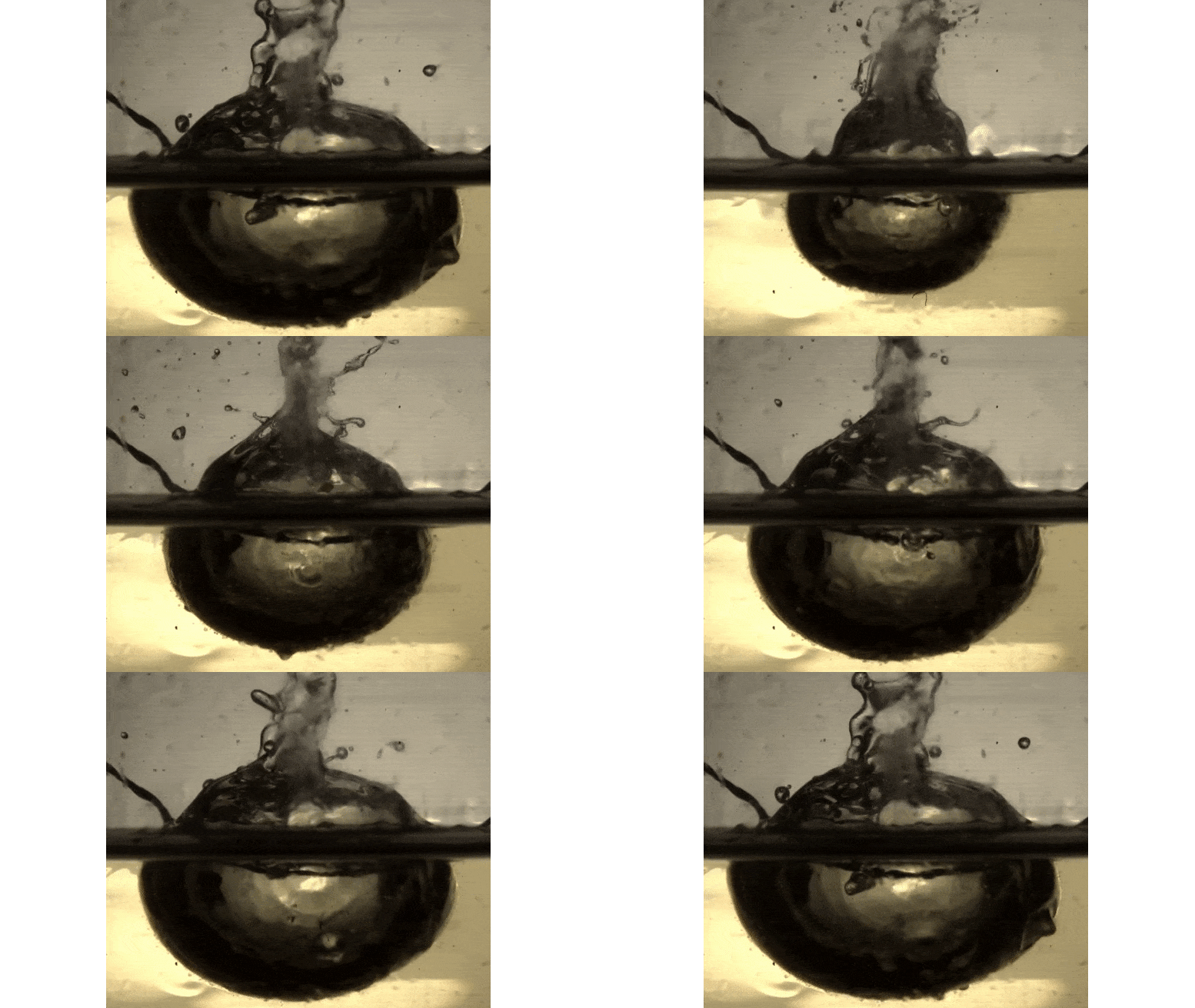
Moistened chopsticks, water droplets in hot cooking oil reveal complicated bubble dynamics and sound characteristics.
As its name implies, fluid mechanics is a branch of physics concerned with the mechanics of fluids (liquids, gases, and plasmas) and the forces on them. It can be divided into two areas of study: fluid statics and fluid dynamics.
While many fluid dynamics researchers deal with the flow of fluids, a team of scientists recently looked at something a bit more explosive: what happens when a drop of water or a drop of batter hits hot oil?
Experienced cooks can determine when cooking oil has reached the right temperature for deep-frying by inserting moistened chopsticks in the hot oil. Bubbles form on the sticks and the sizzling sound they produce can tell the cook when it is time to add food to the pan.
Exploring Bubble Formation in Hot Oil
In the journal Physics of Fluids, by AIP Publishing, researchers from the United States, Canada, and Saudi Arabia carefully studied bubbles that form when water droplets come into contact with heated cooking oil. When the investigators inserted moistened chopsticks in hot oil, they found the type and number of bubbles formed depended on the amount of water absorbed by the chopsticks as well as the chopstick material.
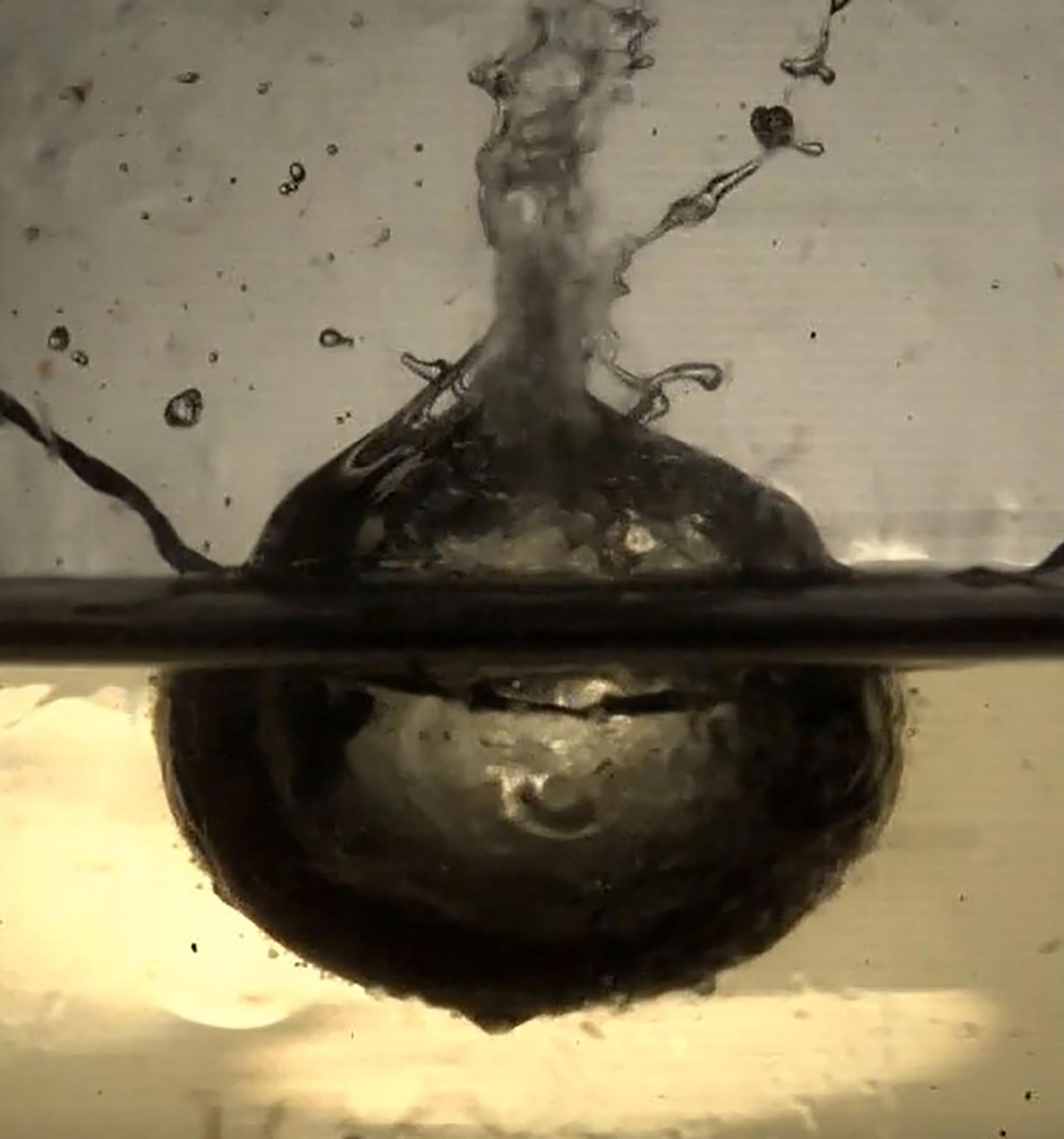
They experimented with water droplets and droplets of batter suspended on the tip of a chopstick. The water droplet exploded when it hit the hot oil, where the batter droplet developed bubbles over its surface.
To further investigate what happens when food is placed in hot oil, the researchers used a small piece of paper moistened with water as a model. They found that the amount and type of bubbling in this case depended on both the amount of water and the temperature. They observed that different types of vapor cavities were formed in the hot oil when water met it.
These initial experiments led to a series of more controlled studies using a setup that allowed water droplets to be added to hot oil from an overhead wire on a movable stage. A high-speed camera and a sensitive microphone were used to gather detailed data about the shape of the bubbles that form when the water droplet hits the hot oil and the sizzling sound they make when they pop.
Video of the explosion cavity which forms when a water droplet hits hot oil. Credit: Tadd T. Truscott
Types of Bubble Cavities Identified
“We found three types of bubble events in our experiments: an explosion cavity, an elongated cavity, and an oscillating cavity,” author Tadd Truscott said.
The explosion cavity forms when a water droplet enters the hot oil and undergoes a microexplosion due to the sudden temperature increase, forming a vapor bubble that can rupture the surface. The elongated cavity involves a water droplet that explodes without rupturing the surface.
The oscillating cavity happens when the droplet slips off the wire and is quickly submerged. It undergoes a multistep explosion process and begins to oscillate before breaking up into numerous small bubbles.
Audio signals from the microphone revealed that the three cavity types produced different acoustic, or sound, characteristics.
“We can distinguish different acoustic signal characteristics for each type of cavity,” Truscott said. “Deciphering the sound signals could lead to future applications, such as acoustic sensing of aerosol generation.”
Reference: “Morphology of bubble dynamics and sound in heated oil” by Akihito Kiyama, Rafsan Rabbi, Zhao Pan, Som Dutta, John S. Allen and Tadd T. Truscott, 7 June 2022, Physics of Fluids.
DOI: 10.1063/5.0088065
Never miss a breakthrough: Join the SciTechDaily newsletter.
Follow us on Google and Google News.
1 Comment
… an great one is The Leidenfrost effect… WoW!!!