
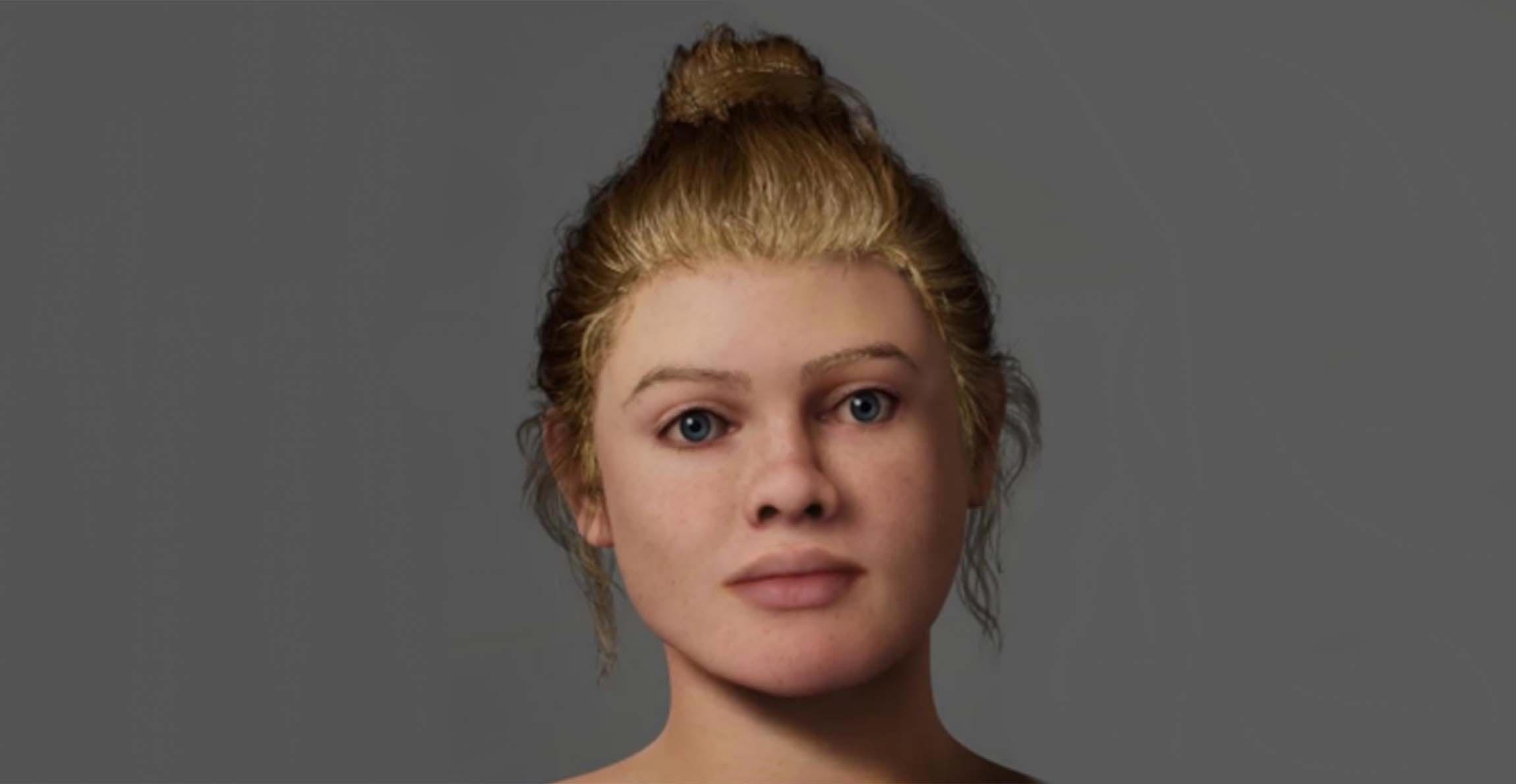
New research suggests the mysterious Roman-era “Beachy Head Woman” was likely from Britain, not the Mediterranean or sub-Saharan Africa.
Advances in DNA sequencing are helping researchers resolve a mystery that has surrounded the Beachy Head Woman for more than ten years.
The remains of a young woman from the Roman period came to light in 2012, after a boxed skeleton was discovered in the basement of Eastbourne Town Hall during work linked to the Eastbourne Ancestors Project. A note attached to the box indicated that the skeleton had been recovered near the cliffs of Beachy Head in the 1950s, but little else was known about her burial or background.
Public interest grew when early studies suggested that the woman may have had recent sub-Saharan African ancestry, raising the possibility that she represented an early example of African presence in Roman Britain.
Subsequent, unpublished research proposed a different origin, pointing instead to the Mediterranean region, possibly Cyprus. However, those conclusions were drawn from poorly preserved genetic material, leaving considerable uncertainty about who the Beachy Head Woman really was.
Improved genetics clarify her origins
Researchers have now returned to the skeleton using more advanced genetic methods. Dr. William Marsh, one of the scientists involved in the DNA analysis, explains that the new evidence indicates the Beachy Head Woman’s ancestry was likely much closer to southern England than previously thought.
“By using state-of-the-art DNA techniques and newly published genomes, we were able to determine the ancestry of the Beachy Head Woman with much greater precision than before,” William reveals. “We show she carries genetic ancestry that is most similar to other individuals from the local population of Roman-era Britain.”
Dr. Selina Brace, an ancient DNA expert at the Natural History Museum in London and senior author of the research, explains that the skeleton’s changing story represents the natural process of science.
“Our scientific knowledge and understanding is constantly evolving, and as scientists, it’s our job to keep pushing for answers. Thanks to the advancement of technology that has occurred in the past decade since Beachy Head Woman first came to light, we are excited to report these new comprehensive data and share more about this individual and her life.”
The findings of the study were published in the Journal of Archaeological Science.
Life in Roman Britain
The first significant contact between Britain and Ancient Rome was in 55BCE, when Julius Caesar led a military expedition to what is now Kent. Roman Britain, however, wouldn’t come into being until almost a century later, when Emperor Claudius launched a full invasion.
At its height, Roman Britain stretched from southern England to the Antonine Wall just north of what is now Glasgow. It contained a network of forts, roads, and cities that were connected to the rest of the Roman Empire, bringing people from across Europe, north Africa, and beyond.
Inscriptions and other sources show that during this period, people were moving between Britain and north Africa, and that this continued after the fall of the Roman Empire. Recent ancient DNA analysis, for example, shows that people with mixed European and sub-Saharan ancestry were living in seventh-century Dorset and Kent.
The life of Beachy Head Woman
During the Roman occupation of Britain, signs of the empire were common around Beachy Head. This includes a villa at Eastbourne, a fort at Pevensey, and rural settlements at Bullock Down and Birling. A variety of burials have also been found in the area, including a child and several adults.
While it’s not sure exactly where the Beachy Head Woman was buried, carbon dating of her skeleton suggests that she died at some point between 129 and 311 AD – coinciding with the Roman occupation of Britain.
Further examination of the skeleton has offered a few other clues about the Beachy Head Woman’s life. She was around 18-25 when she died and probably stood at just over 1.5 meters tall. There’s also a healed wound on her leg, suggesting a serious but non-fatal injury at some point well before her death.
The skeleton also contains some clues about what the Beachy Head Woman might have been eating. Levels of carbon and nitrogen in her bones, for instance, suggest that her diet probably contained a lot of seafood.
From fragmentary DNA to a clearer picture
The first research into her genetic data took place in 2017, when scientists first attempted to extract DNA from her bones. Their analysis of her DNA hinted that the Beachy Head Woman may have come from the Mediterranean.
However, the scientists were only able to extract a small amount of low-quality DNA. This wasn’t enough for them to be sure about the results, and so the results were not published in a scientific journal.
By 2024, however, new ancient DNA methods could now retrieve more data so the team returned to Beachy Head Woman. This time, they were able to sequence a lot more high-quality DNA.
The additional data allowed them to analyze Beachy Head Woman’s ancestry in much greater detail. They discovered that her DNA was most similar to the rural population of Roman-era Britain, with no indication of recent African or Mediterranean ancestry. They concluded that it was therefore most likely that Beachy Head Woman originated from southern England.
With the additional DNA data, they were also able to analyze Beachy Head Woman’s DNA using modern forensic tools. This forensic analysis predicted that she would likely have had light skin pigmentation, blue eyes, and fair hair. These details have been used to update the digital facial reconstruction of Beachy Head Woman.
Further technological advances will continue to improve our understanding of the past as we reconstruct the lives of people living thousands of years ago.
Reference: “Beachy Head Woman: clarifying her origins using a multiproxy anthropological and biomolecular approach” by Andy Walton, William Marsh, Alex Strang, Jonathan Seaman, Kelly Van Doorn, Hella Eckardt, Caroline Wilkinson, Ian Barnes and Selina Brace, 17 December 2025, Journal of Archaeological Science.
DOI: 10.1016/j.jas.2025.106445
Never miss a breakthrough: Join the SciTechDaily newsletter.
Follow us on Google and Google News.
2 Comments
Very interesting article 👍
She looks like me or…..I look like her