
Close Menu
    Facebook X (Twitter) Instagram
    SciTechDaily
    • Biology
    • Chemistry
    • Earth
    • Health
    • Physics
    • Science
    • Space
    • Technology
    Facebook X (Twitter) Pinterest YouTube RSS
    SciTechDaily
    Home»Health»DNA “Chaos” Reveals the Secrets of Aging
    Health

    DNA “Chaos” Reveals the Secrets of Aging

    By Impact Journals LLCApril 18, 2025No Comments4 Mins Read
    Facebook Twitter Pinterest Telegram LinkedIn WhatsApp Email Reddit
    Share
    Facebook Twitter LinkedIn Pinterest Telegram Email Reddit
    Old Hands Aging Clock Time
    A new study reveals that “methylation entropy”—the randomness of chemical tags on DNA—can accurately predict biological age and offers insights beyond traditional epigenetic clocks. By analyzing DNA from cheek swabs across a wide age range, researchers found that methylation patterns become more or less disordered with age, highlighting a promising biomarker for aging and potential age-related therapies.

    The scientists state that epigenetic clocks based on the entropy of methylation states predict chronological age with accuracy comparable to common methods that rely on the methylation levels of individual cytosines.

    Researchers Jonathan Chan, Liudmilla Rubbi, and Matteo Pellegrini from the University of California, Los Angeles, have developed a new method to measure changes in DNA that can help predict a person’s biological age. Their study, published in the journal Aging, introduces a metric called methylation entropy, which captures how randomly chemical tags, known as DNA methylation marks, are distributed across the genome over time.

    Unlike traditional epigenetic clocks that estimate age based on average DNA methylation levels, this method focuses on the degree of disorder in methylation patterns, offering a new perspective on how aging affects the genome. The researchers found that methylation entropy performed as well as, or better than, existing age prediction models.

    To test their approach, the team analyzed DNA from buccal swabs (cheek cells) of 100 individuals ranging in age from 7 to 84. Using targeted bisulfite sequencing, they measured methylation entropy across 3,000 specific regions of the genome. Their findings suggest that increased variability in DNA methylation is closely linked to aging and may provide valuable insights for studying age-related diseases.

    What Is Methylation Entropy?

    Entropy in this context reflects how disordered or varied the methylation patterns are at certain sites on the DNA. The researchers discovered that as people age, the entropy of methylation at many locations changes in a reproducible way. Sometimes it increases, reflecting more random patterns, and sometimes it decreases, showing more uniformity. These shifts are not always tied to how much methylation is happening, which suggests entropy provides new information beyond what traditional methods can offer.
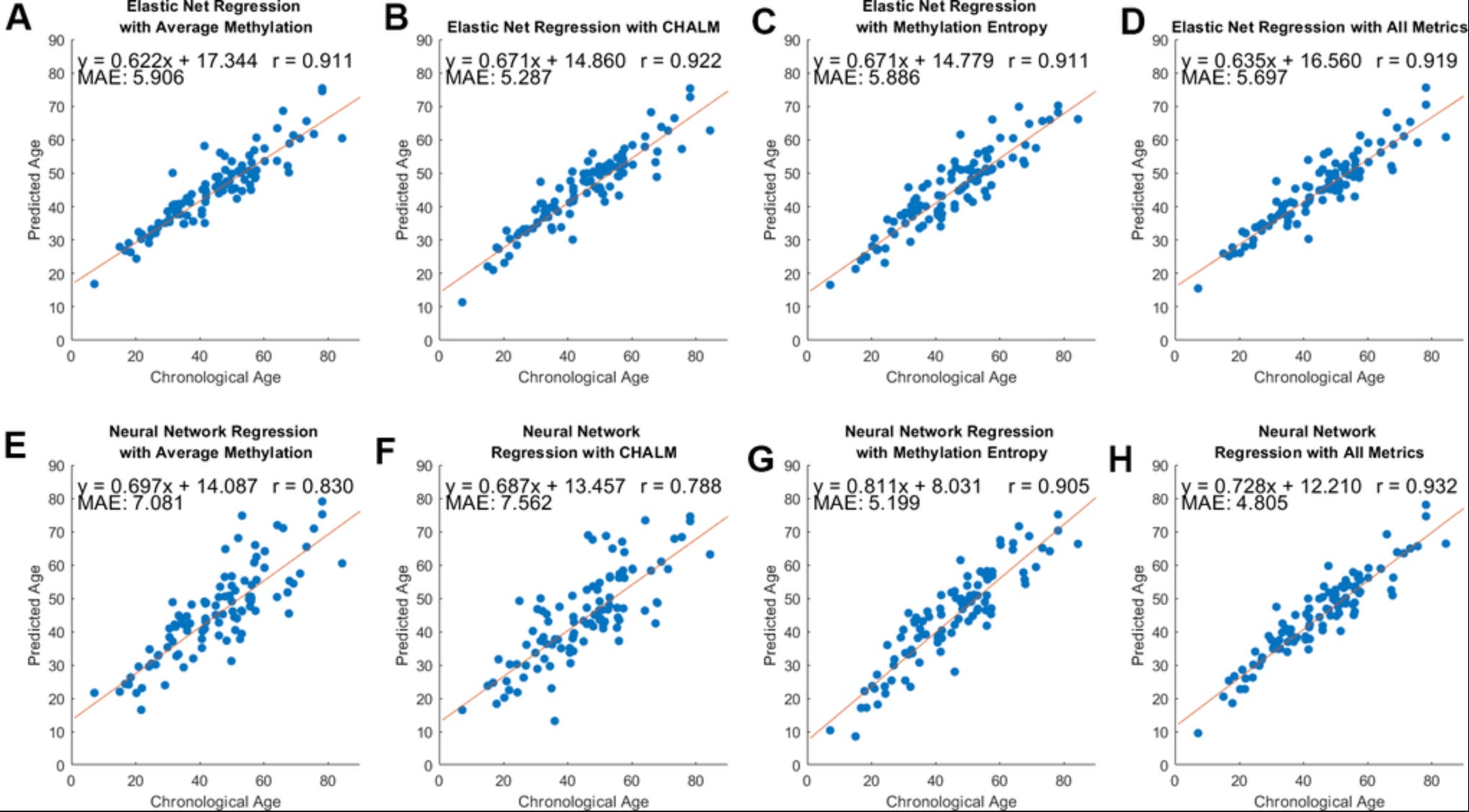
    Model Performance Across Three Methylation Metrics and Two Regression Methods
    Model performance across three methylation metrics and two regression methods. Pearson’s correlation coefficient, equation of best-fit line, and MAE between predicted and chronological age are included. (A–D) Predicted versus chronological age using average methylation, CHALM, entropy, and a combination of these metrics with elastic net regression. (E–H) Predicted versus chronological age with neural network regression. Credit: 2025 Chan et al.

    To test how well this new metric could predict age, the team used both statistical and machine learning models. They found that methylation entropy predicted age as accurately as traditional methods, and the best results came from combining entropy with other measurements like average methylation and a method called CHALM. These combined models were able to estimate age with an average error of just five years.

    According to the researchers, “[…] methylation entropy is measuring different properties of a locus compared to mean methylation and CHALM, and that loci can become both more or less disordered with age, independently of whether the methylation is increasing or decreasing with age.”

    This research supports the growing theory that aging is partly caused by a gradual loss of epigenetic information—the biological “instructions” that help keep our cells working properly. This insight also connects with recent studies suggesting that restoring this lost information might reverse some signs of aging. While more research is needed to study methylation entropy in other tissues, this work points to a more precise and powerful way to measure biological aging, which could influence the future of aging-related treatments and therapies.

    Reference: “DNA methylation entropy is a biomarker for aging” by Jonathan Chan, Liudmilla Rubbi and Matteo Pellegrini, 12 March 2025, Aging.
    DOI: 10.18632/aging.206220

    Never miss a breakthrough: Join the SciTechDaily newsletter.
    Follow us on Google and Google News.

    Aging Biomarkers DNA Epigenetics Genomics
    Share. Facebook Twitter Pinterest LinkedIn Email Reddit

    Related Articles

    Ancient Viruses in Your DNA May Predict How Fast You Age, Study Finds

    Aging Reimagined: How “Immortal” Jellyfish DNA Could Extend Human Life

    Stem Cell Technology Rejuvenates Old Human Cells by Wiping Their DNA Clean

    New Yale Study Links Childbearing to Accelerated Aging

    UCLA Study Shows That Obesity Accelerates Aging of the Liver

    Engineers Develop New Method to Detect Epigenetic Modifications

    Regular Exercise Induces Changes in DNA

    UK to Sequence Genome of 100,000 Patients

    Researchers Use Bioinformatics and Epigenetics to Aid Cancer Research

    Leave A Reply Cancel Reply

    • Facebook
    • Twitter
    • Pinterest
    • YouTube

    Don't Miss a Discovery

    Subscribe for the Latest in Science & Tech!

    Trending News

    Scientists Uncover Promising New Strategy To Stop Parkinson’s in Its Tracks

    Experts Reveal the Surprising Cancer Link Behind a Common Vitamin

    This Strange “Golden Orb” Found 2 Miles Deep Stumped Scientists for Years

    Giant “Last Titan” Dinosaur Discovered in Thailand Was Bigger Than 9 Elephants

    This “Longevity Gene” May Protect the Brain From Aging and Dementia

    Common Cleaning Chemical Could Triple Your Risk of a Dangerous Liver Disease

    Scientists Discover Bizarre 100-Million-Year-Old Insect With Giant Claws

    Scientists Discover “Good” Gut Microbes That Could Protect Against Autism and ADHD

    Follow SciTechDaily
    • Facebook
    • Twitter
    • YouTube
    • Pinterest
    • Newsletter
    • RSS
    SciTech News
    • Biology News
    • Chemistry News
    • Earth News
    • Health News
    • Physics News
    • Science News
    • Space News
    • Technology News
    Recent Posts
    • NASA’s Roman Space Telescope Nears Launch for Epic Hunt Across the Universe
    • Ancient Mega-Floods Once Ripped Across Mars and Left This Giant Scar
    • Scientists Just Used Sunlight To Pull Off a Quantum Physics Feat Once Thought Impossible
    • Scientists Discover “Immature” Brain Cells That May Defy Alzheimer’s
    • Children of Centenarians Share One Surprising Habit That May Boost Longevity
    Copyright © 1998 - 2026 SciTechDaily. All Rights Reserved.
    • Science News
    • About
    • Contact
    • Editorial Board
    • Privacy Policy
    • Terms of Use

    Type above and press Enter to search. Press Esc to cancel.