
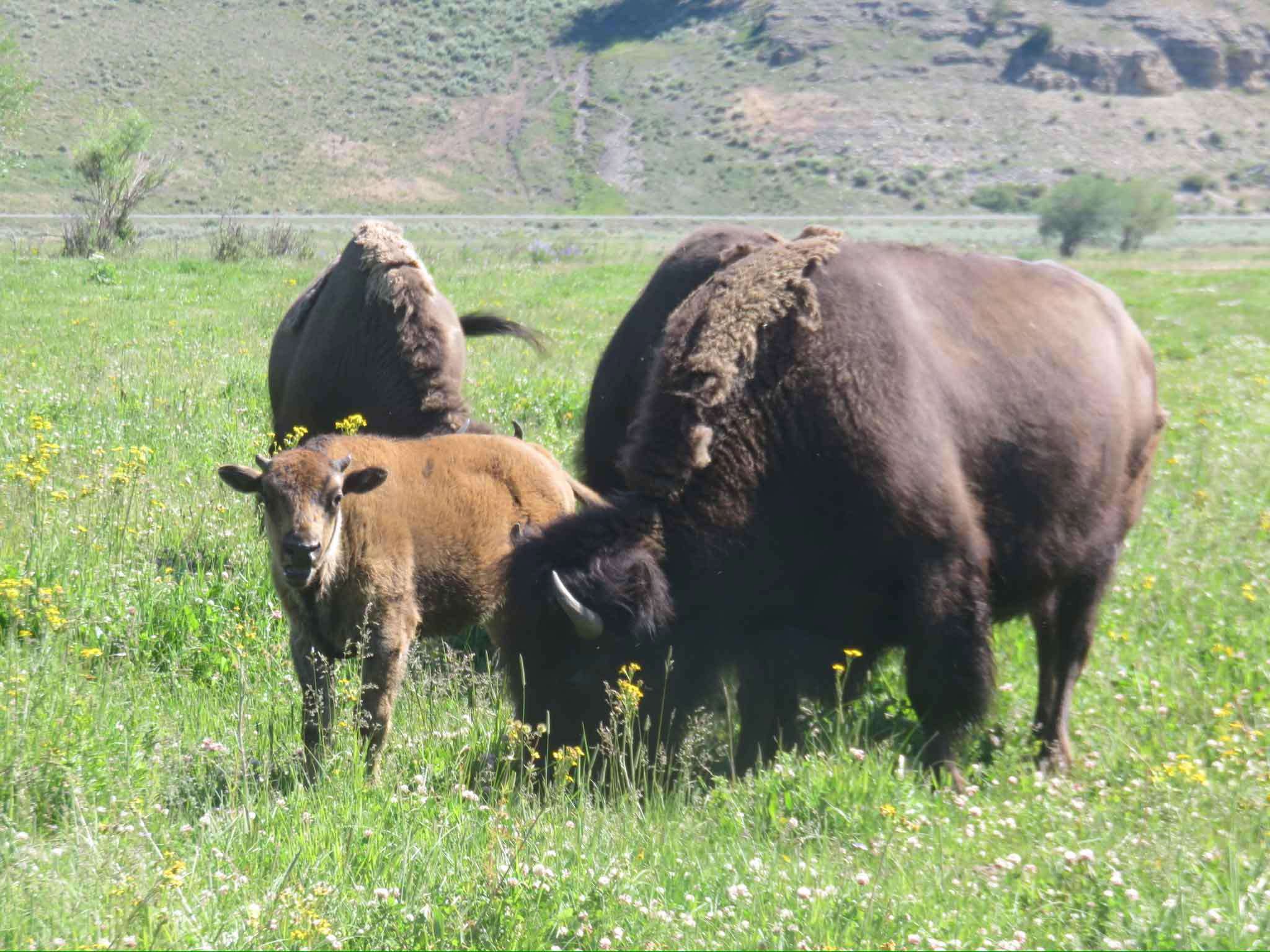
A federally funded study led by biologists at Brown University has revealed that the diets of various large herbivore species are more varied and complex than scientists had previously understood.
For generations, both scientists and students have sorted animals into categories based on diet: carnivores eat meat, browsers feed on flowering plants, conifers, and shrubs, and grazers primarily consume grasses.
However, new federally funded research led by Brown University biologists in partnership with Yellowstone National Park scientists shows that herbivores often eat a far broader range of plants than previously recognized, depending on the conditions they face.
The study, published in the Proceedings of the National Academy of Sciences, found that long-standing methods of classifying herbivores by the proportion of grass in their diet oversimplify reality. Such systems can overlook important variations in what individuals within a species eat, as well as similarities that can emerge between different species, explained study co-author Tyler Kartzinel, associate professor of ecology, evolution, and organismal biology at Brown.
“This challenges biologists to consider whether we’re finding patterns in nature that reinforce our perceptions of what animals should be doing rather than what they are actually doing,” Kartzinel said. “It makes a very compelling case that in Yellowstone, we’re putting animals into boxes that include all members of a species but not considering the differences in eating behaviors within species or — perhaps more importantly — some of the similarities that unite different species.”
Kartzinel noted that studies like this can provide valuable insights for predicting how wildlife will use resources in shifting landscapes, especially in contexts where conservation approaches are debated.
“These findings are a big step toward understanding how so many species of large mammals can survive together in Yellowstone,” Kartzinel said. “Our findings suggest that maintaining plant diversity is a critical requirement for maintaining the diversity of migratory wildlife.”
When grazers become browsers
For the past seven years, the research team has examined how animals in Yellowstone search for and select their food. In a study published the previous year in Royal Society Open Science, they focused on identifying the typical foraging patterns of each herbivore species in the park.
In their latest work, the scientists partnered again with Yellowstone researchers to monitor five species of large herbivores: pronghorn, bighorn sheep, mule deer, elk, and bison. They gathered both plant samples and fecal matter from tracked animals. At Brown University, the samples were analyzed using DNA metabarcoding to determine the specific plants consumed. The team also applied straightforward AI methods to assess how many distinct dietary patterns exist within Yellowstone’s herds and whether each species maintains its own characteristic diet type.

Hannah Hoff, a Ph.D. candidate in ecology, evolution, and organismal biology at Brown, contributed her background in botany and data science. Drawing inspiration from a seminar by Brown biology and data science professor Sohini Ramachandran, Hoff combined machine learning approaches with genetic analysis to gain deeper insights into herbivore feeding behavior.
Diet overlap and seasonal shifts
The study revealed that the dietary distinctions between species were less pronounced than scientists had expected. In fact, individuals from different species often shared significant portions of their diets, with the degree of similarity varying according to location and season.
A key finding was that feeding patterns may be influenced more by available resources than by species identity. During the summer, animals from multiple species tended to focus on nutrient-rich wildflowers found in meadow habitats, while in winter, many shifted toward diets dominated by coniferous trees and shrubs.
During the winter, bison in particular, but not exclusively, tended to keep looking for grasses and similar types of food even when they were frozen under snow, while some of the smaller herbivores, like mule deer and pronghorn antelope, tended to switch more dramatically toward a diet of evergreen trees.
“It turns out the appropriate question is not, ‘Does that species eat grass?’” Kartzinel said, “but rather, ‘Is it eating grass right now?’”
As a plant ecologist, Hoff took a plant-forward approach to understanding this ecological community.
“There’s sometimes a tendency to treat vegetation as a static ‘habitat type,’ instead of as a dynamic set of interacting species with their own individual ecologies,” Hoff said. “Centering our analysis of diet groupings on the plant species that distinguished them allowed us to examine how seasonality, nutrition and spatial distribution influence herbivore foraging — insights that may be obscured by broad diet classifications.”
Kartzinel said the findings offer a lesson for scientists as well as iconoclastic animals.
“Imagine a herd of bison who are all supposed to be grazers, with one or two who want to eat like browsers,” Kartzinel said. “The traditional way that scientists would tell this story could be to dismiss the difference as aberrant or unimportant. But findings like this show us that dietary diversity actually is normal, and we should tell the story of the browsing bison, as well.”
Reference: “The apportionment of dietary diversity in wildlife” by Hannah K. Hoff, Bethan L. Littleford-Colquhoun, Rebecca Y. Kartzinel, Heidi M. Anderson, Chris Geremia, Lauren M. McGarvey, Carlisle Segal and Tyler R. Kartzinel, 14 July 2025, Proceedings of the National Academy of Sciences.
DOI: 10.1073/pnas.2502691122
This research was funded by the National Science Foundation (DEB-2046797, OIA-2033823) and the National Parks Service Cooperative Research and Trainings Program (P22AC00332-00, P23AC00378).
Never miss a breakthrough: Join the SciTechDaily newsletter.
Follow us on Google and Google News.
1 Comment
I read the title and thought the article was going to be about all the bugs on the plants that herbivores eat. I would be very interested in that sort of an article. Are herbivores really strictly herbivores since they probably eat a ton of bugs? And what nutritional value do the bugs have for the herbivores, do they cause digestion issues, do the herbivores taste the bugs on the plants, so many questions now. I can’t believe I never thought about this before. lol