
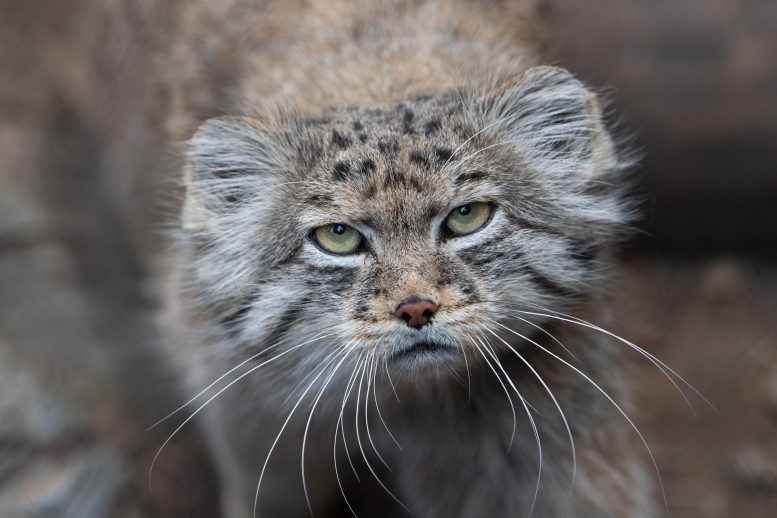
A new scientific finding marks the first documented discovery of Pallas’s Cat on the world’s highest mountain.
A new paper published in Cat News has made a landmark identification of the first recorded sighting of Pallas’s cat on Mount Everest, located in Sagarmatha National Park in Nepal. This extraordinary discovery is a result of the 2019 National Geographic and Rolex Perpetual Planet Everest Expedition, which was the most extensive scientific expedition to the mountain in history.
From April 7th to May 2nd, 2019, Dr. Tracie Seimon, a co-leader of the biology field team from the Perpetual Planet Everest Expedition, and part of the Zoological Health Program at the Wildlife Conservation Society’s Bronx Zoo, collected environmental samples from two sites located at elevations of 5,110 and 5,190 meters (16,765 and 17,027 feet) above sea level, along Sagarmatha National Park on the Southern Flank of Mount Everest. The samples were taken from locations 6 km (3.7 miles) apart.
“It is phenomenal to discover proof of this rare and remarkable species at the top of the world,” said Dr. Seimon. “The nearly four-week journey was extremely rewarding not just for our team but for the larger scientific community. The discovery of Pallas’s cat on Everest illuminates the rich biodiversity of this remote high-alpine ecosystem and extends the known range of this species to eastern Nepal.”
The DNA analysis of scat samples collected from both sites confirmed two Pallas’s cats inhabit Mount Everest and overlap in territory with red fox. The researchers found evidence of pika and mountain weasel DNA in the samples, an important food source for Pallas’s cat. These findings also add a new species to the list of known mammals in Sagarmatha National Park, a heavily visited and protected World Heritage site.
“This is a unique discovery not only in terms of science but also conservation as this population of Pallas’s cat is legally protected under CITES (the Convention on International Trade in Endangered Species of Wild Fauna and Flora),” said National Geographic Explorer and co-author of the paper, Dr. Anton Seimon. “We hope that the confirmation of this new charismatic species will raise awareness of and education about the diversity of species at this iconic World Heritage Site.”
The number of tourists visiting Sagarmatha National Park and Mount Everest has been dramatically increasing, from just a few thousand in the 1970s to over fifty thousand in 2019. It is notable that Pallas’s cat went undetected in this park until 2019, and the new study demonstrates how conservation genetics and environmental sampling can be utilized as a powerful approach to discovering and studying cryptic and elusive species like Pallas’s cat.
Future research combining camera trap surveys and the collection of additional scat samples would help to better define the Pallas’s cat population, range, density, and their diet in Sagarmatha National Park.
“The groundbreaking 2019 Perpetual Planet Everest Expedition continues to be extremely valuable to better understand the most iconic environment on our planet,” said Nicole Alexiev, Vice President of Science and Innovation Programs at National Geographic Society. “These results are a perfect illustration of why this work is important and a cornerstone of our partnership with Rolex to study and explore Earth’s critical life support systems.”
Reference: “First report of Pallas’s cat in Sagarmatha National Park – Mount Everest Region, Nepal” by T. A. Seimon, M. Lim, B. Nightingale, S. Elvin, A. Elmore and A. Seimon, December 2022, Cat News.
Abstract.
From April to May 2019, an international, multidisciplinary team of scientists conducted the most comprehensive single scientific expedition to Mt. Everest in the Khumbu Region of Nepal as part of National Geographic and Rolex’s Perpetual Planet Expeditions partnership. Team members from eight countries, including 17 Nepalese researchers conducted trailblazing research in five areas of science that are critical to understanding environmental changes and their impacts: biology, glaciology, meteorology, geology, and mapping. To learn more visit: https://www.nationalgeographic.com/environment/topic/perpetual-planet
Never miss a breakthrough: Join the SciTechDaily newsletter.
Follow us on Google and Google News.
1 Comment
OMG that is the most adorable cat face I’ve ever seen! I’m in love 😍