
Close Menu
    Facebook X (Twitter) Instagram
    SciTechDaily
    • Biology
    • Chemistry
    • Earth
    • Health
    • Physics
    • Science
    • Space
    • Technology
    Facebook X (Twitter) Pinterest YouTube RSS
    SciTechDaily
    Home»Space»Do Stars Remember Their Past? Study Sheds New Light on Old Theories of Stellar Evolution
    Space

    Do Stars Remember Their Past? Study Sheds New Light on Old Theories of Stellar Evolution

    By University of InnsbruckOctober 5, 20222 Comments4 Mins Read
    Facebook Twitter Pinterest Telegram LinkedIn WhatsApp Email Reddit
    Share
    Facebook Twitter LinkedIn Pinterest Telegram Email Reddit
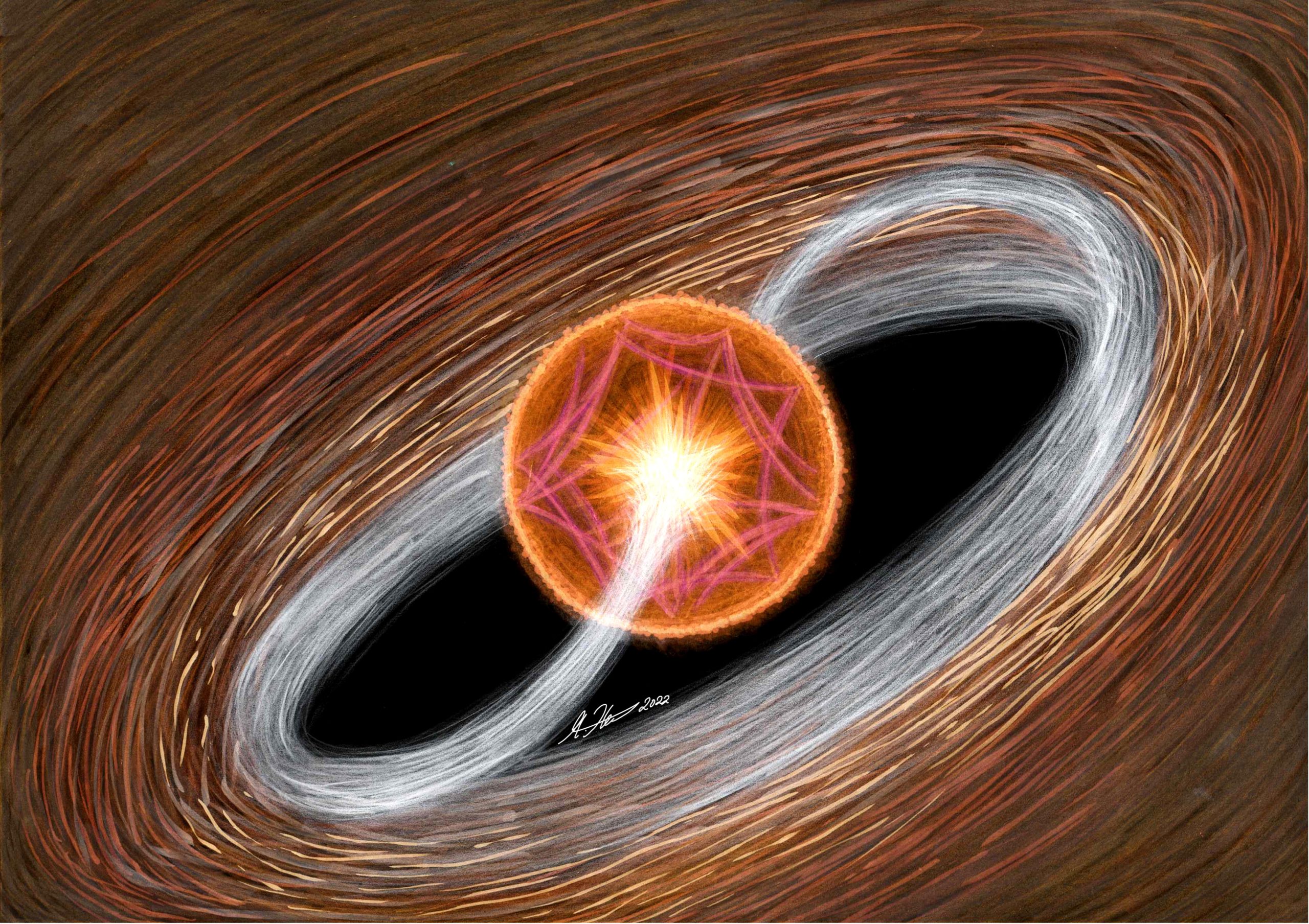
    First Stages of Young Star
    The young star in the center is in a molecular cloud and is enveloped by a disk. In the first stages of its life, the star attracts numerous materials, for example, through magnetic fields, which are constantly remixed in turbulence. The interior of the young star is permeated by pulsations. Credit: Mirjana Keser

    A Star’s “Childhood” Shapes Their Stellar Evolution 

    From newborns to teenagers, stars in their “young years” pose a significant scientific challenge. It is extremely challenging to model the process of star formation in theoretical models due to its complexity. Observing a star’s oscillations is one of the few methods to find out more about a star’s age, structure, or formation.

    “Comparable to the exploration of the Earth’s interior with the help of seismology, we can also make statements about their internal structure and thus also about the age of stars based on their oscillations,” says Konstanze Zwintz.

    Zwintz is regarded as a pioneer in the young field of asteroseismology and heads the research group “Stellar Evolution and Asteroseismology” at the Institute for Astro- and Particle Physics at the University of Innsbruck.
    Star Evolution Model
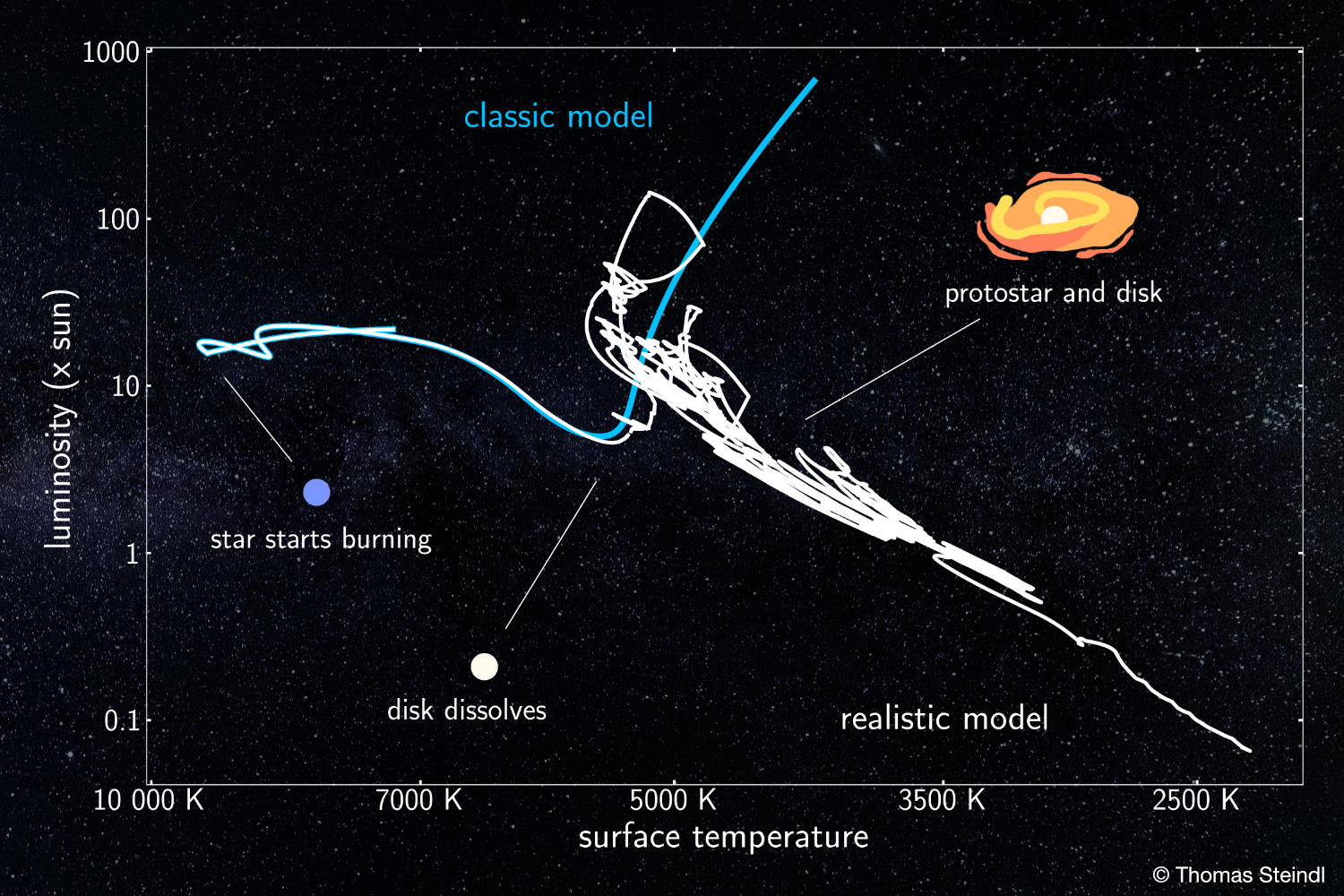
    The blue line shows the evolution of a star before the transition to the main sequence (blue dot) according to the classical models applied since the 1950s. The white line represents the realistic representation resulting from Thomas Steindl’s new model – the star’s “wild” years from infancy to teenage years, with the evolution running from right to left in the image. Credit: Thomas Steindl

    Because of the increased ability to make precise observations with space telescopes like TESS, Kepler, and James Webb, the study of star oscillations has evolved considerably in recent years. These advances are also shedding new light on decades-old theories of stellar evolution.

    With a New Model to Zero Hour of Adult Stars

    As long as stars are not yet converting hydrogen into helium in their cores, they are referred to as “children.” At this stage, they are in the pre-main sequence; after ignition, they become adults and move on to the main sequence.

    “Research on stars has so far focused mainly on adult stars – such as our Sun,” says Thomas Steindl, a member of Konstanze Zwintz’s research group and lead author of the study.

    “Even if it sounds counterintuitive at first glance, so far little attention has been paid to the evolution of the pre-main sequence because the phase is very turbulent and difficult to model. It’s only the technological advances of recent years that allow us a closer look at the infancy of stars – and thus at that moment when the star begins to fuse hydrogen into helium.”

    In their current study, the two Innsbruck researchers now present a model that can be used to realistically depict the earliest phases of a star’s life long before they become adults. The model is based on the open-source stellar evolution program MESA (Modules for Experiments in Stellar Astrophysics).

    Inspired by a talk given by astronomer Eduard Vorobyov of the University of Vienna at a 2019 meeting, Thomas Steindl spent months refining the method for using this stellar evolution code to recreate the chaotic phase of early star formation and then predict their specific oscillations.

    “Our data show that stars on the pre-main sequence take a very chaotic course in their evolution. Despite its complexity, we can now use it in our new theoretical model.” Steindl said.

    Thus, the astronomer shows that the way the star is formed has an impact on the oscillation behavior even after ignition of nuclear fusion on the main sequence: “The infancy has an influence on the later pulsations of the star: This sounds very simple, but it was strongly in doubt. The classical theory assumes that the time before ignition is simply irrelevant. This is not true: Comparable to a musical instrument, even subtle differences in the composition lead to significant changes in the tone. Thus, our modern models better describe the oscillations in real stars.”

    Konstanze Zwintz is delighted with this discovery and is very optimistic about the future: “I was already convinced about 20 years ago, when I first saw the oscillation of a young star in front of me on the screen, that I would one day be able to prove the significance of early stellar evolution on the ‘adult’ star. Thanks to the great work of Thomas Steindl, we have now succeeded: Definitely a eureka moment for our research group and another milestone for a better understanding of the growth steps of stars.”

    Reference: “The imprint of star formation on stellar pulsations” by Thomas Steindl, Konstanze Zwintz and Eduard Vorobyov, 19 September 2022, Nature Communications.
    DOI: 10.1038/s41467-022-32882-0 

    Never miss a breakthrough: Join the SciTechDaily newsletter.
    Follow us on Google and Google News.

    Astronomy Astrophysics Stars University of Innsbruck
    Share. Facebook Twitter Pinterest LinkedIn Email Reddit

    Related Articles

    Study of Supergiant Star Betelgeuse Unveils the Cause of Its Pulsations – Not at All Close to Exploding

    Distant Colliding Galaxy Dying Out As It Loses the Ability to Form Stars – Ejecting 10,000 Suns-Worth of Gas a Year

    Massive Rotating Stars in the Pleiades Cluster

    All 468 Stars in Milky Way Stellar Stream Theia 456 Are Related – “It’s Like Finding a Needle in a Haystack”

    A Star Dying Soon After the Beginning of the Universe Could Be Disrupting Mobile Phone Reception Today

    “This Galaxy Is Witnessing a Truly Extreme Event” – Galaxy Mergers Could Limit Star Formation

    Cosmic Neon Lights: Strange New Type of Star Revealed in X-ray Light

    Striped or Spotted? Planetary Scientists Solve a Brown Dwarf Mystery

    Chandra Studies Extraordinary Magnetar: Fastest Spinning and Possibly the Youngest Magnetar Known

    2 Comments

    1. xABBAAA on October 5, 2022 11:34 pm

      … if stars form in a dark matter web, and if those things do influence the matter via gravity!
      Then what happens to reaction? You know things do spin too… and then that should propagate further and further, but then… error!

      Reply
      • xABBAAA on October 5, 2022 11:34 pm

        … better said THE ERROR!

        Reply
    Leave A Reply Cancel Reply

    • Facebook
    • Twitter
    • Pinterest
    • YouTube

    Don't Miss a Discovery

    Subscribe for the Latest in Science & Tech!

    Trending News

    Popular Vitamin B3 Supplements May Help Cancer Cells Survive, Scientists Warn

    Scientists Discover Strange Property of Rice and Turn It Into a Smart Material

    NASA Artemis II Skips Burn As Astronaut Captures Stunning View of Earth

    NASA’s Artemis II: Humans Just Left Earth Orbit for the First Time Since 1972

    What Causes Chronic Pain? Scientists Identify Key Culprit in the Brain

    Semaglutide Shows Surprising Mental Health Benefits in Massive 100,000-Person Study

    This Liquid Snapped Instead of Flowing and Scientists Were Shocked

    Breakthrough Alzheimer’s Drug Rewires the Brain Instead of Just Clearing Plaques

    Follow SciTechDaily
    • Facebook
    • Twitter
    • YouTube
    • Pinterest
    • Newsletter
    • RSS
    SciTech News
    • Biology News
    • Chemistry News
    • Earth News
    • Health News
    • Physics News
    • Science News
    • Space News
    • Technology News
    Recent Posts
    • Scientists Uncover the Secret “Glue” That Helps Soil Hold Water
    • Climate Change Is Altering a Key Greenhouse Gas in a Way Scientists Didn’t Expect
    • Why Antarctic Sea Ice Suddenly Collapsed After Decades of Growth
    • Astronomers Discover the Most Pristine Star Ever Found
    • New Study Suggests Gravitational Waves May Have Created Dark Matter
    Copyright © 1998 - 2026 SciTechDaily. All Rights Reserved.
    • Science News
    • About
    • Contact
    • Editorial Board
    • Privacy Policy
    • Terms of Use

    Type above and press Enter to search. Press Esc to cancel.